Louis-Charles Desnos, “Coëffure à l’Insurgente.”Souvenir à la Hollandoise, enrichi de nouvelles Coëffures les plus galantes, 1780. The Getty Research Institute, Los Angeles (92-B23531)
Whether it’s famously blonde Blake Lively wrapped in a Navajo blanket on the cover of Vogue or a Karlie Kloss walking the runway in the Victoria’s Secret fashion show wearing a feathered headdress and little else, high-fashion knockoffs of Native American clothing and textiles inevitably make headlines for all the wrong reasons. Of course, this kind of cultural appropriation is nothing new—a century ago, Paul Poiret and Sonia Delaunay drew modernist inspiration from ancient Native American textile patterns—but it’s been going on even longer than you might think.
The coiffureà l’insurgente was one of many French fashions of the late 1770s and 1780s inspired by the defining philosophical issue of the time: America’s battle for independence, in which France was a key political and military ally. Ship-shaped coiffures à la Belle Poule and gowns of “Franklin gray”—the color of Benjamin Franklin’s hair—adorned the court of Louis XVI; coiffuresà l’Americaine and chapeaux à la Pensilvanie appeared in French fashion magazines. At the time, “insurgente”—meaning “rebel”—was a synonym for “American” in French. A habit à l’insurgente appeared in the fashion magazine Gallerie des modes in 1779; it was described as being similar to gowns worn by Anglo-American women. But while its relation to American dress is obscure—and possibly invented to capitalize on the trend—the coiffure à l’insurgente clearly resembles a Native American feathered headdress, or war bonnet.Far from being perceived as offensive or exploitative, the coiffure à l’insurgente and other pro-American fashions advertised their female wearers’ patriotism and political acumen.
This image comes from a rare edition of the 1780 almanac Souvenir à la Hollandoise, enrichi de nouvelles Coëffures les plus galantes in the special collections of the Getty Research Institute (GRI), Los Angeles. The GRI is a research library adjacent to the J. Paul Getty Museum, with its own extensive holdings and exhibition program. Its special collections include rare books, prints, photographs, architectural drawings, correspondence, and archival material, much of it useful to fashion historians. A photo archive of two million images of artworks—housed in boxes sorted by genre and country—is a valuable resource for hard-to-find images, or just idle browsing. The GRI also has a good selection of fashion books, journals, and exhibition catalogues on open shelves, plus a wealth of reference material and extensive online resources like the BHA and ArtStor.
While its changing exhibitions gallery and Plaza Level (which includes Getty publications, recent periodicals, and general reference books) are open to the public, you need to apply for a reader’s card to visit the GRI’s stacks, photo archive, and special collections. It is worth getting one. Although the Getty has recently made its images available to the public free of charge under an open content policy, only a fraction of the GRI’s vast holdings have been photographed, and searching the Digital Collections can be frustrating. But helpful, knowledgeable librarians and an unusually user-friendly environment make the GRI’s embarrassment of research riches manageable.
Dr. Kimberly Chrisman-Campbell is an independent scholar and consultant with an impressive background in fashion and history. She received her B.A. from Stanford University, her M.A. from the Courtauld Institute of Art, and her Ph.D. from the University of Aberdeen. Chrisman-Campbell has published numerous journal and magazine articles on 18th– and early 19th-century French fashion. She has also contributed to several books and museum catalogues, including Fashioning Fashion: European Dress in Detail, 1700-1915 (Los Angeles: Prestel and Los Angeles County Museum of Art, 2010) and Paris: Life & Luxury in the Eighteenth Century (Los Angeles: Getty Publishing, 2011).
The Western Region of the Costume Society of America held their symposium this year at the Museum of Contemporary Craft in Portland, OR, on October 11. I was fortunately enough to attend and was treated to seven lovely papers (some works in progress), and two lively discussions with attendees on the papers presented, as well as on the state of the western region and what members want more (and less) of. Attendees were very engaged in the discussions, more than I’d seen at a regional level.
After opening remarks, the Annual Business meeting, and a short talk by CSA National President, Kathy Mullet (who is a Western Region member), the papers were presented. Given by Brenna Barks, Clara Berg, Meghan Hanson, Jennifer M. Mower, Linda Florence Matheson, Ilana Winter and JoAnn Stabb, the papers were varied – both in their topics, as well as in the progress of research. Topics included
Issey Miyake’s use of Japanese revival style,
GLBTQ style clothing in a regional museum,
a preview of the Michel Arnaud Fashion Photography Archive at FIDM,
pre-WWII WPA sewing rooms,
Street to runway fashion from the 40s-80s,
A history of Rockmount Ranch Wear, and
Romaine Brooks’ Amazon/Tuxedo fashions and their influence through history
It was also a good mix of emerging professionals and well –seasoned presenters. Regional diversity was good too – presenters were from Fresno, Los Angeles, Davis, Seattle, and Corvalis, covering three states (California, Oregon, and Washington).
Happily, attendees were also given packets of information with abstracts for all the papers presented, and much discussion was generated by the topics in the symposium wrap-up. I was glad to get to spend such good time, considering these interesting topics. It makes me glad that there is still so much research left to do! Below are some photos I took from the Fashioning Cascadia Exhibition:
Right now two major museums, on opposite coasts of the United States, both have exhibitions on the Kimono. The Los Angeles County Museum of Art has Kimono for a Modern Age (through October 19, 2014) and the Metropolitan Museum of Art in New York has Kimono: A Modern History(through January 4, 2015). This unique situation requires a unique review. And so, I’m happy to present two simultaneous reviews of the two exhibitions by two experts in the field: Brenna Barks agreed to review the LACMA exhibition, and Nadine Stewart reviewed the Met’s exhibition. Below are their reviews. Happy Reading!
Kimono for a Modern Age
The Los Angeles County Museum of Art (through October 19, 2014)
Guest Review by Brenna Barks
Little attention is paid to what can be called the decline of the kimono in Japanese fashion. Most museum-goers, and thus most museum exhibitions, concentrate on the “expected”: what is seen as the traditional, soft, delicately patterned kimono that so inspired the Impressionists and the patrons of Japonisme. Indeed, this is the majority of kimono. However, kimono – like all clothing – followed fashion. And the fashion during the last “heyday” of the kimono is the subject of the Kimono for a Modern Age exhibition at the Los Angeles County Museum of Art (LACMA).
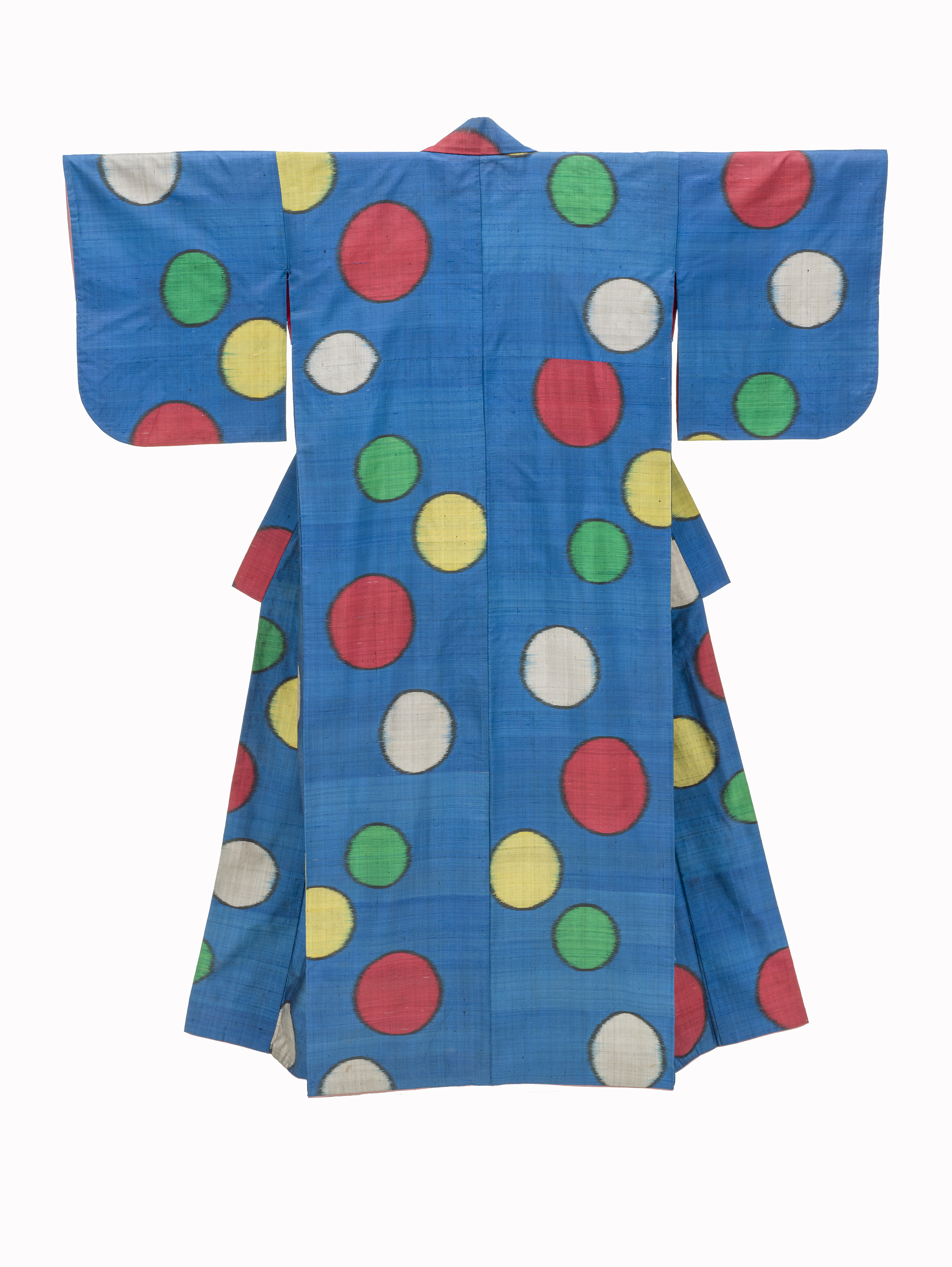
Leading up to and immediately after the second World War, while the traditional patterning remained popular, a new style of kimono emerged: the meisen. The fabric for meisen is unusual in that the warp and weft threads were stencil dyed individually before being woven, creating a marvellous faux-ikat pattern. These patterns were typically large and boldly coloured, contrary to the expected tradition.
Much has been made of the influence that the West had on the patterning of meisen – and LACMA does point out the references to Art Deco motifs or motifs taken from famous Western painters, such as Matisse, in the exhibition. But what LACMA does with their exhibition of over 30 meisen is to properly place them back into context within the Japanese tradition. Yes, there are Western art influences, but predominantly meisen were reinterpretations of Japanese art: landscape paintings, calligraphic motifs, and more often new, bold re-imaginings of traditional Japanese kimono patterns such as arrows or dewdrops.
Some of these re-interpretations can even be seen as forms of protest against American occupation after World War II. At least two meisen in the exhibition feature the Japanese war flag of the rising sun being not-so-subtly worked into the pattern. One in blue as a vague “star” pattern, another into what would otherwise be an image of dawn over a village. Or perhaps instead of open protest, these patterns were a silent message of surviving patriotism and a hope that they would rise again after re-inventing themselves as well as their traditions? LACMA masterfully and tactfully addresses the subject of war and occupation, tradition and fashion head-on through the display of such kimono and their thoughtful, well-written tombstones about each piece.
With the increasing popularity of Western clothing due to ease of wear and maintenance, the kimono declined rather sharply in popularity after the war. The meisen, while largely ignored in the West until now, was in many ways the last hurrah of this beautiful garment. The Kyoto kimono industry closed for good in the early 2000s; so few Japanese people today know how to wear it that schools exist to teach the proper wearing of the kimono, or simply to dress clients when occasion calls for traditional clothing. The LACMA exhibition not only fills this gap in the history of the “symbol of Japan”, but inspires visitors to question what the term “fashion” really means: it does not necessarily mean a shift in shapes and hemlines, but can mean the re-adaptation of tradition and the extended survival of an ancient garment into the modern age.”
Kimono: A Modern History
Metropolitan Museum of Art (through January 4, 2015)
Guest Review by Nadine Stewart
Over Robe (Uchikake) with Long-Tailed Birds in a Landscape Period: Edo period (1615–1868) Date: second half of the 18th century Medium: Silk and metallic-thread embroidery and stencil paste-resist dyeing on silk satin damask Credit Line: Gift of Charles Zadok, 1959 Accession Number: 59.46
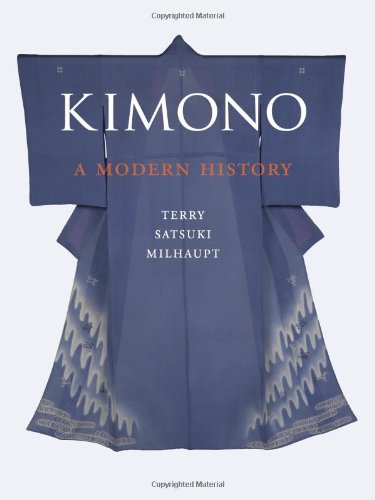
Kimono: A Modern History is a stunning exhibit, not to be missed. The fifty kimonos on display span the period from the eighteenth century to the present day, a time when the kimono evolved from a garment worn by the nobility and the peasantry. Though “kimono” literally means a “thing to wear,” this exhibit shows how much more this garment has meant to Japanese culture over the centuries and how it has influenced fashion in the rest of the world.
The first things on display are swatch samples from the Edo Period (1615-1868), exquisite examples of tapestry weaving in silk and silver thread. In one piece the fighting dragons are made entirely of tiny French knots. In another, we see Western ships with their flags, a reminder that Japan opened up to the West in this period, which would mean a new set of influences and textiles techniques would come flooding into the country. The kimonos in this section are the elegant silk padded kimonos for ladies of the nobility. The fabric of each one is an example of the highest level of craftsmanship–damask grounds overlaid with couched gold thread and silk embroidery.
Elegant as they are, the kimonos are not the only items featured here. A beautiful inlaid cosmetic box with brushes and combs, a large screen showing dancers whose fluid sleeves accentuate their movement, and an etiquette book on how to dress give a sense of the special place the kimono had in this society. The entire exhibit is full of objects that amplify the kimono story from elegant prints that show members of the Japanese court mingling with Western men and women suits and bustles to a “Basket Derby” from 1880-97, a city style made from simple reeds to be worn by the Japanese dandy with his walking stick.
Working class kimonos are just as beautiful as the kimonos for the nobility. Firemen in Japan wore heavy cotton kimonos with figures painted inside for protection as they fought the many fires in a nation of wooden buildings. The kimonos were soaked with water as the men fought fires. The designs inside were only seen during festivals when they were turned inside out. Even rarer, is a farmer’s kimono of recycled rags and a coverlet kimono worn over a person in bed, painted with image of a lobster, the symbol of longevity.
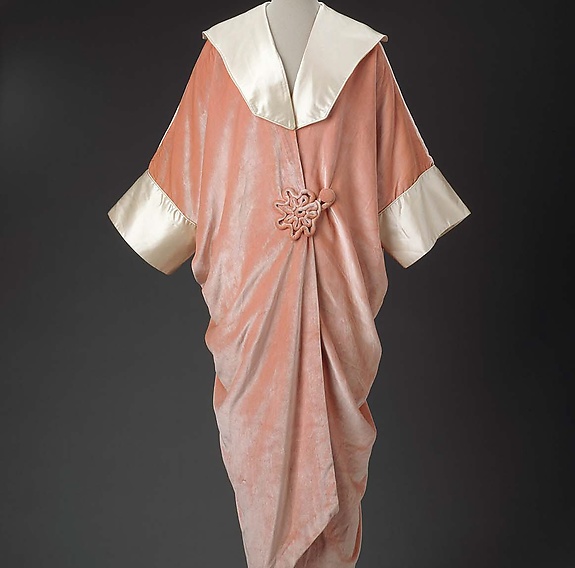
Woman’s evening coat Date: 1910–20 Culture: France Medium: Silk velvet, silk satin collar, cuffs, and lining Credit Line: Lent by Museum of Fine Arts, Boston. Gift of Mr. William B. Gannett
A significant section of the exhibit shows how Japan and the West influenced each other from 1868 to 1912. The Japanese adopted Western chemical dyes and weaving techniques, while the Western fashion was swept up in beautiful images from Japan as these pieces from the collection of the Costume Institute show. A lush pink silk velvet opera cloak by Jean-Charles Worth is displayed next to a kimono robe made by Tashimaya Department Store for the foreign trade. It features short kimono-like sleeves and a simpler printed fabric with Japanese-style motifs. Finally, a light green wool Western-style robe with frog closures features embroidered flowers, which are a fine example of Japanoism.
As Japan moved into the twentieth century, the influences changed, the artistry did not. Modern inventions like cameras, express train tickets, and sheet music appear. Tow kimonos show sobering signs of the nation’s increasing militarism—one shows the siege of Port Arthur during the Russo-Japanese War and another, antiaircraft guns, tanks and planes backing Italy’s invasion of Ethiopia in 1935. Kimonos for the masses appear sold in department stores with design influenced by Art Deco and the De Stijl movement. There is even a child’s kimono treasured by Frank Lloyd Wright with a pattern of wisterias climbing over abstract trellises.
The Exhibition Catalog (Click to purchase)
After World War II, Japan began an effort to preserve its cultural heritage, preserving and honoring the craft of the kimono makers, weavers, and dyers through the Living Treasure Movement. Three kimonos created by these artists give testament to the beauty of their work. At the end of the exhibit are garments from prominent Japanese designers, who have brought the nation to the forefront of fashion while honoring their unique traditions—Hanae Mori, Issey Miyake, and Yojhi Yamamoto, and one more designer, Bonnie Cashin. Her simple black wool kimono-style coat shows her love of the Japanese kimono. It was a design she repeated often though her career.
Kimono: A Modern History is tucked into the Arts of Japan Galleries in the Met’s Asian Arts Wing. The galleries surround the lovely basalt Water Stone (1986) by Isamu Noguchi, whose soothing sound pervades the galleries. It underlines the timelessness of the fashions displayed here and their lasting beauty. This is a fashion exhibit from another perspective, a valuable reminder that Western fashion is not the only fashion.”
A very special thanks to Brenna and Nadine for cooperating on these reviews for Fashion Historia. Can’t make it to New York to see their exhibition? You can buy the exhibition catalog, but the Met has all 170 objects from the show available online for you to look at (sans curatorial insights/labels/wall text) . While there isn’t an exhibition catalog to accompany LACMA’s show, they have created this beautiful video:
*Image: Utagawa Kokunimasa (Japanese, 1874–1944). Swimming at Ōiso, Distant Views of Mount Fuji, 1893. Meiji period (1868–1912). Japan. Triptych of polychrome woodblock prints; ink and color on paper. The Metropolitan Museum of Art, New York, Gift of Lincoln Kirstein, 1960 (JP3382a–c)
**Image: Woman’s Kimono (kosode) with Abstract Hemp-Leaf Pattern, Japan, late Taisho+ (1912-1926) – early Sho+wa (1926–1989) period, Silk plain weave, stencil-printed warp and weft (heiyo+-kasuri meisen), Los Angeles County Museum of Art, Costume Council Fund, M.2012.130.9.
**Image: Woman’s Kimono (kosode) with Abstract Hemp-Leaf Pattern, Japan, late Taisho+ (1912-1926) – early Sho+wa (1926–1989) period, Silk plain weave, stencil-printed warp and weft (heiyo+-kasuri meisen), Los Angeles County Museum of Art, Costume Council Fund, M.2012.130.9.
EXPOSED: THE HISTORY OF LINGERIE
MUSEUM @ FIT
JUNE 3-NOVEMBER 15, 2014
Guest Exhibition Review By Nadine L. Stewart
Saks Fifth Avenue camiknickers, crepe chiffon, silk satin, c. 1924, France, Museum purchase, P86.63.5.
Exposed: The History of Lingerie explores a fashion story that often takes a secondary place in the fashion history—what’s been worn underneath our clothes. These are the pieces that give our bodies the current fashionable silhouette or the clothes we wear for our most intimate moments in bed or lounging at home. Curator Colleen Hill has been fascinated with lingerie since 2008 when she curated Seduction, an exhibition that focused on the erotic nature of fashion. Through the intervening years she kept track of the Museum’s lingerie collection, which occupies the back of its huge clothing storage area. Her interest intensified when the Museum acquired several beautiful collections of custom lingerie, with pieces that were marvels of beautiful details and exquisite craftsmanship. The result is a fascinating exhibit of intimate wear from the eighteenth century to the present.
The first thing one sees in the Museum’s vast lobby is a platform with five underwear ensembles designed by the 2014 BFA students of FIT. Hill told me she decided these garments should provide the prologue to the exhibit because the students’ work was so professional. In the outside entry case stands a mannequin in a witty 1994 Moschino evening dress with a pouf skirt made entirely of 20 black underwire bras complete with their dangling shoulders straps.
But it inside that the real spell of the exhibit takes hold. Mounted on the first platform is a raspberry colored satin corset from around 1889 that glows like a jewel in the low light. Hill told me this corset surprised her for several reasons. One, it was an early example of colored lingerie, which was just becoming acceptable. Even more important, the corset’s bones were made of coraline, a plant based material that was probably more comfortable to wear than the steel bones common at the time. That meant it was probably marketed by Warner Brothers as a “healthy” garment for the stylish woman. The corset shares the platform with a Peter Sorensen evening dress from 2007 with a corset bodice and another jewel-colored corset from the 1850s, this time in blue satin.
Claire McCardell evening dress, printed nylon, 1950, USA, gift of Mr. and Mrs. Adrian McCardell, 72.61.182.
Throughout the exhibit garments are often paired, making it possible to see how the intimate “under” garment was morphed into an “outer” garment. For example, an Empire line nightgown from the 1950s is paired with a Claire McCardell evening gown from the same decade, both in the new wonder fiber—nylon. A princess line slip from 1910 replete with eyelet trim stands next to the lingerie dress—a glorious confection of white eyelet and sheer muslin.
The panorama continues. In the next room is an eighteenth century corset with tie-on sleeves. Such a garment could be worn as outerwear. Next to it is quilted petticoat, which would have been visible too. A lady would pull her overskirt and tied it up, so she could show off the petticoat’s elegant stitch patterns To remind us of that an eighteenth century lady was expected to stand straight, whalebone busk from the 1780s lies in a case in front. This piece would have been inserted into the corset in a place provided between the breasts to keep the wearer erect and stately.
Amid all the elegance and couture work are two companies from the present day that show us how lingerie still fascinates women today. Both Victoria’s Secret and Hanky Panky give the consumer fashionable linger at an affordable price. Hill was also impressed by Hanky Panky’s ethical standards of production in these days of concern over sustainability. But how can one forget that Hanky Panky claims to produce the “worlds most comfortable thong” for a wide range of sizes? There it is–in a colorful three pack!
Another notable company is Cadolle of Paris, a family-owned firm still producing beautiful ready-to-wear and custom lingerie after 5 generations. Founded in 1889 it pioneered innovative brassiere designs and is one of the few companies to produce custom lingerie today. On view is a baby doll nightgown and corset in pink lace.
One of the loveliest lingerie styles was the tea gown, a robe that women of the nineteenth and early twentieth centuries wore to relax and entertain in the privacy of their homes. Hill chose several to display. There’s an early white cotton and lace dressing gown from the 1850s that hides the body under its generous cut. By 1900 the robe was an alluring confection of chiffon, silk and lace. The Fernende Burel gown on display is accented with silk roses placed strategically on each breast! Next to it is an elegant brown silk hostess gown hand printed with gold by Suzanne Bertillon from the 1920s and a Delphos dress which, we are reminded, was originally designed to be worn as tea gown without a corset.
It’s a stunning array that continues with choice examples that bring the exhibit to the present day with the Wonderbra from 1994 and the overtly sexual style of Agent Provocateur. One of the joys of this exhibit is the simplicity of the exhibit layout. It has been well edited, so that the garments are clearly visible without excess clutter. After following the styles of fashionable dishabille, we know that lingerie and the urge for special underwear is something that has continued through the centuries. What’s next?”– Nadine L Stewart
Exposed will be on display till November 15th. On Thursday, November 6, Curator Colleen Hill will host Poupie and Patricia Cadolle in a conversation about their unique family-run business. Admission is free, but reservations are required. Register online.
Since the beginning of 2014, I’ve found myself swimming in a wealth of new fashion history scholarship. In the coming weeks and months, I hope to share some of these gems with you: some in passing and some in greater depth. If you’ve read any of these and have comments, I hope you’ll share them with me and other readers as we go. Here are just a few that I should have already mentioned, that have come out relatively recently*:
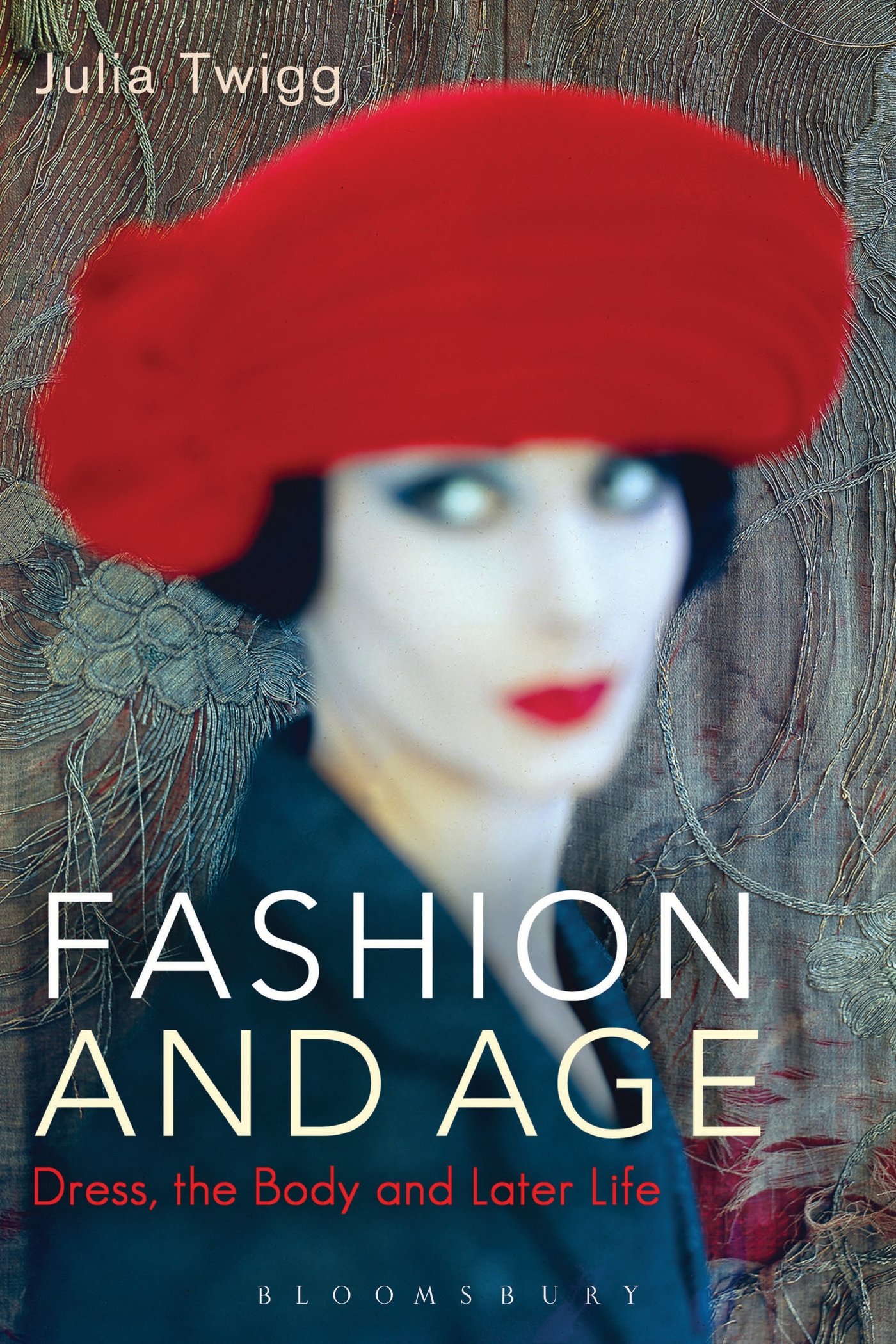
Throughout history certain forms and styles of dress have been deemed appropriate – or more significantly, inappropriate – for people as they age. Older women in particular have long been subject to social pressure to tone down, to adopt self-effacing, covered-up styles. But increasingly there are signs of change, as older women aspire to younger, more mainstream, styles, and retailers realize the potential of the ‘grey market’.
Fashion and Age is the first study to systematically explore the links between clothing and age, drawing on fashion theory and cultural gerontology to examine the changing ways in which age is imagined, experienced and understood in modern culture through the medium of dress. Clothes lie between the body and its social expression, and the book explores the significance of embodiment in dress and in the cultural constitution of age.
Drawing on the views of older women, journalists and fashion editors, and clothing designers and retailers, it aims to widen the agenda of fashion studies to encompass the everyday dress of the majority, shifting the debate about age away from its current preoccupation with dependency, towards a fuller account of the lived experience of age. Fashion and Age will be of great interest to students of fashion, material culture, sociology, sociology of age, history of dress and to clothing designers.”
Roland Barthes was one of the most widely influential thinkers of the 20th Century and his immensely popular and readable writings have covered topics ranging from wrestling to photography. The semiotic power of fashion and clothing were of perennial interest to Barthes and The Language of Fashion – now available in the Bloomsbury Revelations series – collects some of his most important writings on these topics. Barthes’ essays here range from the history of clothing to the cultural importance of Coco Chanel, from Hippy style in Morocco to the figure of the dandy, from colour in fashion to the power of jewellery. Barthes’ acute analysis and constant questioning make this book an essential read for anyone seeking to understand the cultural power of fashion.”
The Handbook of Fashion Studiesby Amy de la Haye, Agnès Rocamora, Joanne Entwistle and Helen Thomas (Bloomsbury, December 2013)
The Handbook of Fashion Studies identifies an innovative spectrum of thematic approaches, key strands and interdisciplinary concepts that continue to push forward the boundaries of fashion studies. The book is divided into seven sections: Fashion, Identity and Difference; Spaces of Fashion; Fashion and Materiality; Fashion, Agency and Policy; Science, Technology and New fashion; Fashion and Time and, Sustainable Fashion in a Globalised world.
Each section consists of approximately four essays authored by established researchers in the field from the UK, USA, Netherlands, Sweden, Canada and Australia. The essays are written by international subject specialists who each engage with their section’s theme in the light of their own discipline and provide clear case-studies to further knowledge on fashion. This consistency provides clarity and permits comparative analysis.”
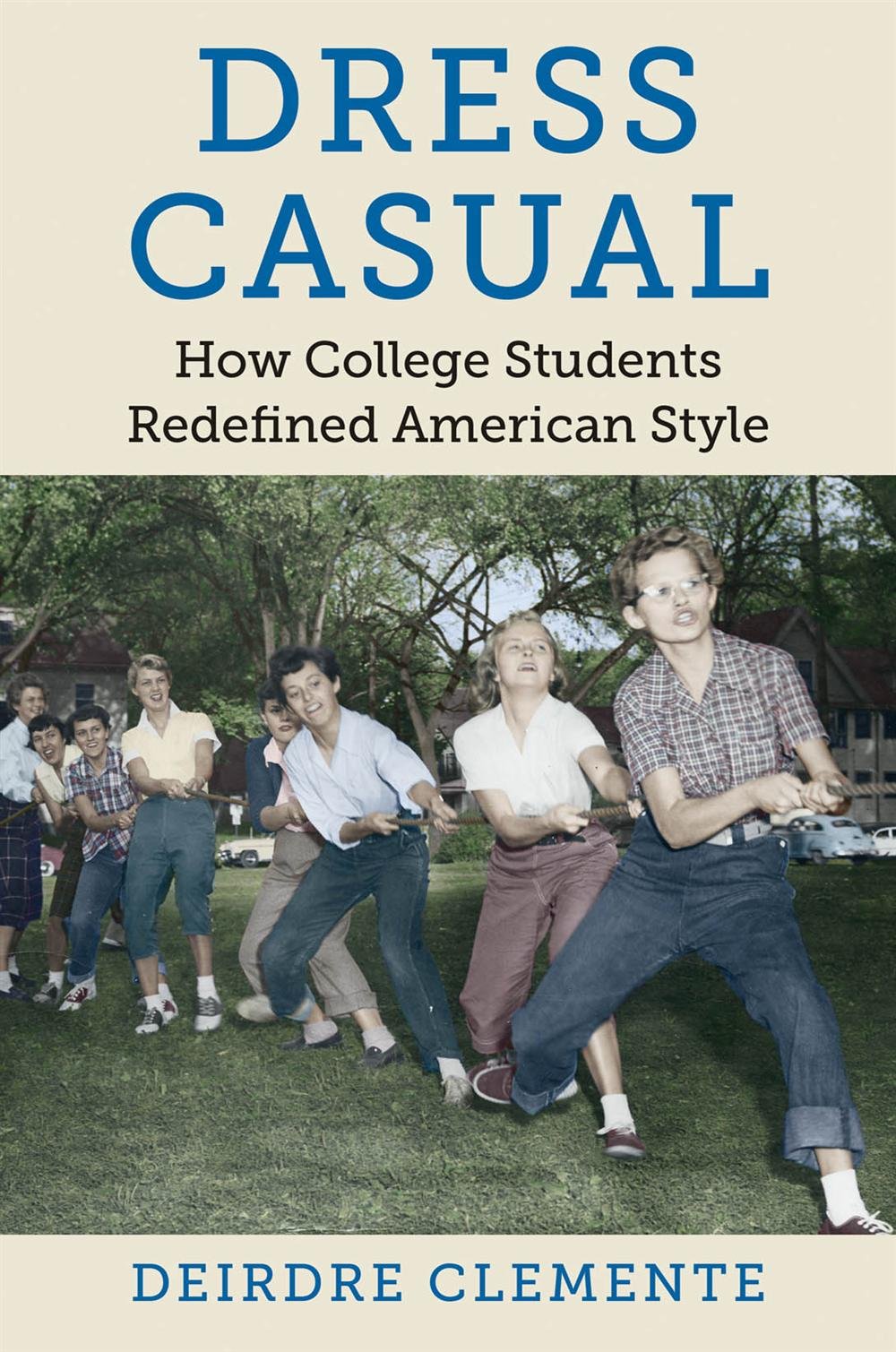
As Deirdre Clemente shows in this lively history of fashion on American college campuses, whether it’s jeans and sneakers or khakis with a polo shirt, chances are college kids made it cool. The modern casual American wardrobe, Clemente argues, was born in the classrooms, dormitories, fraternity and sorority houses, and gyms of universities and colleges across the country. As young people gained increasing social and cultural clout during the early twentieth century, their tastes transformed mainstream fashion from collared and corseted to comfortable. From east coast to west and from the Ivy League to historically black colleges and universities, changing styles reflected new ways of defining the value of personal appearance, and, by extension, new possibilities for creating one’s identity.
The pace of change in fashion options, however, was hardly equal. Race, class, and gender shaped the adoption of casual style, and young women faced particular backlash both from older generations and from their male peers. Nevertheless, as coeds fought dress codes and stereotypes, they joined men in pushing new styles beyond the campus, into dance halls, theaters, homes, and workplaces. Thanks to these shifts, today’s casual style provides a middle ground for people of all backgrounds, redefining the meaning of appearance in American culture.”
*Please note these descriptions come directly from the publishers.
I’m happy to be able to share with you, this review by my good friend, and fellow CSA Western Region board member, Brenna Barks. She recently visited the Asian Art Museum in San Francisco to hear “HIps Don’t Lie — GORGEOUS Idea Talk” by Nicole Archer, a fellow CSA member, as a part of a CSA Western Region meet-up. . The talk is part of programming support for the current exhibition, Gorgeous (on view through September 14). Brenna kindly agreed to write up her thoughts for Fashion Historia:
Hips Don’t Lie – GORGEOUS Idea Talk by Nicole Archer
The first piece Nicole Archer led the group to in the GORGEOUS galleries for her talk, ‘Hips Don’t Lie’, was Gerhard Richter’s 1991 piece, Spiegel, blutrut (Blood Red Mirror). It was an unexpected first piece to examine, and with it, Nicole masterfully set the tone for the entire talk.
I had noticed the piece during my quick walk-through prior to the talk and had admired it for the color and for the power of such a rich color on such a large, stark piece. But I was in a bit of a hurry because I didn’t want to miss the start of the talk so I didn’t have time to notice what Nicole pointed out: the piece’s reflective properties. Oil painted on glass, Spiegel, blutrut is naturally reflective and for a talk that focused on posture, body language, and how we use both to communicate and relate not just with ourselves and each other, but with the art objects we encounter, the first “image” Nicole confronted us with was ourselves.
This forced us to examine how we were standing and carrying ourselves, and enabled Nicole to introduce the major tenet of her talk, best summarized by a Nietzsche quote she shared with us: “There is more wisdom in your body than in your deepest philosophy.” Our bodies know as much about figurative art – and non-figurative art, we would learn – as our minds do.
Nicole then discussed the hip line and its use throughout art history and across various cultures. Starting with the ancient Etruscan kore statues and the statuary of ancient Egypt, there is a firm, stiff posture with the hips straight and parallel which establishes one’s presence, or gives one a dominating, determined, confident (if static) air. This was followed by the ancient Greek s-curve and the contro posto poses; each of these stances adds a sensuality and a movement to the body that the initial posture does not have.
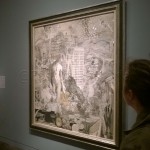
This was best illustrated by Nicole through Narkissos (1976 – 1991), a collage drawing by San Francisco artist, Jess which features a self-portrait of the artist in the composition in the more sensual s-curve posture, with another male figure in the background in the firmer, straight-hipped, kore-style stance. The contrast between firmness and softness in stance, between strong confidence and a gentle sensuality emphasized the artwork’s main theme: exploration and celebration of male, homosexual desire. As Nicole stated through her use of the Nietzsche quote at the start of the talk, my body “knew” what the difference in those postures meant and I had read the difference almost subconsciously; by viewing the work through the lens of Nicole’s thesis and expertise, and hearing and participating in the discussion with my fellow attendees, this difference was brought to the surface and for me added even more depth to an already exquisite piece.
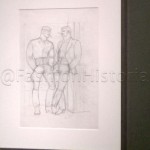
I was not alone in my revelations. While gathered around a sketch by Tom of Finland, as various people examined the figures’ postures and connected with them physically through mimicking their poses (some only mentally, some physically), there were multiple and all equally interesting and accurate interpretations of what the two men in the sketch were doing: they were subtly checking out each others behinds, they were establishing who was the dominant and who was the less dominant person in this exchange, they were posturing for a third person observing them, and so on.
While examining the comedic Laughing Nude by John Currin (1998), one young man pointed out that the hands of the woman depicted were not graceful, but – through illustrating with his own hands – rather awkward, and that their depiction was almost masculine. This meant that Currin’s Nude was not only a parody of the distorted nudes and female figures found in most Northern Renaissance paintings, but also perhaps a parody of contemporary nudes, which tend to over-emphasize an ideal of grace and delicacy.
That so many people felt comfortable speaking aloud can only be credited to Nicole. Her ability to engage with her audience, and her style of delivery were nothing short of masterful. With or without any artistic knowledge, Nicole emphasized that since we all have bodies, we can all relate to these artworks, and that no way we relate is wrong. People felt confident and comfortable enough to speak, even though surrounded by a large group of strangers in a very public setting, something I’ve never seen before. She was also very engaging, miming actions – such as the impossibility of “strutting” while maintaining a straight-hipped, kore-style stance – explaining things quickly and succinctly, making us laugh, and genuinely listening to anyone who spoke, welcoming new insights and perspectives.
Movement was as much a theme as posture. Comparing a Japanese triptych of Three Types of Edo Beauties, wrapped in their kimono with the static nature of a Noh robe hanging in a case, Nicole perhaps intentionally echoed a statement of Lou Taylor’s: that recreating the dynamism of movement in clothing can never quite be achieved in a museum or gallery setting, a living, moving body is required to give the clothing life. As Nicole illustrated, our stance indicates what movements are possible as much as what we are doing and where we are indicates the style of movement. “Why don’t we strut in galleries?” she asked. Contrasted with the performance by Phonique and other performance artists happening in the museum at the same time, it was a very thought-provoking question. It was not suggesting that we necessarily should strut, but it brought to the forefront of our minds how different situations and their different etiquette’s dictate our bodily stances and movement.
By the end of the talk through the gallery, Nicole had brought our attention to movement even in artworks that were not human: the curves of a Balinese dagger and the swaying, beaded curtain of Felix Gonzalez-Torres’s Untitled (Golden) each had their own movement and a sensuality which mimicked the s-curve of so many of the figures we had examined. Nicole also brought attention to the curators’ expertise in this exhibition by highlighting juxtaposing pieces that might seem unrelated at first, until you examine the poses and stances the art depicts – even between “realistic” photographs, and cubist portraits.
After this wonderful, insightful talk, which felt more like a private class than a lecture, I don’t think I will be completely unaware of my own stance and body language in a museum or gallery for a long time to come.
Nicole Archer
Tom of Finland sketch “Untitled” 1983 (SFMOMA Collection)
Jess’s “Narkissus”
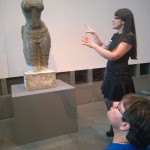
Nicole with the piece that inspired the talk, “Torso of a female deity” 1400 – 1600, Southern India (Asian Art Museum)
Currently on view at the New York Historical Society (through June 15, 2014), “Bill Cunningham: Facades” is a photography show from the now iconic photographer and the results of an eight-year project to document the architectural riches and fashion history of New York City which pairs models in period costumes with historic settings. Nadine Stewart, Fashion Historian, has graciously provided a review here for those not able to see the exhibit in person, or for those looking for some analysis of the show. Thanks again to Nadine!
“Fashion is the armor to survive the reality of everyday life. I don’t think you should do away with it. It would be like doing away with civilization.”
— Bill Cunningham
Today Bill Cunningham is an icon. Readers of the New York Times can follow his analysis of street styles and social life every week. He was the subject of a critically acclaimed documentary. He’s followed fashion tirelessly both in New York and abroad for 35 years. When he began, it was a lonely quest. Now bloggers copy his work every day. None of them have the knowledge or wit to equal him.
“Facades” covers an early period in Cunningham’s career. It’s a smaller, quieter exhibit across the park from the glory of the Charles James exhibit at the Metropolitan Museum of Art. Yet its images resonate just as strongly. The pictures were taken in the late 1960s when he was transitioning to his special brand of fashion photography from earlier work as a milliner and fashion journalist.
Grand Central Terminal, New York City, ca. 1968-1976 By Bill Cunningham, Gelatin silver photograph, New-York Historical Society, Gift of Bill Cunningham
Beginning in 1968, Cunningham shot a series of 88 gelatin silver prints that matched iconic New York architecture with historic fashions–a range that stretches from the eighteenth century to the 1950s. His model for this eight year project was his neighbor in the Carnegie Hall Artist Studios, Editta Sherman, a fellow photographer who became his partner and muse. Together they scoured thrift shops, flea markets and auctions for vintage clothing. One find, later photographed in front of St Paul’s Chapel, was an eighteenth century man’s coat and vest scrounged for a secondhand shop on Ninth Avenue. In the end, they used 500 outfits at 1800 locations.
In 1968, New York was considered a decaying hulk. Historic buildings like Penn Station were being torn down to make way for an uncertain new future. Preserving the past was still being debated. Some city planners felt that the only way for the city to develop was to cut its link with the past and tear down older buildings. Cunningham clearly disagreed with this approach, a feeling that comes through in the loving way he photographs each building, finding angles a less informed observer would have missed. Editta was the perfect muse for this project. A striking image of Editta in a graffiti-covered subway car dressed in Edwardian splendor, sums up the grittiness of the time, but Editta sits proudly, no giving in to the squalor around her. Her presence is powerful as it is in every picture. She modeled with flair and style—a 56 year old muse who threw herself into each pose whether she was portraying a Victorian grande dame, a flapper from the 1920s, or a swinging mini-skirted girl from the 1960s. Cunningham used his background as a milliner to provide her with hats that punctuate the picture and echo the architecture in the background—like the towering fur toque Editta wears in a close-up in front of the Guggenheim.
Though the pictures were taken 37 years ago, they show a clear relationship between architecture and fashion that informs us today. They are not simply historical dress-up. Each shot shows an understanding and a love of the city. They have a freshness that contemporary fashion photography with its Photoshopped perfection often lacks.
Editta Sherman died in 2013 after she and Cunningham were evicted from Carnegie Hall, their home of 60 years. This exhibit gives us a vision broader than fashion history or iconic New York architecture. It gives us a sense of what type of spirit it takes to survive in a dystopian time.
There are moments I think we’re beating this horse to death. I worry that we are still far too fixated on the hijab (veil) and on Muslim women’s dress, though we should be turning our gaze toward other, more pressing issues that profoundly affect women: e.g., poverty, war, and environmental degradation. Will we ever be content to let women dress as they choose without judgment or comment?
Islamic Fashion and Anti-Fashion: New Perspectives from Europe and North America is an essential collection that fulfills a great deal of scholarship. It features sixteen essays covering history, anthropology, sociology, and fashion studies. Editors Emma Tarlo and Annelies Moors have written an excellent introduction, particularly in its discussion of how dress affects religiosity and piety, how fashion relates to assimilation and creativity, and the politics of so-called Muslim dress or “the performative power of the headscarf to make identity claims and political demands,” as Rustem Ertug Altinay puts it in his chapter “Sule Yüksel Senler: An Early Style Icon of Urban Islamic Fashion in Turkey.” Tarlo and Moors remind us that Muslim women are habitually perceived as shrouded and silenced and that their coverings often seem to prove they are merely “agents of barbarism,” as Canadians A. Brenda Anderson and F. Volker Greifenhagen write in “Covering up in the Prairies.” Yet within the bounds of “proper” Muslim dress, there is vast, sophisticated sartorial ingenuity and, as Tarlo calls it, “the agency of the hijab.” (Unfortunately, too much sensational focus on the hijab also robs women of their agency.) The editors write that the “book grows out of awareness of the discrepancy between public discourses…and actual developments…pointing to the need for greater understanding and more nuanced interpretation.” Indeed.
Altinay’s chapter about Turkey pushes the book’s self-ascribed Europe boundaries, but Banu Gökanksel and Anna Secor bridge the gap with “Transnational Networks of Veiling Fashion Between Turkey and Western Europe.” Many Europeans are ethnic Turks, many whose families arrived generations ago as guest workers. Maria Curtis addresses Turks in the United States with “Closet Tales from a Turkish Cultural Center in the ‘Petro Metro’, Houston Texas.” Altinay offers essential historic ballast (with kudos to Audrey Hepburn), for one thing, helping to explain how the headscarf was enthusiastically re-inaugurated into a society that was mandated by its leadership to be secular.
Most interesting are those essays about unfamiliar, rarely noticed practices and challenges, like Daniela Stoica’s “The Clothing Dilemmas of Transylvanian Muslim Converts” or Katarzyna Górak-Sosnowska and Michael Lyszcarz’s “Perspectives on Muslim Dress in Poland: A Tatar View,” a study of the Tatars’ distinctive, traditional uses of the headscarf as they encounter a new (and often insistent) interpretation of Islam.
Annelies Moors’ “Fashion and its Discontents: The Aesthetics of Covering in the Netherlands,” Synnøve Bendixsen’s “‘I Love My Prophet’: Religious Taste, Consumption and Distinction in Berlin,” and Connie Carøc Christiansen’s “Miss Headscarf: Islamic Fashion and the Danish Media” look to the entanglements of belonging, social conflict, politics, gender, and sexuality (among other things).
I once asked Reina Lewis – who, like Leila Karin Österlind with “Made in France: Islamic Fashion Companies on Display,” examines merchandising in “Hijab on the Shop Floor: Muslims in Fashion Retail in Britain” — whether the trend among Euro-American women combining trousers with dresses was related to the beautiful salwarkameez, a customary costume in South and Central Asia. She thought it more likely to be a retro-hippie craze. I’m not so sure, because, as we see in various chapters of this book, and in Tarlo’s previous work, contemporary Islamic fashions, increasingly distanced from indigenous clothing, are so modish, attractive, elegant, fun, and streetwise that even young non-Muslim women could find them irresistible. But would they also wear hijab? Well, that might, at the very least ─ at last ─ render all this who-wears-what fuss moot.
Hollywood Costume is the lavishly illustrated coffee-table book and exhibition catalog from the Victoria & Albert exhibition of the same name. It frequently juxtaposes film stills with the physical costumes. The above costume was designed by Travis Banton for Claudette Colbert in Cleopatra, 1934. The image below shows Colbert wearing the dress (and showing off much cleavage) For more on the costumes in this film, see my article at Worn Throughfrom 2010.
Another spectacular costume featured in Hollywood Costume (along with installation shots and an essay by Sam Gatley on dressing the mannequin) is this costume for Irene Bullock (Carole Lombard) in My Man Godfrey, 1936 by Travis Banton (Page 214-5, Gown and duster jacket designed by Travis Banton. The Collection of Motion Picture Costume Design Larry McQueen. Credit: Victoria and Albert Museum).
My Man Godfrey happens to be one of my favorite movies (hello, William Powell!). The image of this dress is gorgeous in this two-page spread, but seeing all those glass bugle beads in motion in the film is just absolutely stunning. The scene below features the dress, but is also a fairly important point of the plot: (pardon the ad at the beginning of the clip):
For more wonderful insights, be sure to check out the book, Hollywood Costume (Abrams) edited by Deborah Nadoolman Landis.
*Page 137 The Collection of Motion Picture Costume Design Larry McQueen. Credit: Victoria and Albert Museum
My new diggs, in Redding, CA are providing me with a great opportunity to explore and learn new elements of fashion and its history in a part of California that isn’t well documented. This past weekend, I went to French Gulch Old West Days (about half an hour North of where I live). A few of the activities sounded intriguing – “Mountain Men Exhibits” and “Craft Booths” as well as re-enactors in costume. Many of the historical and educational institutions here were closed for the day, because they planned to be in attendance there – including the Shasta Historical Society and Shasta County Library.
Bland, Carrie Tuggle sitting in her wedding dress (no date given, though she was born in 1877) Shasta Historical SocietyFull length photo of woman in wedding dress holding bridal bouquet. Reverse: "Virginia M. Wood Redding - married William A. Banigan - Anderson July 14, 1923" Shasta Historical Society.


 Dr. Kimberly Chrisman-Campbell is an independent scholar and consultant with an impressive background in fashion and history. She received her B.A. from Stanford University, her M.A. from the Courtauld Institute of Art, and her Ph.D. from the University of Aberdeen. Chrisman-Campbell has published numerous journal and magazine articles on 18th– and early 19th-century French fashion. She has also contributed to several books and museum catalogues, including Fashioning Fashion: European Dress in Detail, 1700-1915 (Los Angeles: Prestel and Los Angeles County Museum of Art, 2010) and Paris: Life & Luxury in the Eighteenth Century (Los Angeles: Getty Publishing, 2011).

 The papers topics were based loosely on the topic “F

 *
*



 The Language of Fashion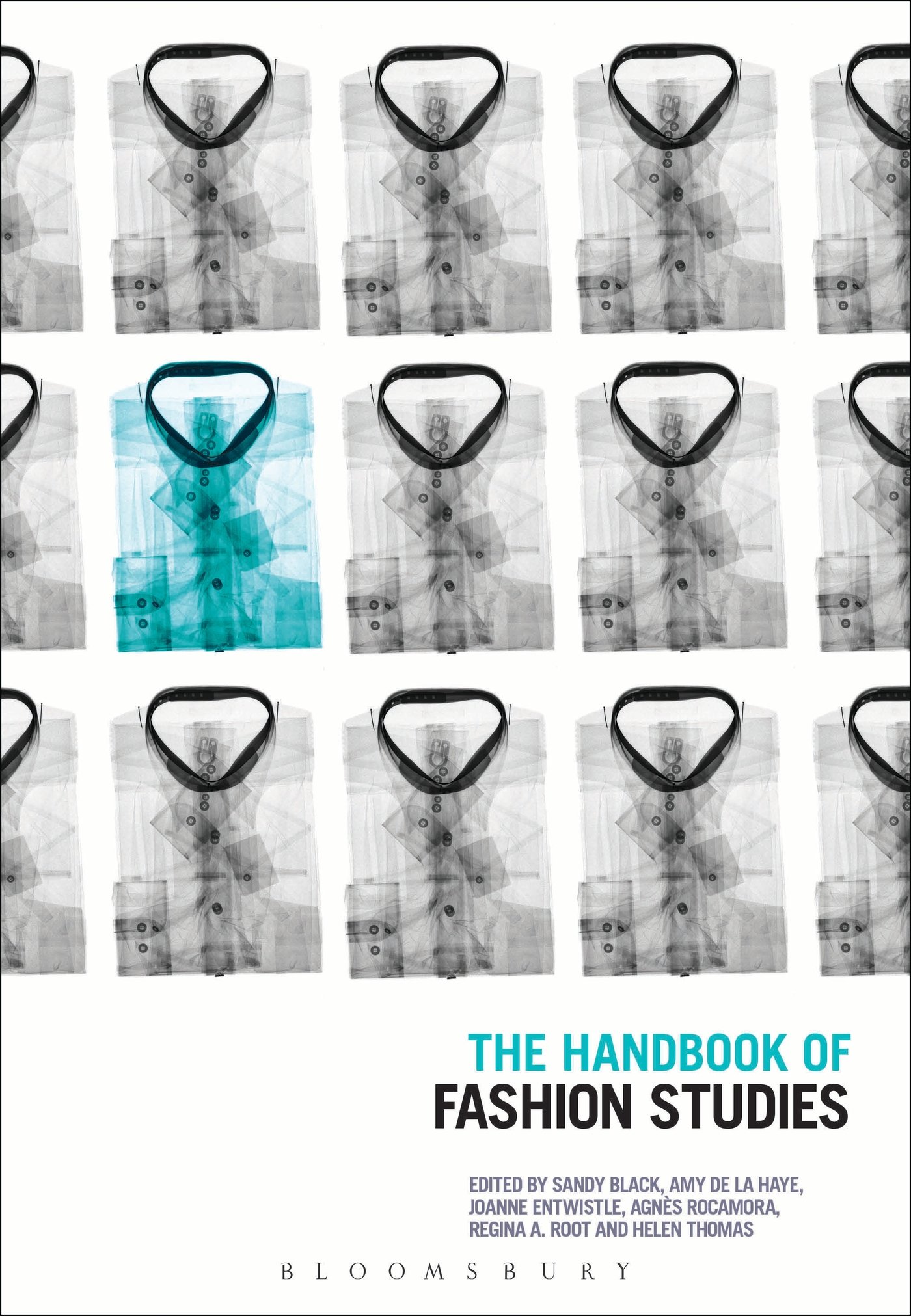

 The first piece Nicole Archer led the group to in the GORGEOUS galleries for her talk, ‘Hips Don’t Lie’, was Gerhard Richter’s 1991 piece, Spiegel, blutrut (Blood Red Mirror). It was an unexpected first piece to examine, and with it, Nicole masterfully set the tone for the entire talk.