New from Abrams/V&A in time for holiday gift giving, is Pearls by jewelry historian Beatriz Chandour-Sampson and Hubert Bari, curator at the Qatar Museum authority. Meant to accompany the exhibition of the same name (on view through January 2014), this survey of pearl jewelry spans both time and the globe: from the Byzantine Empire to Jackie Kennedy to the present day.
Ceremonial Glove, Palermo, Sicily, before 1220: Red Velvet, gold, enamel, niello, pearls, amethysts, garnets, rubies, sapphires, spinels. Possibly for the coronation of Frederick II of the Staufer dynasty, Kunsthistorisches Museum, Weitliche Schatzkammer, Vienna
Beautifully illustrated, Pearls utilizes the Victoria & Albert and other museum collections to good effect. The text is both sweeping and detailed, which helps keep this volume petite by packed with information. Eight chapters (or essays) detail the global history and importance of pearls as jewelry.
Covering both its natural (and unnatural) history, as well as their historical context the chapters are basically chronological. While the book primarily covers the history of pearls in the western world, the introduction, first, and concluding chapters explore the global aspects of pearls: their trade, their creation, and their particular role in eastern cultures.
Chrysanthemum Brooch, Tiffany & Co, New York, c1904, Gold, platinum, diamonds, pearls. The pearls are from Mississippi, Tiffany & Co Archives.
Not surprisingly, I’m interested in the twentieth century section of the book, and it does not disappoint in its representation of Belle Epoch, Art Nouveau, and Art Deco examples from makers and designers such as Cartier, Schiaparelli, Chanel, Tiffany, and the like. Photographs of royalty, socialites, film stars, and political figures pepper the pages of this chapter, providing context to significant pieces.
All chapters utilize a wide range of museum collections, high quality images, and very well written text making Pearls a marvelous gift for jewelry enthusiasts and historians alike.
Icon with Virgin and Child, Ivan Nikolaev Mnekin, Moscow, 1886. Gilded Silver, oil mainting on metal, enamel, freshwater pearls. Cyrillic maker's mark 'iM'" the pearls are from Russia. Qatar Museums Authority, Doha
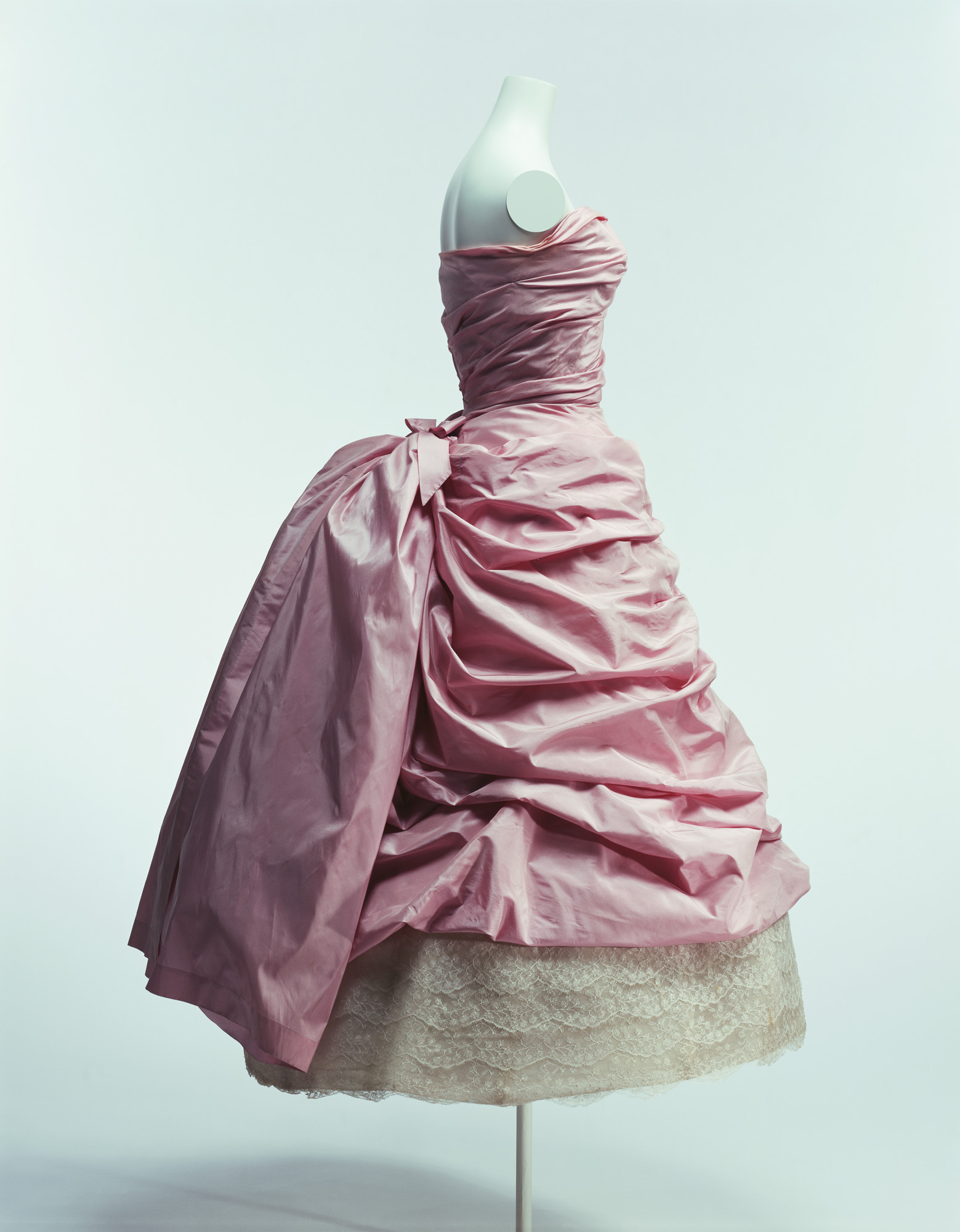
Balenciaga taffeta gown with lace trim, 1955 (Kyoto Costume Institute)
A few weeks ago I was lucky enough to attend the Costume Society of America program including a tour of “Wear to Party” at the Museum of Ventura County, as well as the tour of Lotusland with a lecture on Ganna Walska (the Polish opera singer) and the costumes designed for her by Erte.
I’m going to go into too much detail (CSA Members can look forward to a writeup in our Spring 2014 newsletter of the event). However, I do want to share a few photos from the tour of “Wear to Party” – which was fabulous, informative, and fun.
“Wear to Party” is an exhibit focused on the clothing worn while social entertaining in Ventura County, including beach parties, barbeques, dinner dances, and of the prom attended by local residents. Our tour guide was the volunteer curator (and former Smithsonian curator), Shelly Foote – whose knowledge seems endless. My favorites from the exhibit include several 1930s dresses: a garden party dress with a jellyfish print, a black taffeta evening gown with a dramatic back, and a black velvet gown with green beaded sleeves. However, the pink Balenciaga-esque prom dress was also a favorite. See more below.
This pink prom dress dates was purchased at I. Magnin in 1956, the year after Balenciaga put out a similar gown
1937 Taffeta gown purchased at Burgdorf Goodman’s in New York while the own was heading to her honeymoon.
1934 velvet and rayon dinner dress (likely worn by the owner to the local 20-30 Club, a dinner-dance venue.
Released just a few weeks ago, Jean Patou: A Fashionable Life by Emmanuelle Polle highlights the extensive private archives of the Patou heirs for the first time. This oversize monograph from Flammarion that Polle spent two years researching, features 250 color and black-and-white illustrations, including the much of the early days of fashion photography (such as those by Baron de Meyer).
The book is divided into three sections: a biography of Jean Patou, his work in Paris, and his work in the United States. Pages are covered from edge to edge with fashion sketches, photographs of garments (sportswear, swimwear, day-wear, etc, gowns), fashion photographs (including both street fashion and studio photographs), focused on the 1920s and 1930s – the height of his powers. It also includes information related to his famous perfumes-Joy and Que Sais-Je.
In New York in 1924, Jean Patou poses in one of the eighty-odd suits he claimed to own.
Though his career lasted a short fifteen years, his use of embroideries, jersey, and interest in day pajamas, and sportswear made him a rival of Chanel. The book also includes discussion and visual representation of the inspiration he gained during World War I-even including some garments he collected and kept as inspirational pieces. The book discusses his clientele, his friends, his lovers and gives an in-depth look at the man and his design work (much of which researched from private letters, diaries, and other previously unpublished material).
This book is a welcome addition to fashion history literature – as it is the first book to focus solely on the short but substantial career of Jean Patou since the 1980s. Jean Patou: A Fashionable Life is one of those rare gems that will be of interest to both established fashion historians, archivists, libraries, museums and fashion enthusiast alike. Especially those interested in Paris, and the Art Deco period.
For a ‘sneak peak’ of the interior, check out the small gallery below.
Jean Patou Archives, “Fleurs du mal” coat in caramel silk velvet, back embroidered with flowers, 1921. It wasn’t unusual for the names of Jean Patou’s designs to carry literary references. This one reflects the couturier’s taste for the poetry of Baudelaire.
In New York in 1924, Jean Patou poses in one of the eight-odd suits he claimed to own.
Just a few days ago the new issue of Smithsonian Magazine landed in my mailbox. The entire issue is dedicated to the 101 objects (out of the 137 million in the Smithsonian’s collection) that are the ‘most important’ in American history and culture (arguably, of course). More than a few objects of clothing and textiles made the cut.
Each is accompanied by a small contextual essay and an illustration (usually a photograph of the actual object, but occasionally illustrations are included).
Neil Armstrong's Space Suit (1969)
Some of the essays are written by surprising people. For example, Martha Stewart penned the essay on the Singer Sewing Machine and Justice Sandra Day O’Conner wrote the essay on her own judges robe.
The essays are available in part or in full online, and grouped by theme: Wild America, Discovery, Voice, Power, Invention, Community, Happiness, America in the World, and Freedom. It’s a good issue and a unique look at the history of the U.S. The weekend’s approach is a good excuse to seek out the issue, sit down and read it (especially those for those with historical leanings).
What articles of clothing would you have included that they left out?
If you could see the stack of books on my ‘to do list’ you might run for the hills, but you also might sit down for a good long read. There are some great reviews ahead – so keep an eye out. First up is Hollywood Before Glamour: Fashion in American Silent Film by Michelle Tolini Finamore. Released earlier this year, it has been on my to do list the longest, and here are some brief notes about it’s contents.
Nearly 300 compact pages of academic scholarship cover the 1900s through the 1930s in 6 thematic essays (plus an introduction). Not surprisingly, much of the work discusses Lady Duff Gordon (or Lucile), and also includes an entire chapter on the designer Peggy Hamilton.
It also includes discussions of American Fashion design on film during World War I, and the rise of the ‘specialist’ costume designer (including Adrian, Andre-Ani, Travis Banton, Howard Greer, Iribe, Mitchell Leisen, Max Ree, and Sophie Wachner – though noticeably absent is Natacha Rambova.) Actor’s who provided their own wardrobes for modern films, and the marketing potential that came out of that is also explored. The book is well researched, but is not meant to be a comprehensive study of the era. It remains a helpful resource.
*Anna Moore/Lillian Gish wearing negligee in Way Down East (United Pictures 1920, director D.W. Griffith). Photo by Bain News Service, new York. George Grantham Bain Collection, Library of Congress.)
Looms, placed near windows, at the blanket factory of Sutter's FortFor sale in the store at Sutter's Fort
On a mini-vacation to Sacramento last week, I spent a little while at the Sutter’s Fort State Historic Park. For those unfamiliar, the Swiss immigrant named John Sutter founded the fort in the Sacramento Valley after getting a land grant from the Mexican government in 1939. Sutter then created a flourishing agricultural empire, and a haven for many immigrants traveling west. More famously, on January 24, 1848, James Marshall made his customary inspection of the sawmill he was building for John Sutter, and discovered gold that began California’s famous gold rush.
Interestingly, it was the same James Marshall, Sutter’s head carpenter, who made the looms and spinning wheels for the Sutter’s Fort blanket factory. Thousands of sheep were raised near the fort and in the spring, the sheep were sheare, and the wool processed at the Fort. Local Native Americans worked the looms and wheels. The factory was in the same location in 1846 that it is today, and there is much educational programming (mostly for children) related to its history. The Fort also displays hand-knitting and other textile arts throughout its rooms, and the store even has small kits for learning to quilt, spin, weave, and even sew.
a typical immigrant’s room, note the spinning wheel, quilt, and hand-knitting
Patty Reed’s doll is back on display after some much needed conservation
Recreation of John Sutter’s room at the fort. He got his bed linens from the Russians.
Looms, placed near windows, at the blanket factory of Sutter’s Fort
Spinning wheels at the blanket factory of Sutter’s Fort
My bedtime reading for the last month has been something of a guilty pleasure: Rather than making me sleepy, it keeps me on the edge of my seat and is a fascinating true tale of a real-life bond girl with brains, independence, and beauty.
The Many Lives of Miss K: Toto Koopman – Model, Muse, Spy by Jean-Noel Liaut, translated by Denise Raab Jacobs (Rizzoli, September 2013) is the deftly told story of the world’s first bi-racial model (Javanese and Chinese), who was also a spy, and who was openly bi-sexual, and who also served time in WWII concentration camps, and was influential in the career of artist Francis Bacon.
Her work within the world of Fashion (with a capital F) is detailed here in riveting and creative narrative, and much of that time is in my favorite time period (aesthetically): the 1920s and 1930s. From the designers she worked with, to the Parisian socialites who became her friends: She was an It girl, to be sure.
Toto worked for a brief six months for Chanel in 1930 as a house model, appearing in just one show for the 1930-31 fall/winter collection, “Which featured sober antelope coats and fluid evening dresses with backs that evoked peacock tails.” (24)
She quickly went on to work for Marcel Rochas, and following that Mainbocher (who would become her favorite designer). She even became a ‘jockey:’
The term used for a young woman–model, actress, or socialite–who wore their ‘colors,’ representing them [designers] in Parisian society. And Toto was everywhere: at the opera, at the Longchamp and Auteuil racecourses for the pesages, in nightclubs such as Chez Bricktop and at galas hosted by Jean Patou.” (26)
Toto Koopman models a gown by Augustabernard for photographer George Hoyningen-Huene in Vogue's September 1933 issue.
Toto regularly wore clothes from the most important designers of the 1930s: Chanel, Vionnet, and Schiaparelli. “Always drawn to eccentricity, Toto added quirky accessories, such as gloves with red lizard skin between the fingers, intentionally made to look like diseased skin–definitely Schiaparelli” (47-48)
She also worked steadily with some of the worlds most famous fashion photographers: including George Hoyningen-Huene, Edward Steichen, Horst P. Horst and Cecil Beaton. She first worked with Hoyningen-Huene in 1932, and he considered Toto an ideal model for the designs of Vionnet, Augustabernard, and other designers focused on neo-classicism.
The dresses hugged the curves of the body like a second skin, making it impossible to wear undergarments. To avoid indecency, Toto powdered her breasts and pubic area so that the fabric would not cling to those parts of her body.” (39)
Her work with Honingen-Huene appeared in Vogue often, and she even appeared on the cover. Outside of the long hours at the photography studio, Toto would spend little time with the other models – except for Lee Miller. The pair would remain friends and Miller’s surrealist sense of humor amused Toto. Some of Toto’s other friends included some giants in the Paris social scene. Women who shopped at Cartier and Schiaparelli, and who threw eccentric parties at a time when surrealism (and eccentricity) ruled. Bettina Jones, Roussy Mdivani, Salvador Dali, and Jean Cocteau were among her social set.
The Many Lives of Miss K: Toto Koopman – Model, Muse, Spy is a fascinating read, not only for the sections pertaining to fashion, but also for the historical context they provide for this time period. Despite the glamorous aspects of her life, there are some parts of this book that detail the hard, cold facts of The Resistance, World War II, and Concentration Camps, and while difficult to read it makes the story of Toto Koopman that more amazing, intriguing, and thoroughly fascinating. I’d encourage any fashion historian interested in the war and interwar years to pick up a copy.
The Community Memorial Museum of Sutter County in Yuba City, CA is holding an exhibition of Victorian gowns from its own collection (Remembrance of Gowns Past on view through November 16). The museum website details:
The Community Memorial Museum of Sutter County is featuring a new exhibit called Remembrance of Gowns Past to display a portion of the Museum’s collection of Victorian era dresses. . . . Accompanying the dresses are photographs of women from the Yuba-Sutter area wearing typical apparel from the second half of the 19th century, with long full skirts and elaborate hats. Admission to the opening event is free. The exhibit will remain through November 16th.
According to Museum Director, Julie Stark, the exhibit includes wedding dresses, day dresses, and maternity dresses that are “accompanied by photographs from the nineteenth century of Yuba-Sutter residents, all dressed in their best clothing for their photo portraits taken at a photographer’s studio in Marysville.” The exhibit also includes a 1960s gown showing Victorian influence and a Steampunk coat referencing duster-style coats of the era. There are about a dozen ensembles in the exhibit, ranging in date from 1860 to 1910 (plus the two twentieth-century pieces).
The museum is located at 1333 Butte House Rd Yuba City, CA 95993 and is open Wednesday through Friday from 9:00 a.m. to 5:00 p.m. and Saturday from noon to 4:00 p.m. Admission is free.
A few weekends ago I treated myself to a trip to the Silver Dollar Fairgrounds in Chico for Fiber Fusion 2013, an event put on by the Mount Lassen Fiber Guild. So yes, I mostly went because of my obsession with knitting – but much to my surprise, the spinners and weavers nearly out-numbered the knitters. Though I do own a spinning wheel, and even have fleece yet to spin, I’m fairly new at that.
There were sheep, and full fleeces, spinning and weaving displays, lace and tatting displays, as well as an adorable Angora rabbit that almost ended up coming home with me. Participants learned to make rope, what tatting was, and how to dye fabric using natural materials (like avocado pits, oak leaves, and tree bark).
It was a feast for both the eyes and for the hands (unlike most museum exhibits, the exhibitors invite you to touch!). I came home with far too much yarn, a brain full of inspiration, and perhaps even a desire to raise some fiber animals myself. Many of the vendor’s mentioned their plans to go to Lamb Town in Dixon on October 6 – so if you missed Fiber Fusion, or live closer to the SF Bay Area, give Lamb Town a try.
Chain-stitch sewing machine at the McLoughlin House
Historic clothing at the McLoughlin House
A few weeks ago, I was one of a lucky few to travel to Oregon City, Oregon and Fort Vancouver, Washington to participate in the Costume Society of America Western Region‘s program on Victorian clothing on the west coast. Along with twenty or so other attendees, the program included a visit to the Fort Vancouver costume shop and the historic home of John McLoughlin (who presided over the Hudson’s Bay Company, and was later known as the ‘father of Oregon’).
At the costume shop, we learned about the process of dressing the volunteer re-enactors who play a large role in making history come alive at the fort-including a look at the reproduction costumes, their trimmings library, and sewing shop.
The Fort has over 700 volunteers and over 100 under the age of 18, due in large part to the Dame School and Young Engage School – a special youth volunteer interpretive program that teaches local youth in hand work and living skills from the 19th century.
Jewelry on display at the McLoughlin house
At the historic McLoughlin House, back in Oregon City, we were able to view of some historic garments from the 1820s-1870s from a private collection, as well as some of the textiles, home-craft tools, and jewelry related to the McLoughlin family – who were known for their skills at embroidery, knitting, and other hand work. I was particularly intrigued by the jewelry in a small display case downstairs – that included a mourning ring.
The tour ended with attendees being invited to learn fish scale embroidery or “Imitation Pearl Work” using scales from Carp (Salmon, it turns out, have scales that are much too small). I spent the better part of an hour nearly one-on-one with the instructor, who told me the details of how she obtained the scales, and researched which were the best to use. It was a fascinating process. According to Erin Gilday, “most surviving fish-scale embroideries, which adorned everything from mantel draperies to lampshades, cushions, scarves, needle books, and purses, were made in England, researchers also have found examples in France, the West Indies, Barbados, Australia, New Zealand, and the United States. (Those who want to know more about it should checkout Gilday’s article “Sew Fishy: The Use of Fish Scales in Victorian Embroidery” in the July/August 2012 issue of Piecework Magazine).
Fish Scale Embroideries at the McLoughlin House (This one by Heather Vaughan)

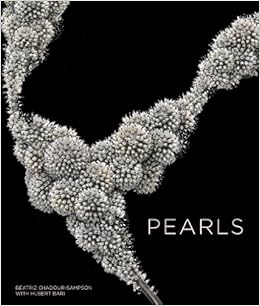 New from Abrams/V&A in time for holiday gift giving, is Pearls by jewelry historian Beatriz Chandour-Sampson and Hubert Bari, curator at the Qatar Museum authority. Meant to accompany the exhibition of the same name (on view through January 2014), this survey of pearl jewelry spans both time and the globe: from the Byzantine Empire to Jackie Kennedy to the present day.




 *
*


