September, 17, 2011 to February 4, 2012 at Lacis Museum of of Lace & Textiles
The Fall textile exhibit will focus on THE KNITTED LACE OF ESTONIA and its manifestations in relation to the alternate Estonian knitting disciplines, as well as the knitted lace in the cultures of Russia, Shetland, Germany and other geographic enclaves where lace knitting became the spirit of the soul.
Nancy Bush, sharing her love of Estonia, will be taking a curatorial role and will develop educational programs coordinated with the exhibit. September 17, 2011 to February 4, 2012, with a Friday evening opening party on September 16.
An invitation is extended to lace knitters, who have ventured into the cultural knitted laces of the exhibit and who would like to share their accomplishments, to submit photos of their work for consideration as to inclusion in this exhibit.
Lilli Ann established her ready-to-wear business in San Francisco in 1942. Despite her West Coast location, her exquisitely detailed coat and suit designs were versatile and sophisticated. Many of her suit styles were elegant enough to wear to the theater or cocktail parties. Lilli Ann ads of the period reflected this elegance through the dramatic fashion images created by the great Hollywood photographer George Hurrell. Writing in her book, Ready-Made Miracle, former Vogue editor Jessica Daves noted that in 1967, Lilli Ann was the largest American manufacturer of coats and suits in the price bracket of $69.50 to $250.”
—As Seen in Vogue: A Century of American Fashion in Advertising By Daniel Delis Hill (Texas Tech University Press, 2004)
I have a couple of problems with this description of Lilli Ann’s West Coast-based business and its seeming East Coast bias. When I first read this brief description, I thought it was suggesting that Lilli Ann was able to overcome the apparent narrow-minded and unsophisticated location of her operations (San Francisco), and that she somehow managed to create designs that were “versatile and sophisticated” anyway. It seemed to be downright insulting to the city that W Magazine heralded as the last bastion of sophisticated society (in 2007).
Upon further reflection, however, I realized that the author was perhaps meaning to convey the perception at the time (1942) that New York, Paris and London were stronger fashion cities – rather than the contemporary opinion at the time this book was published (2004).
So I put it to you, fellow fashion scholars – what is your take and how could the author have made his point more clear?
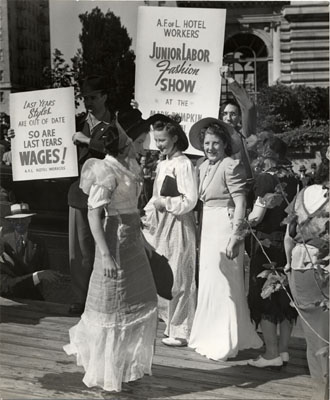
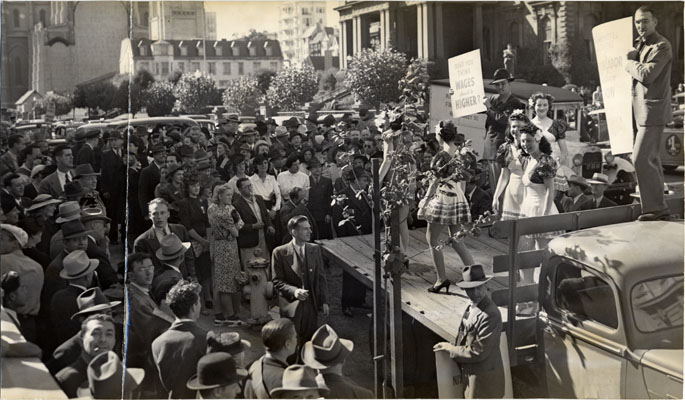
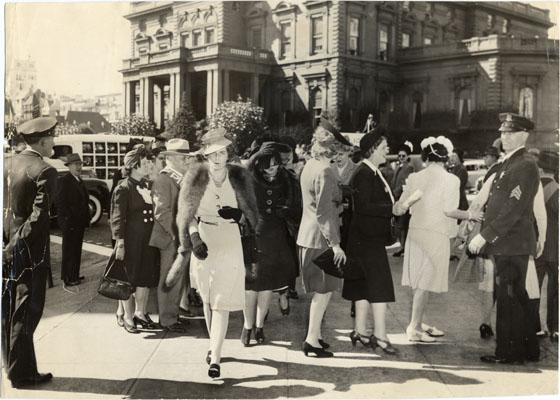
September 23, 1941: "Striking hotel workers put on a fashion show outside the Mark Hopkins Hotel yesterday afternoon to parody the Junior League's annual ditto within the picketed hostelry. Here is one of the several acts." (Via SFPL)September 22, 1941: "Hotel strike pickets fashion show at Mark Hopkins" (via SFPL)September 24, 1941: San Francisco -- Hotels. Strike -- Labor's Jr. Labor Fashion Show, Mark Hopkins". Via SFPL
Myrna Loy in a Dolly Tree design (the Thin Man, 1934)
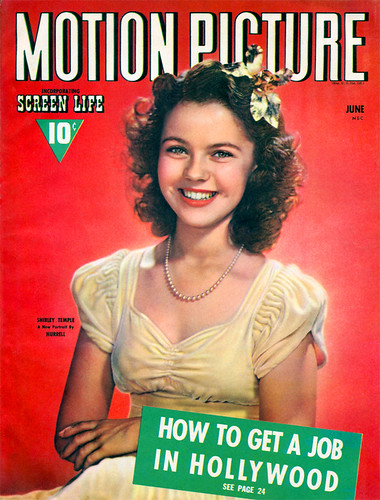
In Motion Picture magazine, June 1942, this funny little article was posted about costume designer Dolly Tree. She was probably best known for her work in the 1920s and 1930s – most notably The Thin Man series starring William Powell and Myrna Loy (For more on her early work in illustration, do travel over to this fascinating post at the Jazz Age Club). The brief piece below offered 1942 readers the unique opportunity to learn about the field of ‘costume design’ as a career directly. Including qualifications, income, and hazards of the position. I’d love to hear comments from those currently in the field to find out how much still rings true.
Motion Picture Magazine. (June 1942. 63(5): 27):
Top designer Dolly Tree can tell you hers is nice work, but the competition in this field is plenty tough”
Motion Picture Magazine, June 1942
Title
Designer
Working
Conditions
Assistants start at $50 a week. Top designers get $1,500 to $2,000. They keep regular office hours, but can never limit their work to those hours. They’re constantly getting rush calls for designs, both day and night. They have no guild.
Qualifications
First and foremost: tact. You have to please everybody. Also, you have to be a rapid sketch artist, with original and dramatic ideas. You must have an infinite knowledge of materials and dyes. And you must know dress construction, to be able to guide seamstresses.
Preparation
Start by designing, and making, your own clothes. You’ll discover how much you need to learn about costuming, materials and actual manufacture. Then go to some good school of design and, after you graduate, get a job—and experience—with some successful designer.
Getting Started
Know some influential person, and impress that person with your ideas. That’s how Natalie Visart became De Mille’s designer at 22. She learned he was going to film Cleopatra, did research on things Egyptian, whipped up hundreds of sketches—and got the job.
What Lies Ahead
With Hollywood fast becoming THE fashion capital, any successful Hollywood designer can stepout and open a profitable salon. (In fact, Adrian just has.) But, remember—the competition is keen and only the best designers succeed.
Beware!
The competition is the cut-throat kind. Just when you think you’re doing all right, some smooth-talking newcomer from Paris or New York will talk you right out of a job, unless you can succeed in out-talking him first.
Recently retired to Stratford, Ontario from a career in teaching in the school of Animation, Art and Design at the Sheridan Institute of Design and Technology, to say that Joseph Hisey has a background in art and design history is putting it mildly. He is a Past Chair of the Costume Society of Ontario, a contributing correspondent for the Canadian Antique Collectors Association and a freelance costumer for local regional theatre and vintage clothing collector.
In April 2012, he plans to lead a costume and textile study tour to U.K. for members of the CSO and CSA. He also has a blog of his own jhisey.blogspot.com. For Fashion Historia, I asked Hisey if he would give us his point of view on the “Little Black Dress”
It seems that our interest in “The Little Black Dress” is as acute as ever. In response to the 50th anniversary of the film “Breakfast At Tiffany’s,” the Fashion Institute of Design & Merchandising are focusing on our infatuation with this cultural icon (on view through August 13, 2011). Although this fashion mainstay has been the stuff of editorials since the publishing industry began, contrary to popular beliefs, the use of black in fashion did not begin with the 18th century practice of mourning; black as a distinctive garment color can be documented back to the 15th century.
L to R: Hubert de Givenchy re-creation of the LBD from the opening scene of Breakfast at Tiffany’s, Courtesy of Hubert de Givenchy Couture. Valentina, c. 1947-1950, FIDM Museum Collection. Karl Lagerfeld for Chanel, 1985; FIDM Museum Collection.
Since the Renaissance, it was the dye of choice for many who wanted to express their power and authority, hence its domination of the male business wardrobe. At the very least, this neutral hue obscured dirt before commercial cleaning services were available. The mordant used was expensive and unstable. Consequently, a “true” black became a status symbol. Artists such as the 16th century Italian, Bronzino, painted black garments worn by the scholarly and 17th century Dutch masters introduced us to the religious and political powers of a new, prosperous middle class. By the early 19th century, black in fashion re-emerged from a hundred-year absence in paintings by Goya, Ingres, Tissot, and Sargent, all experts in depicting contrasts of lace, satin, and velvets against the starkness of black.
Our assumption that black was reserved for mourning is perhaps due to the influence of Queen Victoria and the influence she had on Western society. Regarded as exotic, with connotations associated with the Spanish court, the appetite for black became more pervasive by the second quarter of the 19th century. Fashion journals, such as Le Folet in France, described its use by the late 1840s for evening wear, as recorded by Ingres in several of his portraits. Whether this was the choice of the artist or the client, we will probably never know. In her book, Ingres in Fashion, Aileen Ribeiro dedicates an entire chapter to the black dress and the artist’s penchant for it.
In Whistler, Women and Fashion, authors Susan Grace Galassi and Helen M. Burnham go to great lengths to discuss the impact of the black dress from a portrait of Lady Meux, painted in 1881. Ambiguous at best, Whistler’s representation of her black velvet dress is defined more by the contrast of the white fur garment draped around her figure, than by the details revealed through his brushwork. Her jewels highlight her status and affluence, and provide a source of contrast that is otherwise not apparent in the image.
By the 20th century, the simple black dress became a standard in the fashion world. Exposure through the press and popular films elevated it to “must have” status. Edith Head was credited with the title, “costume supervisor” on Breakfast At Tiffany’s, and the dress created by Givenchy for Audrey Hepburn as Holly Golightly caused a sensation and demand for this fashion staple. So ingrained in our psyche is this dress that at auction, in 2006, one of three working copies by Head brought an astounding $923,187.00!
Perhaps then, this is the success of “The Little Black Dress.” It remains mysterious, ineffable, and possesses a fashion allure that extends beyond gender or class. Dress it up or dress it down, “The Little Black Dress” is truly a chameleon in the closet.”
Bathing suit by Elsa Schiaparelli, c. 1928 (c) Condé Nast Archive / CORBIS
Lannoo Publishers recently released a new book on the history of knitwear titled, Unravel: Knitwear in Fashion by Emmanuelle Dirix. Dirix teaches costume history at the fashion department of the Antwerp Academy and the book was published to coincide with an exhibition at the Fashion Museum in Antwerp (on view through August 14). Articles on the exhibition have already come out from A Shaded View and Dazed Digital. For more on the exhibit, check out this interview with MoMu’s curator Karen Van Godtsenhoven.
The catalog, however, is a hidden gem that could easily slip under the radar of many a fashion historian. It is printed in both English and Dutch, and includes a dozen essays covering various aspects of knitwear history as well as interviews with current knitwear designers and artists (including Sandra Backlund) . I am particular fond of the essays “Drop One, Pick Up Two, Drop One” by Emmanuelle Dirix , “Knitting for Victory” by Jane Tynan and “Twinset and Match” by Alistair O’Neill.
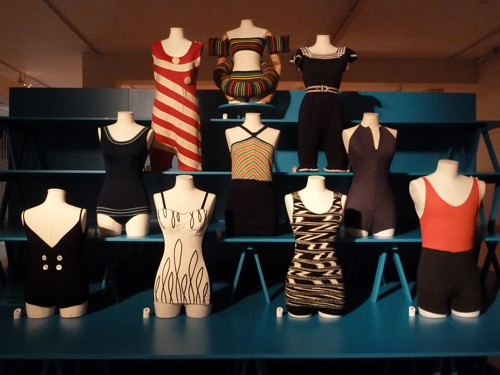
Swimsuits on exhibit from 1910-1955 (including McCardell, Gernreich) See below for close ups of these suits.
Dirix’s essay traces the history of knitwear from home knitting and ‘hobby culture’ in the arts and crafts movement through Chanel and Schiaparelli and Patou’s use of knitwear for sportswear and into the use of surrealism and trompe le’oeil sweaters of the 1930s. Her research continues through WWII, post-war era of refinement and into the youth rebellion designers of Mary Quant, Rudi Gernreich and Biba (among others). Her essay leaves off suggesting that the 1980s and 1990s held the “most shocking and subversive knitwear chapter in history” due to the ad campaigns by Italian knitwear label Benetton and its use of racial politics, the Aids epidemic and child labor to shock viewers.
Jane Tynan‘s essay “Kniting for Victory: Military Chic in Fashion Knitwear” tackles one of my favorite topics – knitting ‘comforts’ during wartime. Of particular interest is a booklet discussed in her essay titled “Women & War: How to Knit and Crochet Articles necessary to the Health and Comfort of our Soldiers and Sailors” (1914-1918). “In Twinset and Match: The Culture of the Twinset” by Alistair O’Neill, addresses the development of the iconic image of the woman in a twinset – including the work of Pringle of Scotland, hollywood starlets and the pre-war and post-war context of the sweatergirl. I should also mention the essays by Lydia Kamitsis (“Knitwear in French Fashion: From Gabrielle Chanel to Sonia Rykiel” and Joanne Turney: (“Dressing Like Grandad: Geek Chic and the Significance of the Cardigan in Contemporary Menswear.”)
This book is a gem, and features excellent writing by a number of authorities from an amazing array of viewpoints. If like me, you can’t make it to exhibition at the Fashion Museum in Antwerp before August 14, the catalog makes up for it in spades:
Jersey Swimsuit, Claire McCardell 1951 (Unravel, pg 27)
Rudi Gernreich Swimsuit, 1955 (Unravel, pg. 27)
Cotton Jersey Swimsuit, 1910s (Unravel, pg. 27)
Abstract swimsuit, late 1920s (Unravel, pg. 27)
Applique knitted swimsuit, ca. 1930s (Unravel, pg 27)
1910 Swimsuit (pg. 27, Unravel)
2008-09 Sweater by Dirk Van Saene (Unravel, pg 25)
“Smoking Pull” by Bernhard Willhelm, 2002-03 (Unravel, pg. 24)
Born and educated in San Francisco, Louise Dahl-Wolfe would later work as a staff photographer for Harper’s Bazaar from 1936 through 1958. I recently came upon an extremely detailed account of her life and San Francisco beginnings on from this website (originally published in April 2010):
“Louise Dahl-Wolfe (1895 – 1989) was born in San Francisco. Aspiring to a career as a painter, she attended the California School of Design (now the San Francisco Art Institute). . . . After completing her studies, Dahl-Wolfe designed electric signs from 1921 to 1923; in 1924 she began working for a leading decorator. In 1921 she was invited to the studio of photographer Anne Brigman; this meeting prompted her to buy her first camera, an Eastman bellows camera with a reflector made from a Ghirardelli chocolate box. She used her mother as the subject of her first pictures. Early photographic adventures included taking shots of herself and some friends nude on a beach, using the soft-focus style of her mentor. After Dahl-Wolfe befriended another San Francisco photographer, Consuela Kanaga, who taught her to use a 314-by-414-inch Thorn-ton-Pickard English reflex camera with a Verito soft-focus lens, the two traveled together to Europe in 1927. . . .
Dahl-Wolfe returned to San Francisco in 1928 and began taking commercial black-and-white photographs. . . . After moving with her husband to New York, Dahl-Wolfe was introduced to Frank Crowninshield, then editor of Vanity Fair, who decided to publish her work. . . . This success led to the publication of her first black-and-white fashion work in Harper’s Bazaar in 1936 and her first color work a year later.”
“During the war, when rich fabrics were scarce, embroidery was the principal form of ornamentation on dresses. For a few years after the war, couture houses were starved of fine fabrics. Most available textiles were plain, but couturiers compensated by embellishing them with rich embroidery. Chanel made tunics in black and other dark colors adorned with vividly coloured, ‘exotic’ – meaning in this case, Russian – embroidery. After the White Russians arrived in Paris, Russian women, including aristocrats, supported their families by embroidering Slavic motifs. …” (Stewart, Mary Lynn.“Marketing Fabrics & Femininity in Interwar France,” Textile History. 35(1), 90-111, 2004. 98).
While most people, by now, will have heard much about the exhibition Alexander McQueen: Savage Beauty currently on view (through August 7) at the Metropolitan Museum of Art – not much attention has been paid to the text of the exhibition catalog from Yale University Press. As readers may remember, I wrote the tribute to McQueen for Worn Through in February 2010.
The book itself is a beautiful object, printed in Italy, with a now-familiar hologram of McQueen’s face juxtaposed with a skull. The catalog is visually stunning, and the unique nature of the photographs by Solve Sundsbo have already been discussed at length by others. Individual pieces in the exhibition are not examined in depth here – but two essays do eliminate much of Mr. McQueen’s inspiration and points of reference.
McQueen's Girl Who Lived In a Tree Collection, Autumn/Winter 2008/09 (Via Fashion Muse)
Certainly, any student of fashion will have known of McQueens interest in the gothic and the grotesque, his experimentation with unusual materials -from human hair to seashells, as well as British and Military history and above all Romanticism.
I had heard of his interest in iconic women from history. As the book notes, McQueen once said “I don’t really get inspired [by specific women] . . . It’s more in the mids of the women in the past, like Catherine the Great, or Marie Antoinette. People who were doomed. Joan of Art or Colette. Iconic women.”(115)
What I had not previously been aware of was his use of literary reference. It became obvious from the image on the cover – his own face transformed into a skull immediately brings to mind the tortured character of Shakespeare’s Hamlet.
Alexander McQueen and the Smoking Skull (click for more info)
Curator Andrew Bolton addresses this point first in the preface to the book, highlighting the fact that McQueen had a tattoo from Shakespeare’s A Midsummer Night’s Dream on his arm, “Love Looks not with the eyes, but with the mind.” Bolton explains how this notion of love transforming something ugly into something beautiful was “critical to his creativity.” Continuing to explore McQueens work through the lens of literary criticism, Bolton compares McQueen’s use of Romantic exoticism with the work of Lord Byron and Samuel Taylor Coleridge.
Overall, the catalog has a very light touch in terms of reading – only Bolton’s esssay, an introduction by Susannah Frankel, and an Interview with Sarah Burton by Tim Blanks provide context to the stunning images. I would have loved a deeper analysis of the objects themselves – something I’ve felt has been lacking in several recent exhibition catalogs. However – this catalog is a beautiful object, and represents the most important of McQueens designs. It is a beautiful tribute to a one-of-a-kind designer.

September, 17, 2011 to February 4, 2012 at Lacis Museum of of Lace & Textiles




 Jane Tynan‘s essay “Kniting for Victory: Military Chic in Fashion Knitwear” tackles one of my favorite topics – knitting ‘comforts’ during wartime. Of particular interest is a booklet discussed in her essay titled “Women & War: How to Knit and Crochet Articles necessary to the Health and Comfort of our Soldiers and Sailors” (1914-1918). “In Twinset and Match: The Culture of the Twinset” by Alistair O’Neill, addresses the development of the iconic image of the woman in a twinset – including the work of Pringle of Scotland, hollywood starlets and the pre-war and post-war context of the sweatergirl. I should also mention the essays by Lydia Kamitsis (“Knitwear in French Fashion: From Gabrielle Chanel to Sonia Rykiel” and Joanne Turney: (“Dressing Like Grandad: Geek Chic and the Significance of the Cardigan in Contemporary Menswear.”)