Angora Blizzard with Cormo Wool! (Bungalow Angora Farms)
What is purported to be the largest Fiber and Quilt Show in Northern California will take place on September 28 at the Silver Dollar Fairgrounds in Chico, CA. Fiber Fusion 2013 will include an array of Northern California-based fiber related artists (plant and animal fibers), and vendors, as well as well as quilters. It looks like a great way for fiber-and-yarn lovers (like me) to get to know where to find locally produced products. I’m especially keep on the Alpaca and Angora vendors… According to the Mount Lassen Fiber Guild, it will include:
Vendors, demonstrations, and hands-on activities as well as FREE door prizes and fabulous raffle baskets for everything fiber – weaving, knitting, spinning, crochet, felting, dyeing, native basketry, fleeces, yarn, books, patterns, connections for instruction and workshops. Vendors and demonstrators include breeders, yarn shops, and fiber artists.
Nurse Bertha Mullen (Mrs. Chester Mullen), ca 1918. Photo by Chester Mullen. Bertha Mullen wearing a Red Cross uniform and is knitting a sock. (Shasta Historical Society)
Knitting played a large part in women’s experience of WWI (1914-1918). That fact is recorded in historical collections across the United States, including rural Northern California, as well as across the world. As historian Susan Strawn notes in her book Knitting America, “By the time America entered the war, knitters around the world were already sending hand-knit comforts to soldiers and refugees in Europe. In the far-flung British dominion of Australia, volunteers turned out astounding numbers of socks.” (91).
The Red Cross developed a nationwide campaign, with posters and pattern books designed to encourage women to aid in the war effort – even children knit for the red cross. The Red Cross even went so far as to supply yarn, patterns, needles, and instructions, ensuring distributed of needed articles of hand-knit to the military directly.
San Francisco Call, Volume 112, Number 66, 5 August 1912, pg 7
“On the left is a fall suit trimmed in braid a la militaire. The dictum of fashion for fall wear brings all sorts of braid to the fore. The model shows a pretty fall afternoon walking gown of the new material, scintilla, trimmed effectively with braid. The effect on the skirt gives it a military appearance. The “ocean wave” braid trimmed walking suit at the right is an effective braid trimmed fall walking suit of white French broadcloth, trimmed with “ocean wave” design braid. Braids will play a prominent part as trimmings this fall.”
("If you don't like full skirts..." Article in Harper's Bazaar, Photographs by George Hoyningen-Huene March 1938.) Alexey Brodovitch was an Art Director for Harper's Bazaar under Carmel Snow. He brought a modernist eye (and modern artists like Man Ray, Jean Cocteau, Raoul Dufy, and Marc Chagall ) to the magazine.
My new diggs, in Redding, CA are providing me with a great opportunity to explore and learn new elements of fashion and its history in a part of California that isn’t well documented. This past weekend, I went to French Gulch Old West Days (about half an hour North of where I live). A few of the activities sounded intriguing – “Mountain Men Exhibits” and “Craft Booths” as well as re-enactors in costume. Many of the historical and educational institutions here were closed for the day, because they planned to be in attendance there – including the Shasta Historical Society and Shasta County Library.
Bland, Carrie Tuggle sitting in her wedding dress (no date given, though she was born in 1877) Shasta Historical SocietyFull length photo of woman in wedding dress holding bridal bouquet. Reverse: "Virginia M. Wood Redding - married William A. Banigan - Anderson July 14, 1923" Shasta Historical Society.
Seamstress Brigid Nelson lets down the hem of a dress. The dye that produced the color -- chrome orange -- was formulated in the early 1800s.
This full-day event will include a private tour of the Costume Center, a visit to historical Oregon City, (“the end of the Oregon Trail”), a demonstration of Victorian Fish Scale Embroidery, and much more. The registration deadline is August 30, 2013. CSA members cost is $35.00,non-members $40.00, students receive discounts.
During my very busy trip to New York last week, I was able to squeeze in visits to two fashion exhibitions. FIT’s RetroSpective (briefly reviewed here), and the Met’s Punk: Chaos to Couture.
Much has already been said about the Met’s show – what it has, and what it doesn’t have, what it should be, and what it is not. But many of those reviewers were allowed access to the show in a special media-only preview, without the ‘common man/woman’ present. One of my favorite parts of seeing a fashion exhibition is hearing the reactions of lay-people to shocking designs. Punk: Chaos to Couture, is nothing if not a showcase of extreme styles.
The introductory text reminds viewers of the key elements of punk that have been adopted by couturiers, notably the “sexual and political energy” and the “do it yourself legacy.” Curator Andrew Bolton also acknowledges that “the ethos of punk is at odds with couture” and that “punk caused a breaking of barriers between production and consumption.” This introductory text was read by only a handful of people while I was there – a Wednesday early afternoon. The exhibition drew people from many different walks of life: young, old, men, women, New Yorkers and visitors. It wasn’t overly packed, but it wasn’t empty either.
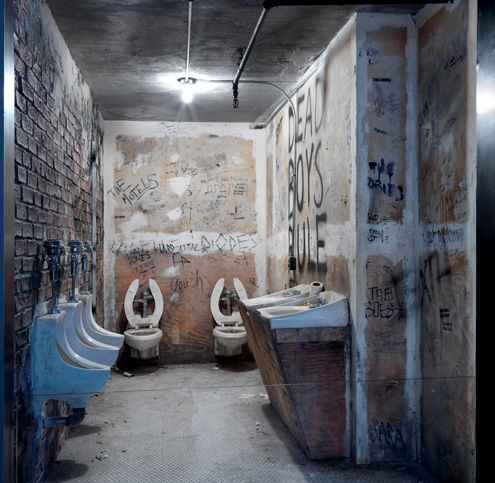
As I came upon the first major ‘wow’ of the show, the recreation of the infamous CBGBs bathroom (with toilet seats up and cigarettes on the floor), two twenty or thirty-something blonde girls snarked, “Really?” and wandered off towards the first gallery of couture. Sure, at first glance, one might not immediately see the connection to fashion. But later rooms reveal that the distressed, deconstructed, graffiti-ed bathroom is easily referenced in the organization of the show – and seems to provide the guiding outline for the rest of the show.
As I walked past the requisite Westwood t-shirts (the 1%ers), saw the quote from journalist Caroline Coon that called Malcolm McLaren the Diaghilev of punk, and the recreation of the Seditionaires shop, I came to the Rodarte knitwear in the “Clothes for Heroes section. I am a sucker for couture knit and crochet, and this 2008 red and black dress over tights (in synthetic, itchy-looking yarn), caught my eye. An adult woman supervising some pre-teens said to her charges, “I could see you in something like that” – perhaps as a way to engage them. But I wondered about the seemingly innocuous comment.
I was engrossed in the DIY hardware section – Zandra Rhodes, Versace, and Givenchy, with the always-clever Moschino (but secretly I wondered where the Donna Karan hardware dresses were). Focused on my own thoughts in this long hall, I didn’t overhear much (especially given the loud disruptive beeping that was surprisingly audible over the equally loud music and video-loops).
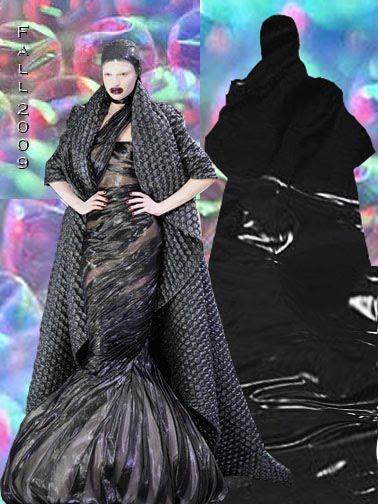
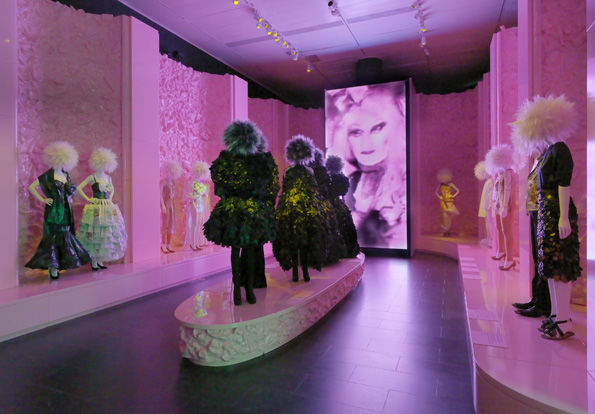
I immediately liked the D.I.Y. Bricolage featured in the next room, with the softer textured pink walls, and equally softened clothes. As I was noticing the differences from the last room, I heard an older man say “I like this room, I like this lighting.” I noticed others nodding and relaxing here – though the clothes had volume, there was less volume in the music, videos, and lighting – as the gentleman pointed out. In particular, I liked the fluffy Pugh trash bag dresses (2013-2014), and the Margiela jackets. As I noticed the Moschino plastic shopping bag dress, I wondered if that might be a historic piece now that plastic shopping bags were being banned in California (and perhaps elsewhere soon). I crushed hard on the McQueen Bubble-wrap dress (2009-2010) as I left the room.
Designs by Ann Demeulemeester
The graffiti room held more famous McQueen’s, and beautiful painted Dolce and Gabbana ball-gowns (2008) but I was intrigued by the Belgian designer Ann Demeulemeester. As I was checking those out, an older woman in a wheelchair said “these are fantastic” and had her assistant push her closer so that she could see more detail in the dark room with dark walls.
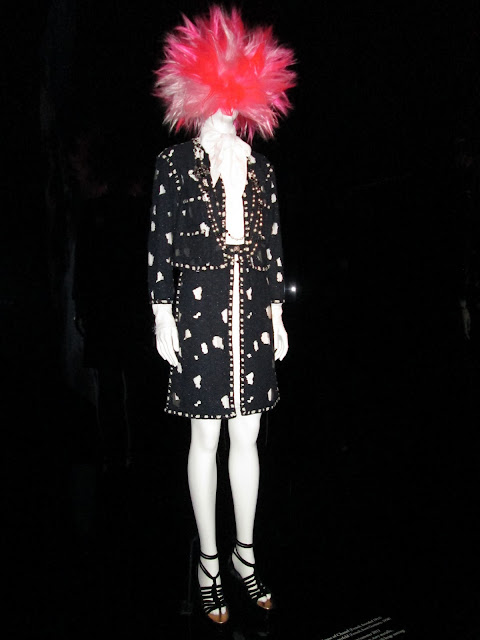
Karl Lagerfeld for House of Chanel, 2011
The next room (D.I.Y. Destroy) somehow reminded of the Vivienne Westwood show at the V & A, and of the Gaultier show at the de Young. As I walked down the lines of static mannequins, I came upon what turned out to be the signature piece of the show.
Some young girls guffawed out loud at the sight of the distressed Chanel suit from 2011. I had mixed feelings that I couldn’t nail down. I could see the humor and irony of finely-made couture being torn to shreds, but there was also something very wrong about such fine craftsmanship being distressed to meet a passing trend. It seemed desperate and didn’t match the well-established Chanel tradition.
Ultimately, that might be my feelings about the whole show – clever, but trying too hard. I don’t know – I’m still sorting it out. Interestingly, the people whose comments I heard were all positive – I like this, that’s beautiful, I could see wearing this. What I don’t know is what those people thought of the show overall. Did you see the show? What did you think?
Yoshiki Hishinuma, evening dress, white and fuchsia polyester, cage crinoline with nylon, Fall 1996, Japan, gift of Yoshiki Hishinuma.
My trip to NYC this week is jam-packed with book related things, but I did manage to take in the RetroSpective exhibition currently on view at the Museum at FIT (May 22-November 16, 2013).
Curated by Jennifer Farley, with textiles organized by Lynn Weidner and accessories by Colleen Hill, RetroSpecitve is my favorite kind of fashion exhibition: It’s focus is on historical representations of fashion throughout history. Though small, it is well-informed and carefully selected to show how the history of fashion is a constant source of inspiration for designers, and has been for hundreds of years. This is not something new, as some would suggest. This small but significant exhibit covers 250 years of revivalism, “from the 18th century to grunge.”
Elsa Schiaparelli, evening dress, black and bronze shot silk taffeta, circa 1939, France, courtesy of Mrs. Michael Blankfort.
The culture of revival is presented here with beautiful examples from FIT’s collection of couture: ensembles, under-structures, dress-forms, textiles, and accessories. It is supported by two video’s from British Pathe, highlighting revivals of the 1920s style in the 1950s, and also of monastic dress in the 1940s.
After an introductory image depicting the changing silhouette of fashions by Ruben Toledo, the exhibition is grouped by style or trend, and includes sections on hoops, bustles, panniers, and 1830s style puffed sleeves, pin-stripes, and more. One of my favorite aspects of this show, was the connections draw between designers of different time periods. Cat Chow juxtaposed with Claire McCardell, Paco Rabanne paired with Yohji Yamamoto, a beautiful 1951 Balmain evening gown is paired with an 18th century robe a la Anglaise, and so on. Some of my favorites surprised me (as I don’t typically go for anything post 1980): a beautiful 1980 YSL evening gown of changeable purple taffeta with puffed sleeves (a la 1830s), a 1996 Yoshiki Hishinuma hooped gown (mixing eastern and western cultures, picture above), and not surprisingly, an Elsa Schiaparelli bustle gown from the 1930s (seen at right). Shoes, handbags, undergarments, upholstery, and other textile designs round out the exhibit and make for a rich experience.
If you happen to be in New York anytime soon, it’s well worth a visit.
P.S.: Did you know that there was a Fashion Archive at the British Pathe Website?
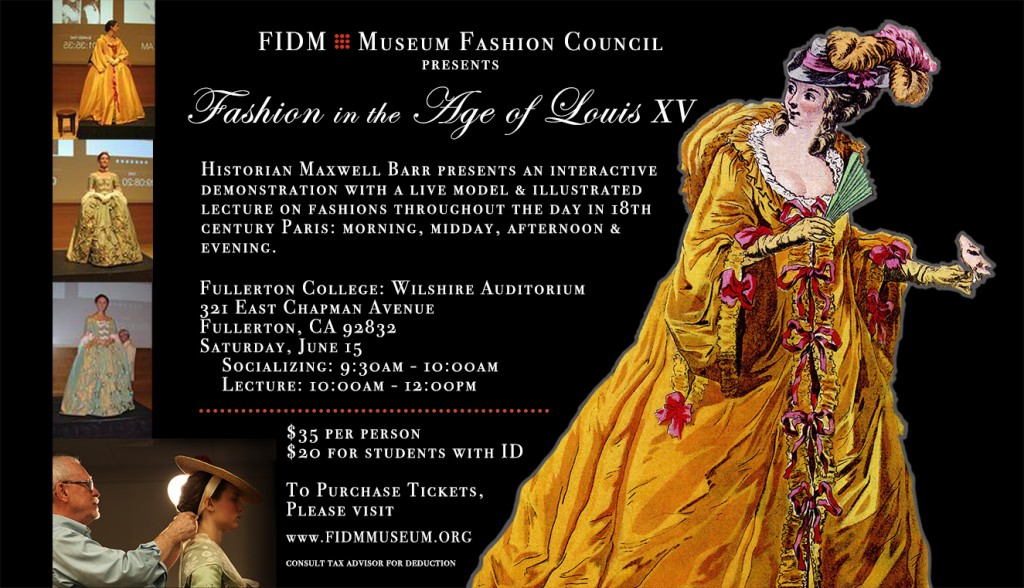
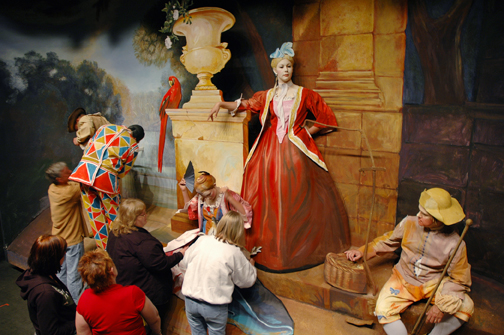
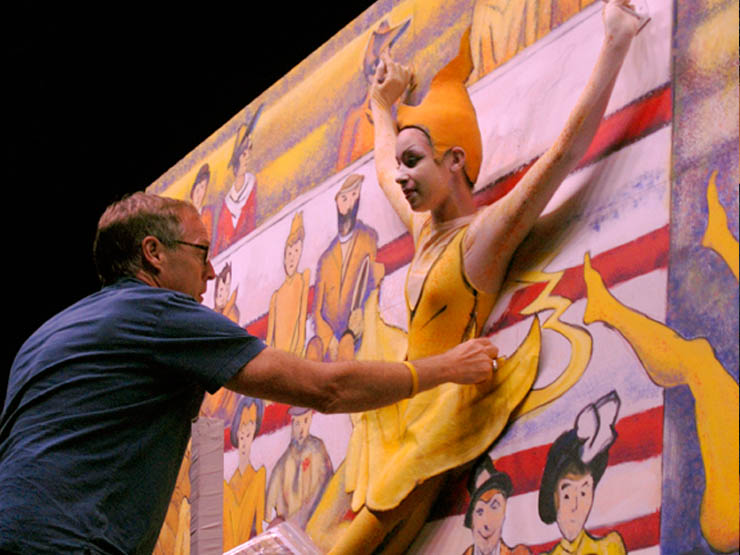
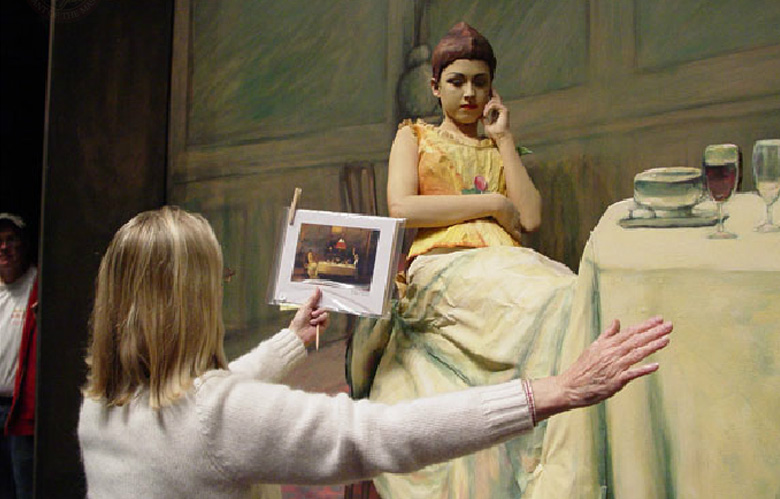
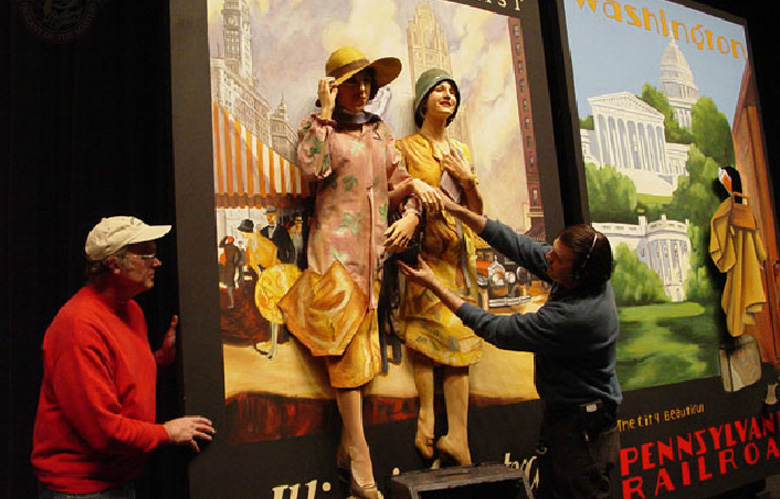
The Costume Society of America, Western region is adding a bonus event for 2013 (and this is your one place to find out about it!) The Pageant of the Masters in Laguna Beach is “ninety minutes of ‘living pictures’ – incredibly faithful art re-creations of classical and contemporary works with real people posing to look exactly like their counterparts in the original pieces.”
Join us behind the scenes at Pageant of the Masters on August 18
Celebrating it’s 80th anniversary, Diane Challis Davy, director of the Pageant of the Masters, notes “We’ll have Vermeer, Gainsborough, Michelangelo, Gerome, Seurat, Rodin, Norman Rockwell. Designers for both stage and screen look to paintings and sculpture for historical information and inspiration. I thought it would be a new twist for the Pageant to take a look back at the work of the Masters that inspired great works of cinema.” And, of course, the show will once again conclude with its traditional finale, Leonardo da Vinci’s “The Last Supper.”
To be held on August 18, those who register for the CSA program will be treated to:
a talk by Pageant Costume and Headpiece Director and CSA Member, Mary LaVenture
a performance of The Big Picture (a salute to classic art that inspired legendary filmmakers)
a post-performance backstage tour
Download the REGISTRATION FLYER here, to sign-up. Discount tickets are available to those who register by June 8 (final deadline is July 12).
Below are some photos from past years of the show to entice you: