San Francisco Silent Film Festival: today – July 15, 2012

Louise Brooks in Pandora's Box (1929)
The Spanish Dancer (1923) costume sketch by Howard Greer (AMPAS)

Starting this evening, the San Francisco Silent Film Festival begins with a showing of Wings (1927) – a film about a lady aviator (or ‘flyer’) starring ‘it girl” Clara Bow. It is one of my favorite silent films, the story AND the costumes are great. Stella Dallas (1925), Mantrap (1926), Spanish Dancer (1923) and Pandora’s Box (1929) are some other favorites with great clothes and great characters. These — plus, the Mark of Zorro (1920) and The Cameraman (1928) with Buster Keaton–make this a killer line-up. The full list of films is below, do yourself a favor and go !

(More details are available here)

17th Annual
San Francisco Silent Film Festival
July 12-15 at the Castro Theatre, San Francisco

View the Full Program Now! Tickets & PassesNow on Sale!

Thursday,
July 12
7:00 pm Opening Night Film
WINGS (1927)
9:30 pm Opening Night Party at
McRoskey Mattress Company
Friday,
July 13
10:30 am Amazing Tales from
the Archives
1:00 pm LITTLE TOYS (1933)
4:00 pm THE LOVES OF PHARAOH (1922)
7:00 pm MANTRAP (1926)
9:15 pm THE WONDERFUL LIE OF NINA PETROVNA (1929)
Saturday,
July 14
10:00 am FELIX THE CAT SILENT CARTOONS (1925-1929)
12:00 noon THE SPANISH DANCER (1923)
2:30 pm THE CANADIAN (1926)
5:00 pm SOUTH (1919)
7:00 pm Centerpiece Film
PANDORA’S BOX (1929)
10:00 pm THE OVERCOAT (1926)
Sunday,
July 15
10:00 am THE MARK OF ZORRO (1920)
12:00 noon THE DOCKS OF NEW YORK (1928)
2:00 pm EROTIKON (1920)
4:30 pm STELLA DALLAS (1925)
7:30 pm THE CAMERAMAN (1928)
Continue Reading

Undergardments: 1920-1929


c1925: Slips and bloomers, fashionable in the 1920s, and a corset, worn during the Victorian era.

The boyish silhouette of the 1920s required special undergarments. Generally, a bandeau was used to flatten the bust with a single piece of fabric. Corsets and girdles were still heavily boned. Corset substitutes were made of softer elastic and referred to as “step-ins.” Specialty corsets were created for wear during sports, dancing, and even pregnancy. Towards the end of the decade, as a natural shape became more popular, brassieres with cups and mild shaping were developed.

Loose-fitting bloomers or knickers were made of silk or rayon and were gathered just above the knee.  They came in a number of forms including one-piece camiknickers, teddy’s, step-ins, or just plain drawers (which resembled slightly flared, bifurcated skirts).  During the early years of the 1920s, calf-length petticoats were worn, but as hemlines rose, these garments were rendered obsolete.

Sources


Laubner, Ellie. Fashions of the Roaring Twenties. Atglen, PA: Schiffer Publishing Co., 1996. 15-17

Mendes, Valerie and Amy De La Haye. 20th Century Fashion. London: Thames & Hudson, 1999. 65

Riordan, Teresa. Inventing Beauty, New York: Broadway Books, 2004. 87

Continue Reading

July 4, 1933: Amelia Earhart in Los Angeles

July 4, 1933: "Ruth Nichols and Amelia Earhart in Try for New Records.Los Angeles, California: Amelia Earhart (left) and Ruth Nichols (right), two of the nations' foremost women fliers, seen as they attended the last day's events of the National Air Races at Los Angeles, July 4th. They will attempt to establish a new transcontinental speed record for women in a flight from west to east, taking off from Los Angeles, July 6th."
Continue Reading

I’m in Print: Sunday Times of London (History of High Heels)

(Click to read the first page of the article)

A few weeks ago, Matt Rudd of the Sunday Times of London asked me for a statement on the history of high heels. Though he didn’t quote me exactly, he did quote me first in his column, “God of Small Things” yesterday. For your reference, here’s the complete version of what I told him:

High heeled shoes have been around nearly as long as human civilization – with the first depictions of elevated shoes (a pre-cursor to the high heel) appearing as ceremonial dress in ancient Egyptian murals dating as far back as 3500 BC, and worn by both men and women of the upper classes. Generally, the popularization of the high heel is attributed to Catherine de Medici who – at only five feet tall – was eager to increase her appeal both to her husband and to the nation of France. Since that time, heels have often been associated with French high fashion – including France’s King Louis XIV who introduced the ‘red soled heel’ that Christian Louboutin has since co-opted as a signature element.”

Download the full article here (pdf)

Continue Reading

Teaser Tuesday: Ladies Hoola Hooping in Lingerie (1958)

Hula Hoop is 54 today " ** FILE ** Two models gracefully swing their new Hula-Hoops as they display the latest bodice creations in lingerie at a fashion show in Frankfurt, Germany, Oct. 21, 1958. It's hard to believe in age of action-packed video games and other whiz-bang gadgets, the Hula Hoop once was the hippest toy around. The hoopla started 50 years ago Thursday, June 19, 2008 when entrepreneurs Richard Knerr and Arthur "Spud" Melin sought a trademark for a plastic cylinder that had inspired by a similar toy that had enjoyed modest success in Australia's school yards. (AP Photo/Riethausen)"
Continue Reading

My Fair Lady (1964): Make-up and Hair

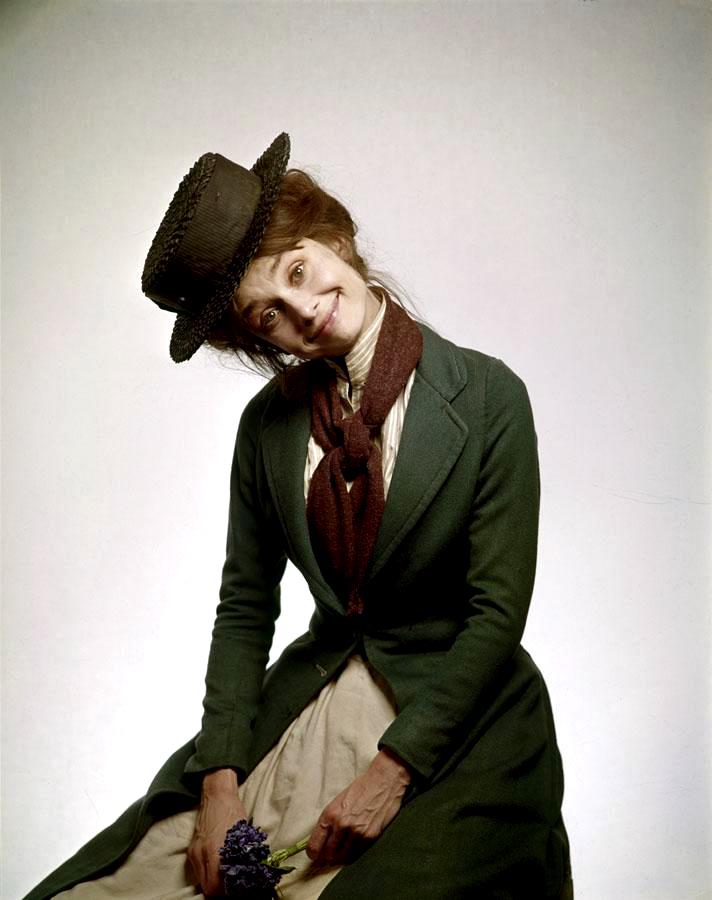
Audrey Hepburn as Eliza Doolittle (My Fair Lady, 1964) Costumes by Cecil Beaton

“The makeup people, led by the Westmore brothers, did a fine job de-glamorizing Audrey, with [Cecil] Beaton’s cooperation. Her hair had to be filled with an unpleasant substance known as Fuller’s earth—which was quite toxic—and she had to wear a special kind of kohl makeup and a drab foundation to make her look sallow and underfed. For the tests she also had to undergo the blackening of her fingernails and the backs of her hands, and her clothes were deliberately made large so that her frail figure would disappear in them…

Every scene had to be tested in costume again and again because the essence of the movie lay in the gradual transition of Audrey from goose to swan. Beaton stood over her like a Svengali, ordering, in his own words, ‘Strands of her hair to be placed in this direction or that, suggesting more or less eyelash, selecting a brooch or a trinket.’ Every hairstyle had to be argued over and decided upon. Finally, Audrey and Beaton jointly settled on Edwardian bangs like those worn by the famous British music hall star Gertie Millar. Audrey risked having her face look even more square than usual because she wanted total period authenticity, and deeply respected Beaton’s taste and experience…

She had particular fun choosing the right hat for the ascot scene. She and Beaton finally chose one that was replete with cloth poppies and antic bows and would tremble when she jumped up to see the horses.”

–Charles Higham, Audrey: The Life of Audrey Hepburn, New York: Macmillan Publishing Company, 1984.


Continue Reading

Book Giveaway: Balenciaga and Spain by Hamish Bowles

Enter to win a copy!

I told you to watch this space for more give-aways! Today’s contest is to win a copy of Balenciaga and Spain by Hamish Bowles. This is an exhibition catalog from the Fine Arts Museums of San Francisco’s exhibition last year. Worn Through writer, Lauren Michel reviewed the show back in May 2011 and included a number of wonderful photographs, plus an interview with Hamish Bowles.

To enter to win a copy of the lavishly illustrated book, I want to know which of his many inspirations speaks to you most. In the comments section below, tell me which Balenciaga design you love – and what inspired it (and be sure to include links to photos!)

Deadline for entry: June 20, 2012

Good Luck!


Continue Reading

Natacha Rambova: Character Development and Costume

Son of the Sheik, 1926 (Click for Source)

Yesterday, the Smithsonian Magazine’s blog, Past Imperfect posted a rather long article on Rudolph Valentino and his impact on sex and seduction in the early silent film era – and of course there is a brief mention of Natacha Rambova (the main subject of my own research). The article spends much of its time focused on the very public battle over the speculation of his sexuality, and his impact on masculinity in film. However, the article fails to discuss the role that Rambova played in the creation of his on-screen persona – especially in the role that many suggest established him as an entirely masculine star, The Son of The Sheik.

Although Rambova and Valentino had already separated by this point, their time together had inevitable effect on the development of his on-screen personas. This, coupled with the fact that Rambova’s costumes from Hooded Falcon were used for The Son of The Sheik, suggests that she had a significant (perhaps unintentional) hand in his career trajectory.

“A stunning Moorish costume adorned the stalwart form of our hero, including a pair of cerise satin Zouave trousers plentifully braided and embroidered in gold. These had been secured in Algiers originally for ‘The Hooded Falcon,’ which Rudy never made and which was the high spot in the Valentino contention with the Ritz-Carlton Company, which sent him into the United Artists fold. Natacha Rambova was the one who designed the costumes, to the tune of $100,000. They now lie on the wardrobe shelves. This is the first use that has been made of any of them.”[1]

Regardless of whether this bit of publicity is true (often the film studios publicity machine’s put out information that was in fact dead-wrong) – many actors regularly explain that putting on their costumes has helped them to ‘realize’ or ‘achieve’ the personality of an on-screen character (see the work of Dr. Deborah Nadoolman Landis). This is no less true in the early days of film. Rambova’s impact on Valentino is regularly discussed – often with negative connotations: she was too avant-garde for some, and European tastes often read as ‘effeminate’ to middle America. It’s unfortunate that this positive association is overlooked.
Despite this foible – I think the article is a good introduction to those unfamiliar with the scandals and speculations associated with Rudolph Valentino and his now infamous cult of celebrity.

[1] Chicago Tribune, April 11, 1926. William McGuire Papers, Library of Congress, Box 83, Folder 1.

Continue Reading