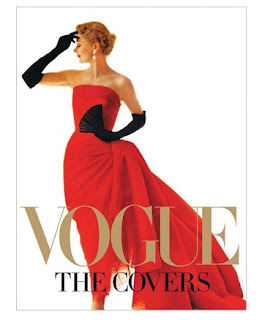
Tuesday Teaser: Chorus Girls from a pre-code 1933 film.

THE HISTORY OF FASHION. . . MOSTLY.

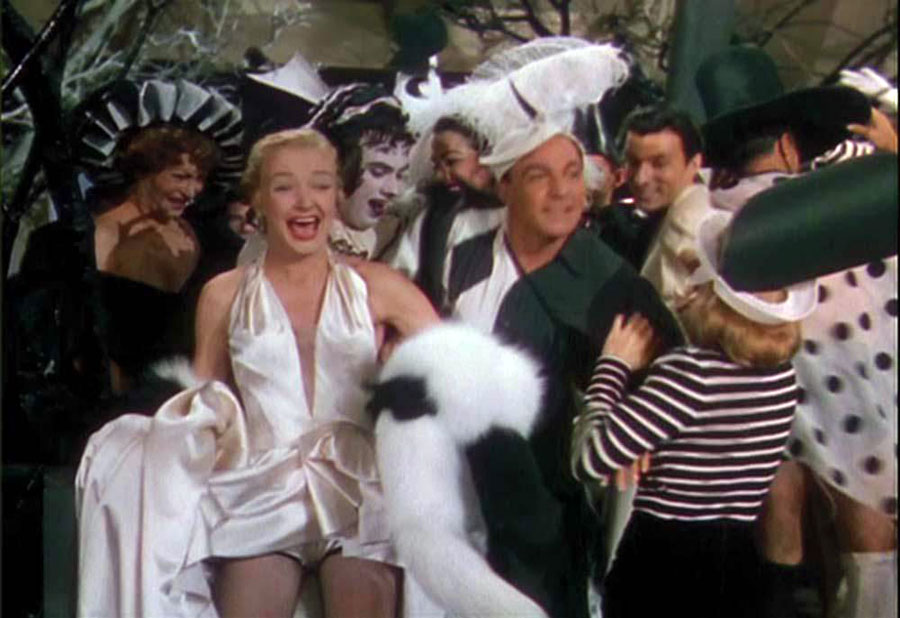
In the beaux arts ball sequence of ‘An American in Paris’ [Walter Plunkett] really went imaginative. His materials included newspapers, oilcloth, canvas and felt. The hats were even more extreme. They featured cardboard boxes, sofa pillows and bird cages. One, of papier-mache, took the form of a woman’s leg.”–Quigg, Jack. “Have Nothing to Wear? Use Ingenuity,” The Washington Post; Jul 8, 1951, pg. S10.
You can see a clip of the scene referenced (the New Year’s Eve party) here.
A nice side-bar for this is that Nina Foch’s gown, according to the organizers of the recent Debbie Reynolds auction, was designed by Orry-Kelly for Walter Plukett in this scene. (Click the image below for more on that!)
I love how you can see so clearly in this short video of Adrian’s fashion designs, who his influences were. I think I caught some Schiaparelli variants, as well as some Claire McCardell. What other influences can you spot?
MGM fashion shows featuring Adrian gowns – “Sweethearts” and “Lovely to Look At.”
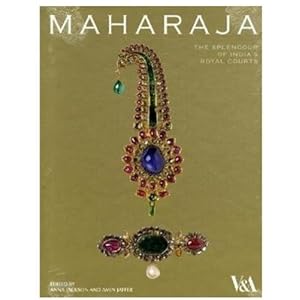
This past weekend, I had the good fortune to be able to visit the San Francisco Asian Art Museum’s current, excellent, exhibition: Maharaja: The Splendor of India’s Royal Courts (on view through April 2012). This show is a somewhat smaller version of the 2009 version put on by the Victoria & Albert Museum in London.

Each piece in the show is impressive: sumptuous materials, exquisite details and extravagant design make obvious that the Maharaja’s were a VERY wealthy bunch. By examining their lives as a whole, the objects included provide a cohesive picture of their worlds and lives.
Objects included in the exhibition include paintings, thrones, regal accessories, men’s and women’s costumes, and LOTS of jewelry, furniture, musical instruments, games and much more. Some of the most physically impressive objects include a full size all-silver carriage, an elephant throne and some of the biggest diamonds and sapphires I’ve ever seen (many many by Cartier). Everywhere you looked were examples of fine craftsmanship, and nearly everything was gilded, embroidered or otherwise embellished to emphasize wealth and power.

One word of advice though – take a magnifying glass to truly appreciate some of the amazingly small and detailed paintings (similar to detail to the recent illuminated manuscripts exhibition at the Getty). The exhibition itself was well-thought out, and the (free) audio-tour was great. The show included several informative videos that provided good context for the show, and the audio-tour offered additional videos if you wanted more information.
Can’t make it to see the show? You’re in luck, there is an exhibition catalog of the V & A’s version of the show (which I sensibly purchased). There’s also an audio-tour that you can easily download through iTunes.

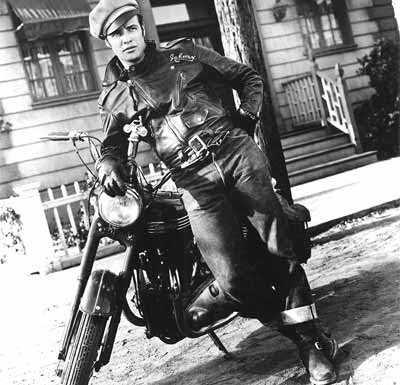
I had fun making it, but never expected it to have the impact it did. I was as surprised as anyone when T-shirts, jeans and leather jackets suddenly became symbols of rebellion… Sales of leather jackets soared, reminding me of It Happened One Night, when Clark Gable took his shirt off and revealed that he wasn’t wearing an undershirt, which created a disaster for the garment industry.”
–Marlon Brando (with Robert Lindsey) in Brando: Songs My Mother Taught Me, New York: Random House, 1994, p. 175-6.

The December 15 application deadline for the Jack Handford Summer Internship is quickly approaching (extended to February 1, 2012). This internship provides a $2,000 stipend for a student member of the Costume Society of America to complete an internship with an accredited museum or costume collection. The internship is open to undergraduate students about to commence their senior year and to graduate students.
Not a member? There are currently two special offers open to non-members who are interested in joining:
The Western region is currently offering a discount to students joining or renewing. Currently registered students can join CSA or RENEW their memberships by sending in a CSA Membership application form with proof of their current registration at an educational institution (copy of a Registration card I.D.) along with a check made out to CSA for $25 (Instead of the regular $45) For more details, click here.
In addition, and for a limited time, join now and receive a pre-selected, complimentary issue of CSA National Symposia Abstracts (valued at $16.00)! Offer ends 12/31/2011. Click here for details!

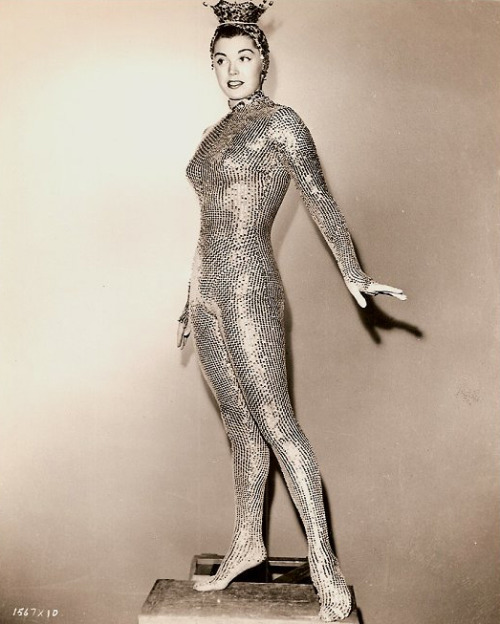
“Designers Helen Rose and Walter Plunkett fitted me in an extraordinary swim costume—much like a diver’s body suit, only covered, including the soles of the feet, with gold sequins, fifty thousand of them—like chain mail. Atop a gold turban, which was wrapped around my head, they perched a gold crown. And it was the crown that held the dagger. . .”
“I took my position on the disk and the hydraulic lift started rising. Up…up…up I went, the pool, the crew dropping away. The lift finally jolted to a stop. I was perched on the height of a six-story rooftop. Acrophobia! Dizziness! My equilibrium was gone because my inner ear had never fully recovered from the seven broken eardrums I’d suffered through years of living underwater. I suddenly couldn’t tell if I was leaning or standing straight, and my mind—as well as my body—must’ve frozen up there. ‘We’re waiting, Esther!’ Busby barked. ‘Jump!’
I forced a smile for the camera and swan-dived from that tiny platform. Hurtling down, I muttered a silent, ‘Oh, shit.’ I suddenly realized what was going to happen next. The gold crown on my head. Instead of being made with something pliable like cardboard, it was lightweight aluminum, a lot stronger and less flexible than my neck.
I hit the water with tremendous force. The impact snapped my head back. I heard something pop in my neck. I knew instantly that I was in big trouble.
Totally unaware, Mervyn called out, “Great. . . Time for lunch.’ (219) Magic words. You only had to say it once. Everyone—Mervyn , Busby, the crew—trooped across the soundstage and within seconds vanished. Only Flossie Hackett, my wardrobe lady, remained, and only because it was her job to get my costume off for later shooting.
I could kick my legs, so I desperately treaded water; but my arms and shoulders were virtually paralyzed. The back of my neck was in screaming pain. In my mind’s eye I saw the headlines: ‘Esther Williams Drowns in MGM Studio Pool.’ I cried out, ‘Flossie, you’ve got to get some help for me.’
She thought I was joking. ‘C’mon, Esther, you’re such a kidder. I want to go to lunch. I’m hungry.’
Flossie, I’m really in trouble,’ I gasped. “Find two guys who can lift me out of the pool.’
Finally she believed I was serious. She ran to the big soundstange door and shouted, ‘I think Esther Williams is dead. She can’t get out of the pool.’
Some men came running in, quickly stripped off their shoes and shirts, and jumped in to pull me out. I was crying by that time,
because the pain was so intense. They carried me to my dressing room. While we were waiting for the ambulance, Flossie carefully removed my gold fishnet bodysuit, rolling it down my body like pantyhose, and those fifty thousand tiny metal sequins were like little knives, nicking and cutting me. (Flossie was supposed to keep my costumes in good repair, so I’m sure the absurdity of peeling off the suit, instead of swiftly cutting it off, never crossed her mind.)
At the hospital, I blacked out from the pain. The X-rays showed that I had broken three vertebrae in the back of my neck. I’d come as close to snapping my spinal cord and becoming a paraplegic as you could without actually succeeding.”
-Esther Williams (with Digby Diehl). The Million Dollar Mermaid: An Autobiography, New York: Simon & Schuster, 1999 (219-220).