The Paley Center for Media will host the next iteration of this substantial auction, and if you’re in the neighborhood you can go see some of the remaining collection before it is forever divided up amount collectors and enthusiasts (ends today!)

THE HISTORY OF FASHION. . . MOSTLY.
The Paley Center for Media will host the next iteration of this substantial auction, and if you’re in the neighborhood you can go see some of the remaining collection before it is forever divided up amount collectors and enthusiasts (ends today!)
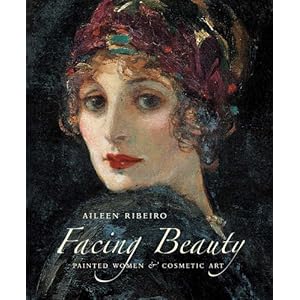
Facing Beauty: Painted Women and Cosmetic Art
By Aileen Ribeiro
Yale University Press (November 29, 2011)
Though I haven’t yet seen it in person – it can only be good. It’s Aileen Ribeiro, right?
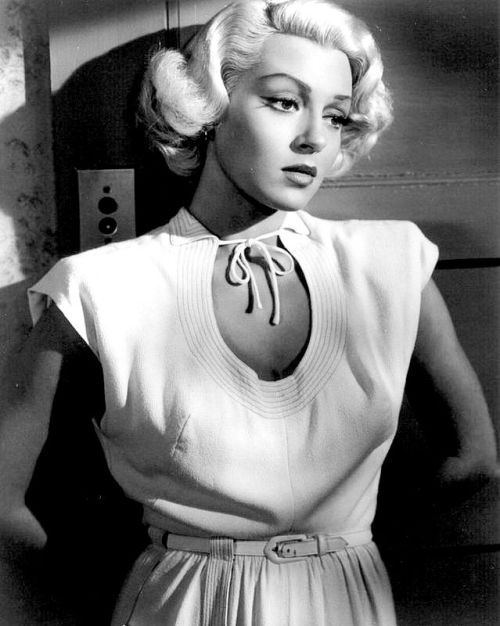
“[Lana Turner] already had platinum hair. She’d been that color. So we left it for the film [The Postman Always Rings Twice, 1946]. The white clothing was something that Carey and I thought of. At that time there was a great problem of getting a story with that much sex past the censors. We figured that dressing Lana in white somehow made everything she did seem less sensuous. It was also attractive as hell. And it somehow took a little of the stigma off of everything that she did.
–Director Tay Garnett, quoted in Joe Morella and Edward Z. Epstein, Lana: The Public and Private Lives of Miss Turner, New York: The Citadel Press, 1971. p. 80
 Moda a Firenze 1540-1580: Cosimo I de Medici’s Style (English and Italian Edition)
By Roberta Orsi-Landini (Author)
Publisher: Edizioni Polistampa; Bilingual edition (October, 2011)
Somehow, this one slipped through the cracks for October. Some of you will remember that I wrote a little piece on the Medici’s when the Isabelle de Borchgrave exhibit was at the Legion of Honor. Here I took a brief look at Agnolo Bronzino of Eleanor of Toledo (1522–1562), the wife of Cosimo I de’ Medici. The Medici family’s had a Papal monopoly on Alum and Eleanor of Toledo employed her own weavers.
Now there is a new book out on Cosimo I de Medici’s wardrobe, written by Roberta Orsi Landini, a textile and costume scholar, who has worked for over 20 years on the textile and costume collections at the Pitti Palace in Florence. Her work here is likely to be of great importance to the study of fashion and textile history.
Other works by Roberta Orsi Landini:


 Fabricating Consumers: The Sewing Machine in Modern Japan
by Andrew Gordon
University of California Press (Nov. 1, 2011)
Written by Andrew Gordon, an expert in Japanese social history and a prestigious professor at Harvard University, this new book – Fabricating Consumers: The Sewing Machine in Modern Japan– shows how the ‘humble’ sewing machine dramatically changed life and society in Japan. It discusses the Singer sewing machine specifically, and shows how the machine in general “not only transformed manners of dress but also helped change patterns of daily life, class structure, and the role of women.”
Stays and Body Image in London: The Staymaking Trade, 1680-1810
by Lynne Sorge-English
Pickering & Chatto Ltd (June 30, 2011)
At the recommendation of Mark Hutter, I recently acquired this new(ish) book, Stays and Body Image in London: The Staymaking Trade, 1680-1810 by Lynne Sorge-English. For those academics studying this time period, it is a good resource with unique analysis. The author uses surviving examples of stays in various collections, to explore how this garment and its manufacture changed over time. Interestingly, it examines how women’s health was affected due to prolonged use. The book combines both material analysis with literary analysis (an eighteenth-century staymakers diary) along with cultural and social history. Important to note, however – this is not a photograph-heavy book, but is a true research resource.

Those of you who follow me on Twitter will know that I went to the CSA hosted program on the FIDM Museum’s current exhibition, FABULOUS: Ten Years of FIDM Museum Acquisitions 2000-2010. During the lecture, our host and curator, Kevin Jones gave us some good behind-the-scenes dirt on the objects included in the exhibition and accompanying exhibition catalog (a veritable textbook on the last 200 years of fashion history, and well-worth the money).

Most interesting to me from his lecture, was the Alexander McQueen dress. The amazing craftsmanship of this dress was discussed. When the museum commissioned the dress it was to take 7 months (!) for the couture house to create it. In order to have the dress photographed for the exhibition catalog, the runway version was loaned to the museum for one day only. Thus, the dress included in the catalog is the same dress that appeared both on the 2008-09 runway and on Sarah Jessica Parker’s back in the Vogue shoot at the Met.
If you haven’t seen the exhibition yet, do so before it closes on December 17.
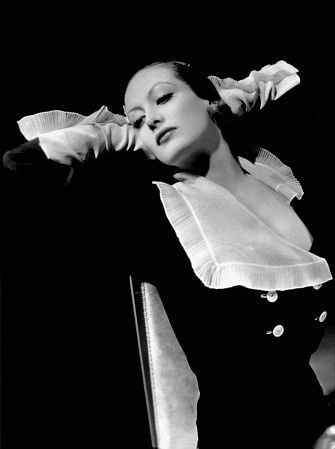
“I played the prostitute [in Grand Hotel, 1932] and I felt that a more sensuous look was needed. Full, natural lip line and generous eyebrows—no bra, no girdle. Definite features were called for, and I found that I liked that look so much that I kept it.”
–Joan Crawford, My Way Of Life. New York: Simon and Schuster, 1971. 159.

“In 1904 a journalist described another type of worker, a member of a new female profession, the fashion mannequin, walking to work across Paris: …’This lovely woman with her slender, curvaceous figure, whose costume, one discerns, has come from a good dressmaker . . . hastens towards the rude de la Paix or the place Vendome. It is barely nine o’clock, but despite the morning hour and the sharp cold that stings the face, more than one passer-by turns round and slips while paying her a quick compliment.’
The four-minute Gaumont film starring Renee Carl, Une Dame Vrainment Bien (1908), made a comedy of just such a scene. A pretty woman exits from a clothing shop, promenades in the Paris streets, and piques masculine curiosity. All the men turn as she passes, setting in motion a comical chain reaction: Falls, collisons, and other blunders. The film is an instance in French film of the way that, as Constance Balides has argued in relation to American comedy films of the 1900s, everyday scenes of women walking through public places are turned into sexual spectacle . . .Perhaps the paucity of films of fashion modeling was due to the fact that, in the early 1900s, the mannequins, young women paid to walk to and fro in the elite fashion houses of the rue de la Paix and the place Vendome, were largely invisible to the general public. . .
–Caroline Evans, “The Walkies: Early French Fashion Shows as a Cinema of Attractions,” in Munich, Adrienne (ed) Fashion in Film. Indiana University Press, June 2011 (pgs. 112-113).

I spent this past Friday and Saturday in the small town of Williams, CA. For those who don’t know it, it is on I-5, at the exit for Clear Lake. It’s primarily a farm town – but its history is long and well preserved in the former school house, now known as the Sacramento Valley Museum. My family’s roots go back to this particular town to at least 1920, but we were in the surrounding area as early as 1885.
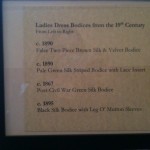
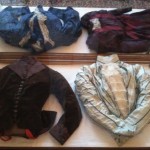
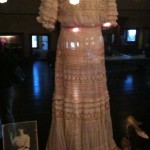
 The museum is a large two-story building and it contains all manner of historical every-day objects. It had a special Veterans Day memorial on view (which included example uniforms and paraphernalia from every major conflict). The permanent exhibitions areas include farming equipment, Williams High Alumni collections (including band uniforms), Masonic paraphernalia, as well as rooms organized by theme: kitchen, bathroom, bedroom, children’s rooms as well as businesses such as apothecary, general store and happily for me, the clothing boutique (all including objects from varying time periods). Shocking -and somehow comforting-to know just how long the same pharmacy (Fouch’s) has been in existence here.
Of particular note were the Model-T car, the dusters in the tack room (circa 1900), and some fine examples of corsets, dresses, and women’s accessories. Somehow, the things worn and used by real people (rather than the rich-and-famous) are always of greater interest to me. They seem more authentic, and by extension, more important to study and understand.
If you ever find yourself in the area, I’d encourage a visit – it’s a unique way to step back in time and smaller, lesser-known collections need your support to survive. Hope you enjoy these quick snap-shots: