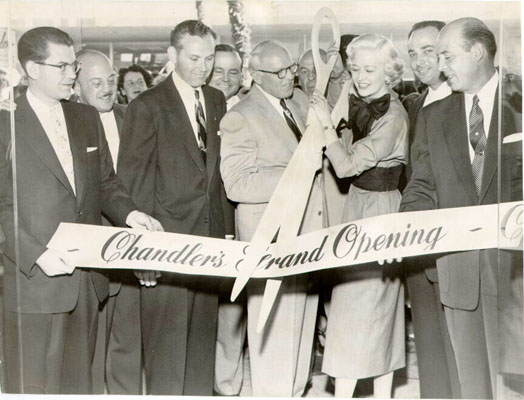
Actress Marilyn Maxwell cutting the ribbon at the opening of Chandler's Shoe Store in Stonestown Shopping Center, 1953 Oct. 19. (San Francisco Public LIbrary)
“GRAND OPENING–With a king-size pair of shears, actress Marilyn Maxwell severs the tape to open the new Chandler’s Shoe Store in Stonestown. Watching, from left, are Al Hoffman, store manager; W. E. Polley, sales manager for the Edison Brothers Stores Inc.; Henry Stoneson, developer of Stonestown, and Roy Haydel, executive supervisor of the Edison stores. Ceremony was yesterday.”
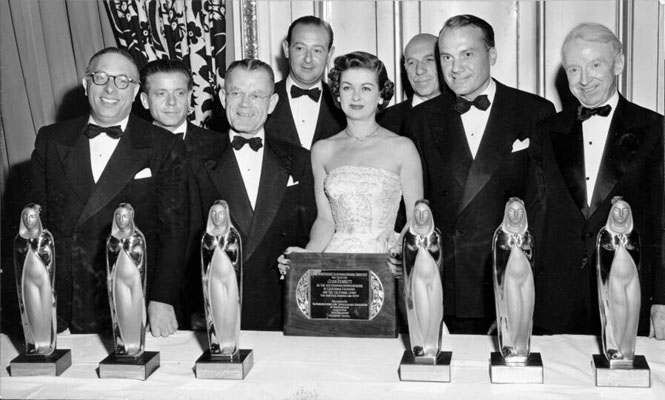
Recipients of the "Fashion Oscars" 1950 June 14.(San Francisco Public Library)
“For their work in bringing national attention to San Francisco’s apparel industry, these folk last night won ‘Fashion Oscars’ at a banquet of the Manufactures & Wholesalers Association. Left to right, front row, Cyril Magnin, vice president of Joseph Magnin Stores; E. C. Lipman, president of Emporium-Capwell Corp.; Miss Joan Bennett (who won a special award as outstanding representative of California fashions and spirit); J. L. Sherk, second vice president of the White House, receiving the award for Michel D. Weill, and Thomas E. Brooks, chief administrative officer of San Francisco. Back row, George De Bonis, vice president of the City of Paris, receiving the award for Paul Verdier; Sylvan Frank, president of the association, and Daniel Koshland, vice president of Levi Strauss & Co.”
Heather Vaughan: Who was your favorite person to interview for this project?
Natasha Rubin: “Deborah interviewed the vast majority of the living illustrators for the book; I contacted some of the new guard (e.g. Oksana Nedavniaya, Phillip Boutte, Jr, and Christian Cordella) for quotes. All of the interviews are pretty compelling. Julie Weiss is great to listen to because she has so many wonderful stories, I mean, she worked with Bette Davis!
Sketch from "Shampoo" by Pauline Annon on Page 95: "Courtesy of the Designer," (Via Los Angeles Times)
The interview with designer Anthea Sylbert about working with her illustrator, Pauline Annon, was fascinating in many respects. She had worked with her for several years, but knew so little about her personal life. Pauline is still alive, but didn’t want to be interviewed; she’s a fine artist and the Hirshhorn Museum in DC has collected some of her work.”
HV: Was there one sketch that you wish you could have included that you could not?
NR: “We were able to include almost every sketch we wanted, except a few due to various reasons. In addition to museums and archives, we were lucky to have so many generous lenders including collectors, designers, illustrators, and also the cooperation of auctions houses such as Christie’s, Profiles In History, and Heritage Auctions.”
HV: How has yours and Deborah Landis’ affiliation with UCLA changed the scope of the research you’ve been doing?
NR: “The support of David Copley has given us the resources to cope with the extensive research demands that all of these projects require. UCLA has provided us with a space to work, an academic community, and of course the UCLA name acknowledges the Center’s credibility and lends prestige. It has also increased our visibility in the costume design community, both nationally and internationally. The Center is now a clearinghouse for information and personal stories about costume design history. Every day I field more requests and calls of interest; it’s very exciting!”
Professor Deborah Landis, Founding Director of the David C. Copley Center, Teri Schwartz, dean, UCLA School of Theater, Film and Television, donor David C. Copley, and Nadja Swarovski, head of communications for the company founded by her grandfather.
HV: What can you tell me about how the David C. Copley Center for the Study of Costume Design at UCLA, and what it will be able to provide for interdisciplinary historians researching this subject? What sorts of materials and resources does it provide?
NR: “The David C. Copley Center for Costume Design is in the process of digital archiving, creating a visual database of film costume illustrations, first-person accounts, and scholarly research placing costume design in the center of a century of cinema storytelling. We also continue to offer opportunities to learn more about costume design for film through panels and lectures. We welcome questions from scholars and those interested in learning more about costume design history.”
Many many thanks to Natasha for being so generous with her time, and for providing many of the images in these two posts. To learn more about the history of film costume illustration be sure to pick up a copy of Hollywood Sketchbook: A Century of Costume Illustration.
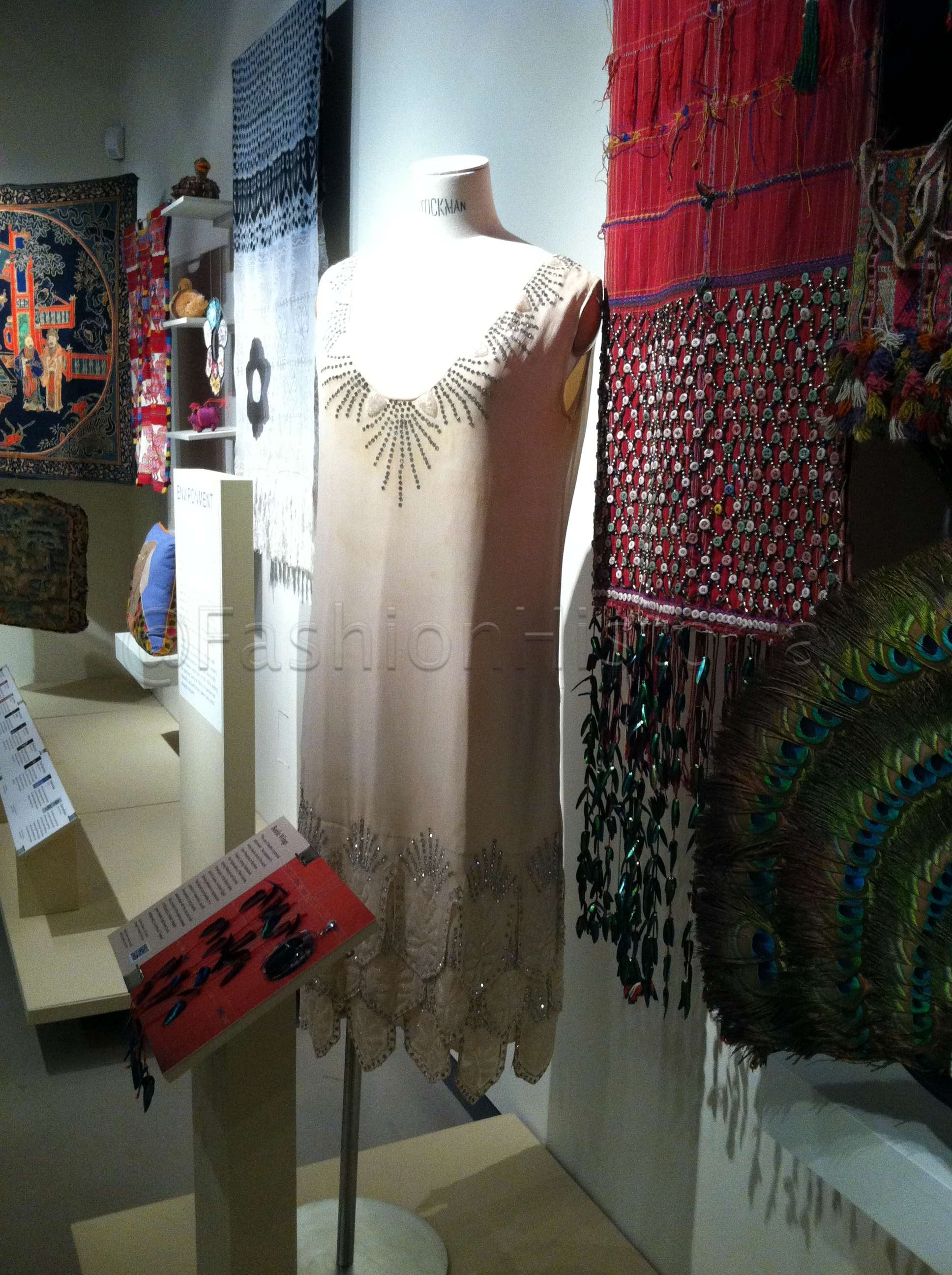
Yesterday I had the unique opportunity to go to a Costume Society of America Meet – Up (an informal and free event giving CSA members the opportunity to mix and mingle with their fellow enthusiasts) at the UC Davis Design Museum. Organized by past-president, Jo Ann C. Stabb, we had gathered together to see Structures, Signifiers and Society: People and Textiles which happened to include a curators walk-through with Mary Schoeser, a UC Davis alumna.
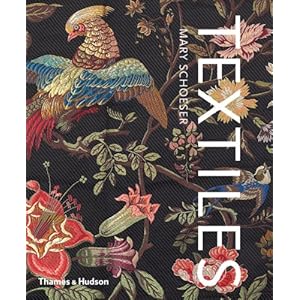
Schoeser, who also has a beautiful new book out Textiles: The Art of Mankind provided an amazing depth to the exhibition — highlighting unique objects and connections within the UC Davis collections. Objects ranged in age, country, technique and quality. It included both hand and machine-made textiles intended for both the art connoisseur and mass market consumers. The exhibition included groupings of historic and ethnographic textiles as they related to environment, identity, and other groupings. In her walk-through, Schoeser drew fascinating connections between the development of the loom and the development of the computer; the rise of the QR Code and it’s connections to textile weaving; in addition to the links between brain chemistry and textile production. It was truly a unique experience.
Making the meet-up all the better were the people in attendance. CSA past presidents, board members, conservators, professors, curators, as well as current students in attendance made for a valuable exchange of ideas. Following the tour, attendees mingled in the hallway over two pieces of historic clothing and examined their ins and outs. Melissa Leventon and Meg Geiss-Mooney pored over the two garments (one from c.1917, the other from c.1894) discussing their ideas about their history while attendees listened in, hovering nearby and asking questions. It was a marvelous day, and a wonderful opportunity.
Structures, Signifiers and Society: People and Textiles is on view through March 18, at the UC Davis Design Museum. Below are some photos to further tempt you:
Veteran’s Building, Fourth Floor, MPD main gallery – Come see what treasures you could snap up for a great deal.
Thousands of theatre, dance, music, opera, musical theatre, and film-related books and memorabilia as well as exhibition materials, office and audio/video equipment, and other odds and ends will be available for purchase.
Guests will pay one admission each time they pass through the sale and can take away all they can carry in one arm load (does not apply to specially priced items).
Admission Prices
Members $20
Non-Members $25
Be sure to arrive early to get first pick of these treasures!
Museum members will be allowed in at 11 am.
The sale will open to the public from Noon to 4 PM.
Proceeds from the sale go toward preservation of the Museum’s collections.
Special Note: MPD sells only duplicates of material already in the collection, material donated specifically to be sold, or material which falls outside the scope of our collecting policy.
Deborah Nadoolman Landis recently released the fantastic resource, Hollywood Sketchbook: A Century of Costume Illustration (Nov. 2012) as a follow-up to her Dressed: A Century of Hollywood Costume Design (2007). My dear friend Natasha Rubin has a marvelous essay in the book that provides depth as well as some unique insights into the research process of the book. After reading it, I wanted to know more. Natasha was kind enough to grant me an interview, which I’m pleased to share with you here:
Heather Vaughan: In your essay you note that you researched costume illustrations that had no signature or movie title: how often did that happen, and were any ‘mysteries’ solved in the book?
A Star is Born, 1954 (Costume Designers: Jean Louis, Mary Ann Nyberg, and Irene Sharaff; Illustrator: Mary Ann Nyberg; sketch courtesy of Catena Passalacqua
Natasha Rubin: “Many mysteries were solved while researching the book. The author, Deborah Nadoolman Landis, and I began to recognize designers’/illustrators’ styles and this helped us match illustrators with designers as well as identify some of the movie titles. Deborah and I had always wondered if Jean Louis drew the sketches he signed for A Star is Born (1954). Due to issues with the production, this film had three credited designers (Jean Louis, Mary Ann Nyberg and Irene Sharaff). One day, while searching the Cinémathèque Française’s digital archive, I came across costume illustrations for additional films that Mary Ann Nyberg designed and the drawings were a perfect stylistic match.
Another huge surprise was learning that John Truscott did not draw all his own sketches. Truscott only designed two films, Camelot (1967) and Paint Your Wagon (1969). The sketches from both of these films are immediately recognizable because of their distinct style, so I was quite surprised when I came across an interview on Galactica.TV’s website with costume illustrator Haleen Holt, which credits her as an illustrator for Truscott on Camelot.
Camelot, 1967 (Costume Designer: John Truscott, Illustrator: Haleen Holt, sketch courtesy of Tom Culver)
I immediately contacted her and she came over to our offices at UCLA and identified—to the best of her memory—which drawings were hers and which were Truscott’s. Ms. Holt has spent over 35 years working in the entertainment industry as a costume illustrator and assistant designer, yet no collector knew her name and no museum or archive identified her in their records. In addition, Ms. Holt noted that Judy Evans (who went on to become an Emmy-winning costume designer) painted many of the aged, speckled backgrounds of the Camelot sketches. Really, if there was one illustrator I thought could not be copied, it would have been John Truscott. In the interview, Haleen recounts the difficult task she had in mimicking his style. This experience was eye-opening in terms of research and what is still unknown. Whether the lack of information was intentional on the part of the designers or the studios or deemed unimportant at the time varied from production to production and sometimes sketch to sketch.”
HV: The bibliography and resources sections of this book are extensive, though mostly primary resources. You also make note that this field has “little academic research, we are establishing the foundation of a field of study.” Who else would you say is at the forefront of historic film costume illustration research?
Paint Your Wagon (1969) via icollector
NR: “First, I must acknowledge the extensive research of Susan Perez Prichard, who wrote Film Costume: An Annotated Bibliography (Scarecrow Press, 1981). Ms. Prichard’s book provided the cornerstone of cinema costume history, and I would be remiss if I didn’t mention her. Sketch collectors and Golden Age fans have also been helpful.
While there are extensive collections of costume illustrations at archives and museums such as the Academy of Motion Picture Arts and Sciences (AMPAS), the British Film Institute (BFI), the Cinémathèque Française, the Brooklyn Museum of Art, the Deutsche-Kinemathek and the Los Angeles County Museum of Art (LACMA), there has been very little scholarship on their holdings. At the Cinémathèque Française Deborah was told she was the only non-museum employee who had ever come to look at the collection.
Additionally, these sketches are rarely, if ever, exhibited. Scholarship takes time and requires financial support, which has become more and more scarce. As the internet continues to compile information, more and more is available online. It would have been virtually impossible to publish this book even ten years ago, just tracking down the sketch collections would have been prohibitive, much less the text research. Though too late for our research on Hollywood Sketchbook, the Theater Library Association published Documenting: Costume Design (2010), edited by Nancy Friedland, which will provide guidance to future scholars in the field.
Also, Lynn Pektal wrote an excellent book called Costume Design:Techniques of Modern Masters (Back Stage Books, 1999), but it focuses primarily on theater designers. Many of today’s working illustrators are much more savvy about getting their work seen, whether through their own websites or book publishing; it’s fantastic that there will be a record of their contribution.”
CONFERENCE: “Conserving Modernity: the Articulation of Innovation,” 9th North American Textile Conservation Conference
San Francisco, California November 12th – 15th, 2013
Synthetics. New ideas to old problems. Wearable art. Creative treatment solutions. Evolving installations. Collaborations with contemporary artists. These are some of the topics that will be addressed in two days of papers and posters presented in the deYoung Museum in Golden Gate Park for the 9th biennial North American Textile Conservation Conference.
Two days of workshops will precede the presentations and will cover aqueous cleaning solutions for textiles, natural and synthetic fiber identification, and progressive display techniques. There will also be workshops offered by San Francisco artists on innovative techniques for resist dyeing and working with ribbon to custom design trims and other embellishments.
The opening reception will take place in the Jackson Square District hosted by Peter Pap Oriental Rugs and the Lotus gallery. The closing gala will be held at the Asian Art Museum.
Following the conference, two additional tours will be offered: a cultural adventure throughout the East Bay and a tour of the Levi Strauss & Co Archives.
For more information contact: contactNATCC@natcconference.com
As you might have noticed, the last few weeks here at FashionHistoria have focused on book reviews. In October I began to receive a steady-stream of packages with glorious, lovely, over sized, and decadent fashion history books. I slowly, but methodically, began sharing their insides with you, starting back in October with Katherine Hepburn’s Costumes: A Book and An Exhibition. Each week in November, there was a new topic and a new book to explore:
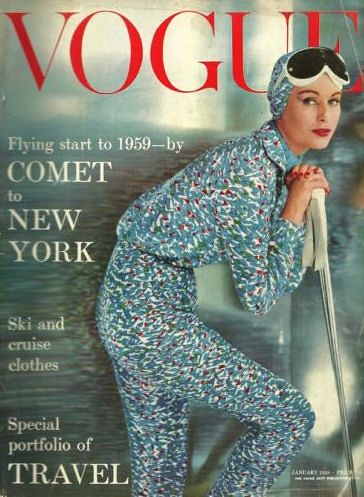
Available as of November 15, Vernier: Fashion, Femininity, and Form by Robert Muir and Becky Conekin (Hirmer Publishers) offers a highly illustrated documentation of Eugene ‘Gene’ Vernier, a photographer at British Vogue from 1954-1967. Beautiful, evocative photographs of 1950s British high fashion are included in this volume, with equally stunning essays by Robin Muir, Becky Conekin and Alistair Layzell.
British Vogue, January 1959 (Cover photo by Eugene 'Gene' Vernier)
Admittedly, I had not heard of Vernier (blame it on my American bias), but his covers and interior photography for Vogue in the 1950s and 1960s are absolutely stunning, and deserve the attention that this publication brings. For a quick over-view (and sneak-peek at the images included in the book), BBC News has a great video interview with Vernier from May of last year. More images can be found in this Flickr set.
Allstair Layzell’s essay, “Eugene Vernier: A life” uses the uniquely modern invention of the QR code to link still images to nine clips of film online, allowing readers to see some of Vernier’s early film work for Pathe (he was a camera man). (I’ve included one below) It’s a unique feature of Vernier: Fashion, Femininity, and Form, and one that I’ve not seen implemented in a book before.
Around Britain: 1947 (Click Image to go to watch the video)