Russian Elegance: Country and City Fashion (min-review andexcerpt)

Russian Elegance: Country & City Fashion from the 15th to the Early 20th Century

By Luisa V. Yefimova and Tatyana S. Aleshina (Vivays Publishing)

Publication Date: January 9, 2012

For anyone with an interest in the beautiful folk costume and decadent fashions of Russia – this is a sumptuously illustrated, and informative new book from Yefimova and Aleshina.

My interest in Russian fashion stems from both a love of folk costume and detailing (which is copious in this book), from Natacha Rambova’s fascination with Russian culture and arts (especially the Ballet Russes), but also because of the strong Russian ex-patriot influence on Parisian fashion in early 20th century. Given these interests, and the recently opened exhibition on Russia here in California (at the Sonoma County Museum of Art) and the anniversary of Fort Ross (settled by Russians), it seems appropriate to delve deeper.

Written by two staff-members of the State Historical Museum in Russia, both are experts in the field of Russian costume and fashion history. Here’s what the pair have to say on the differences between Country and Town clothing in Russia:

“The history of costume in Russia has one essential feature. At the turn of the 18th century Peter the Great, the young reforming tsar, remotely and uncompromisingly decided the destiny of Russian costume. He forced the upper strata of Russian society by decree to wear European dress. Only the peasants and the Orthodox clergy were excluded from the decree. And so, while the gentry adopted the latest Paris fashions as far as their finances allowed them to, the Russian peasants continued to wear their distinctive traditional garb. Thus costume in Russia was divided into two types: traditional Russian dress and fashionable town clothes of the Western European style.”
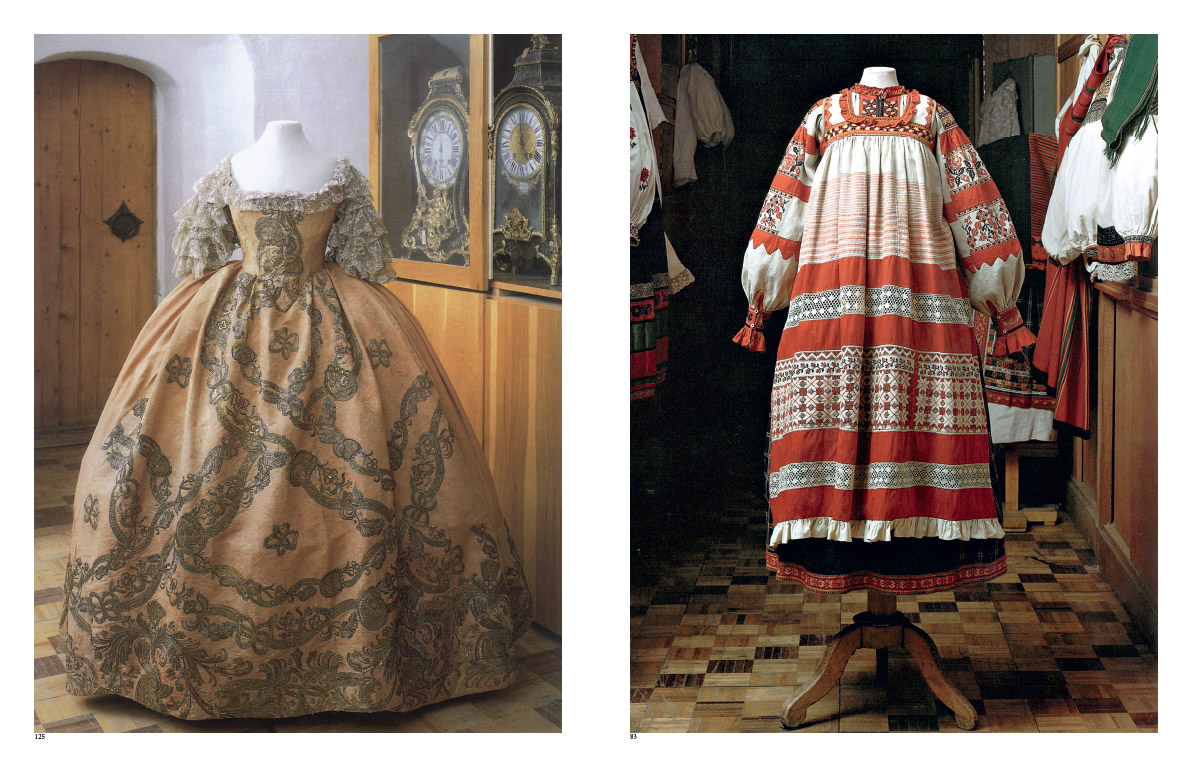
Dress belonging to Empress Elizaveta Petrovna, 1750s, France (left – see note 1) and Peasant Woman’s festive dress, Late 19th-early 20th Century, Yeleski district, Orlov province (right – see note 2).

“All Russian peasants, as well as town commoners and merchants favouring the manners and customs of former times wore traditional Russian dress, which was essentially Russian national costume. Fashionable town clothes were made in the Parisian style, yet not without partiality for bright colours, fancy patterns and a generous amount of trimmings. There was a general fondness for shawls, kerchiefs and wraps, which were skillfully combined with fashionable dress. . .”

Peasant woman's outer dress - corsetka; Late 19th-early 20th century Voronezh province of homespun undyed cloth. (see note 3)

“While national dress and urban costume differed in their basic features, they developed under the same social conditions and evolved in parallel. During the lively celebrations of public holidays on the country estates of the gentry, and at fairs int he towns, aristocrats came into contact with peasants and merchants. By associating with their neighbours and being part of a group containing all kinds of people, those who were interested in costume formed a kind of association. This provided fruitful soil for mutual influence by the folk and town style of Russian costume on each other. Thus, details of fashionable costume such as a low neckline and fully rounded, elbow-length sleeves of the woman’s shirt, and also outer clothes of a fashionable cut became prominent among traditional clothes. At the same time, articles of folk handicrafts such as embroidery and lace began to be used in decorating town clothes.” (8-9)

Much of what is included here corresponds with the notion of country and town influencing each other – and what is evident from the photographs is the appreciation held by all classes for intense detailing and decorative elements – Lace, embroidery, brocade, applique, pearls, fur, beading and quilting appears on every kind of clothing, for all ages and all genders. It is a beautifully produced book – and I’m thrilled to be able to share it.

Image Notes:

1. “Dress belonging to Empress Elizaveta Petrovna, 1750s, Franc. Restored with remnants of a crimson silk suplice. Silk, embroidered with coloured fabric, ornamentation, tinsel, lace. This silk dress from Empress Elizaveta Petrovna’s wardrobe was recreated by the Museun’s restorers from a church vestment. Only its front part, the skirt and part of the bodice survived. It was made of heavy reddish-orange silk of French manufacture with a self-coloured floral pattern. The Museum’s masters restored the dress from the empress’ portraits and fashion plates of the period. It is a ball dress with a narrow bodice compressing the waist and a low-cut neckline both in front and at the back. The elbow-length sleeves are of the French needle lace ‘point d’Argentan,’ and the same lace is used for trimming the neckline.” (112)

2. “Peasant woman’s festive dress, blouse, homespun skirt, apron, late 19th – early 20th century, Yeletski district, Orlov province. The blouse has straight inserts, a short body, with sewn-on collar, long sleeves with frilled cuffs. It was made from homespun linen, decorated with embroidery and cotton threads in a cross. Calico strips were sewn into sleeves. The homespun check wollen skirt, has a woven pattern band at the hem. A sleeveless, straight-cut ‘curtain’ apron with back, was made from homespun red-patterned sackcloth, with sstrips of structural embroidery sewn on, cross-shaped embroidery, lace and calico. Strips of red and white cotton fabric decorate the border of the hem.” (89)

3. “Peasant woman’s outer dress — corsetka. Late 19th-early 20th century, Voronezh province, made from homespun undyed cloth. The foreground shows a Voronezh corsetka seen from the rear – a long garment with knife pleats and decorations on the belt in the form of patterned ‘little discs’ sewn to the cloth. The ends of the sleeves are decorated with embroidery made from factory-made materials.” (95)

Continue Reading

Fashion in the Museum: The Crocker Art Museum

*

This past weekend I made a trip up to Sacramento to visit the Crocker Art Museum – and mainly to see their exhibit on California plein-air paniter, Edgar Payne. However, I was quickly reminded that fashion history can pop up anywhere (I have had similar reminders while on jaunts to other unfamiliar California Museums). In this case, I was particularly excited because so much of the work related not only to fashion and clothing history, but also to California history.

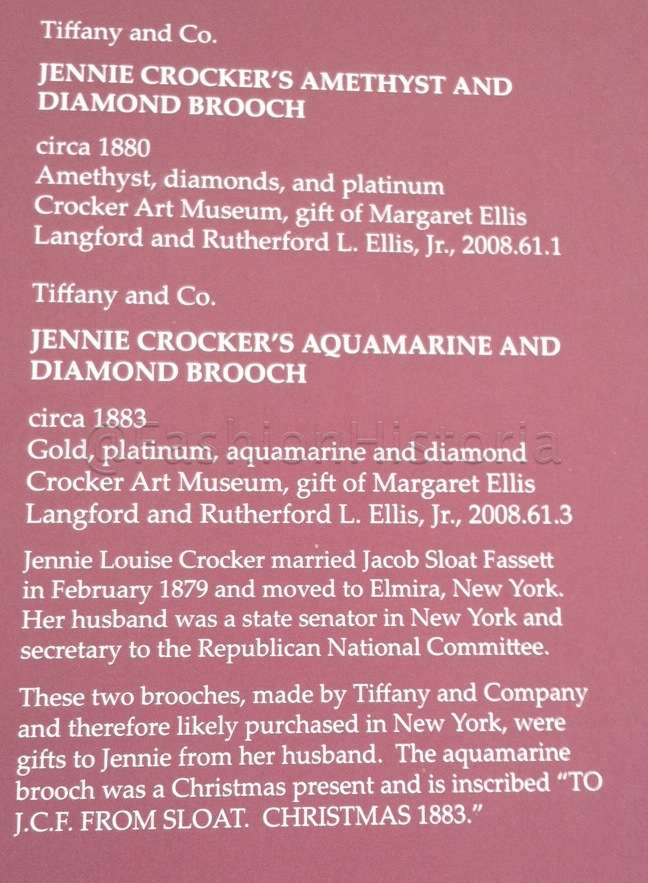
Jeannie Crocker's broach (by Tiffany & Co), c1880

The rooms devoted to the history of the Crocker Art Museum itself held the largest ‘cash’ of fashion related objects. These were full of fascinating and beautiful pieces relating to Margaret Crocker and the rest of the Crocker family, including three stunning 1870s-80s broaches (two by Tiffany and Co.), a related portrait of Margaret Crocker wearing one of the broaches (dating to 1877), an 1860s hair wreath, and a group of Crocker family photographs, among other things.

Several other paintings in the museum’s California history collection held my interest for more than a few minutes, including two lovely portraits, one of Little Miss San Francisco (painted in 1853) and another of Mary Blanche Hubbard by California artist Mary Curtis Richardson (painted in 1889 and reminded me of John Singer Sargent’s work and which the museum compared to Whistler).

Little Miss San Francisco by Charles Christian Nahl, 1853
Portrait of Mary Blanche Hubbard by Mary Curtis Richardson, 1889


On other floors, I found still more examples of fashionable and ethnic dress – from African Kente Cloth (Ghana) and an Indigo-dyed man’s robe (Nigeria) to Japanese tomesode (a type of kimono) and 17th century samurai armor to an Indonesian Spirit Costume (Papua) made almost entirely of rattan.

All-in-all, I thoroughly enjoyed my visit to the Crocker Art Museum and loved the surprises I found there. I hope you’ll enjoy the small set of photos from my visit below (including the full labels for each object)

*Convalescence by William Hahn, 1873 (San Francisco’s Temple Emanu-El and the First Congregational Church can be seen in the parlor window)

Continue Reading

Fashion & Textiles on view in California and the West

click for source

I recently received a note from a reader, describing her trouble finding information on upcoming fashion and textile exhibitions on view in California. So, I thought I’d share what I know with readers. Quite a variety of exhibits are available across the western states: exhibitions of film costumes, exhibits using old techniques in new ways (embroidery and knitting), historical design aesthetics (including ‘California’ design and the Aesthetic movement), as well as contemporary body art (tattoos!). Quite the range to choose from. Please feel free to comment if you’ve been to any of these or others you think readers should know about:

20th Annual Art of Motion Picture Costume Design
Through April 28, 2012
The Fashion Institute of Design & Merchandising/Museum & Galleries (Los Angeles, CA)

The FIDM Museum is proud to present the twentieth anniversary Art of Motion Picture Costume Design exhibition. Celebrating the art and industry of costume designers, this exhibition will present more than 100 costumes from twenty films released in 2011. The exhibition includes selected costumes from all five 2011 Academy Award® Nominees for Costume Design: W/E, Hugo, Jane Eyre, The Artist, and Anonymous. The exhibition also showcases classic film costumes from the FIDM Museum collection and the Department of Recreation and Parks, City of Los Angeles, Historic Hollywood Collection. Some of these same costumes were featured during the first Art of Motion Picture Costume Design exhibition in 1993.

Common Places: Printing, Embroidery, and the Art of Global Mapping
Through May 13, 2012
Los Angeles County Museum of Art (Los Angeles)

Common Places features three objects from LACMA’s permanent collection which transform printed works on paper into one-of-a-kind embroideries: a seventeenth-century valance, a cigarette silks quilt, and Alighiero Boetti’s Mappa. The resulting textiles articulate contemporary aspects of global phenomena and suggest that far from being a recent development, globalization has deep historical roots that extended into the home and everyday life.

California Design, 1930–1965: “Living in a Modern Way”
Through June 3, 2012
Los Angeles County Museum of Art (Los Angeles)

This exhibition is the first major study of California midcentury modern design. With more than 300 objects—furniture, ceramics, metalwork, fashion and textiles, and industrial and graphic design—the exhibition examines the state’s role in shaping the material culture of the entire country. Organized into four thematic areas, the exhibition aims to elucidate the 1951 quote from émigré Greta Magnusson Grossman that is incorporated into the exhibition’s title: California design “is not a superimposed style, but an answer to present conditions…It has developed out of our own preferences for living in a modern way.”

The Art of the Anatolian Kilim: Highlights from the McCoy Jones Collection
de Young Museum (San Francisco)
Through June 10, 2012

A world-class collection of Anatolian kilims given to the Fine Arts Museums of San Francisco by H. McCoy Jones and his wife, Caroline, is showcased in a choice exhibition of two dozen of the finest examples. Presented in the textile arts gallery at the de Young, the Anatolian flat-woven kilims on view, dating from the 15th to the 19th century, include a variety of design types and regional styles, as well as superb examples of artistic and visual prowess. The kilims in the Fine Arts Museums of San Francisco’s permanent collection are considered the most important group of Anatolian kilims outside Turkey.

Knitted, Knotted, Twisted & Twined: The Jewelry of Mary Lee Hu
Through  June 17, 2012
Bellevue Arts Museum (Bellevue, WA)

Over the past 40 years, Mary Lee Hu has affirmed her distinctive voice in the world of jewelry with her elegant, voluptuous creations. Using wire the way hand weavers use thread, Hu has blazed a trail as both artist and innovator, exploring the nexus between metalsmithing and textile techniques. Keen to metal’s ability to bend and manipulate light within a textured surface, Hu’s work is a testament to her sophisticated eye for weightless and rhythmic lines, translated into body adornment. Featuring more than 90 exquisite earrings, rings, brooches and neckpieces drawn from public and private collections internationally, this retrospective traces Hu’s evolution from her experimental designs of the 1960s to today’s creations full of light and movement.

The Cult of Beauty: The Victorian Avant-Garde, 1860–1900
Through June 17, 2012
Legion of Honor (San Francisco)

The Cult of Beauty: The Victorian Avant-Garde, 1860–1900 is the first major exhibition to explore the unconventional creativity of the British Aesthetic Movement, tracing the evolution of this movement from a small circle of progressive artists and poets, through the achievements of innovative painters and architects, to its broad impact on fashion and the middle-class home. The superb artworks on view encompass the manifold forms of Victorian material culture: the traditional high art of painting, fashionable trends in architecture and interior decoration, handmade and manufactured furnishings for the “artistic” home, art photography and the new modes of dress.

Order and Border
Through Oct. 21, 2012
Seattle Art Museum (Seattle, WA)

Stripes are a fundamental visual element, appearing naturally in vertical lines as trees and in manmade products of all kinds, from street dividers to ornate fabrics. The stripe is so basic it is rarely given isolated attention. This installation examines how stripes decorate and structure objects, bodies and spaces. It follows the many ways that stripes are formulated—swirling, rigid, ragged, skinny or bold—and shows how they appear in a wide range of media from a multitude of cultures. These objects help us recognize the range of meanings that a stripe holds, from a minor design feature to the sign of a significant mythic journey.

Indelibly Yours: Smith Andersen Editions and the Tattoo Project
de Saisset Museum, Santa Clara University, Santa Clara, CA
February 24 – March 18 and April 13 – July 1, 2012

Featuring work by ten artists—five known for tattoo and five known for printmaking—Indelibly Yours explores the kinship between marking on skin and the practice of drawing on a printing plate.

Continue Reading

Making your own yarn?

Following up on my post last week from the Portlandia episode featuring the material culture of the 1890s, I thought I’d tell you about a little historic side-project I’ve been working on for the last month: Learning to spin wool into yarn.

What? Why would anyone want to do that when there are so many fabulous stores to buy yarn in already? Well – I’ll tell you – it’s not something I went out looking to do. By happenstance, I got a spinning wheel as a hand-me-down from a cousin (who found it in the garage of their newly purchased house), and for Christmas, my sister gave me a bag of fleece from a farmer friend of hers in Oregon. Suddenly, I had the materials I needed – so why not learn?

Of course, I had to do some research (yeah!) and started off with a few books from the library, some video’s on youtube, and trying to understand how the machine worked. These methods helped get me started, but I didn’t get very far. I clearly needed a class, and thankfully the Piedmont Yarn shop had one available. So, for the last month, I’ve been taking a once-a-week wool spinning class from Lou Grantham, of San Francisco Fiber.

I’ve learned about washing the wool (not too much soap, not too hot, don’t put the water down the drain); preparing the fiber (using paddle carders, flickers, dog-brushes and even a drum carder), drop spindles and spinning wheels, worsted and woolen, and the most fun (for me anyway) is the difference between long draw and short draw (long draw for short fibers, short draw for long fibers).

It’s like magic to watch this messy ball of fiber to into a nice sooth piece of yarn! The only thing I haven’t quite mastered is plying – but I think with some practice I’ll get there (and I do need to learn how to dye it). Thankfully, I still have three very full bags of fleece (yessir-yessir, three bags full) to practice with.

Continue Reading

At the Sonoma County Museum: 200 Years of Decorative Arts Under the Romanovs

Click for source

Notice of this upcoming exhibition appeared in my inbox last week. The Tsars’ Cabinet: Two Hundred Years of Decorative Arts Under the Romanvs was organized by the Muscarelle Museum of Art at the College of William and Mary, and will be on view at the Sonoma County Museum beginning February 25.

The exhibit includes about 160 pieces, much of it by Faberge, including porcelain services, glassware, enamel, silver gilt, and decorated eggs. Many of these are grouped by tsar, which helps to illustrate major social or political trends of each tsars’ reign.

What’s nice is that there is an actual connection between Russian history and Sonoma County: It’s the 200th Anniversary of the establishment of Fort Ross. “Fort Ross was a thriving Russian-American Company settlement from 1812 to 1841. This commercial company chartered by Russia’s tsarist government controlled all Russian exploration, trade and settlement in the North Pacific, and established permanent settlements in Alaska and California.”
As  you’ll see in the notice below, the opening reception is February 25, and includes a $2 discount for anyone who arrives dressed in a Russian-themed costume.
Figures of Hunter, Woman from Kamtchatka, Woman in Coat, Man from Kamtchatka, Samoyed Man, Kabardian Man, Woman in yellow; Tartar from Kazan; Porcelain; c. 1785-1800; Imperial Porcelain Factory, Russia (click for source)
The Tsars’ Cabinet: Two Hundred Years of Decorative Arts Under the Romanovs at the Sonoma County Museum
Opening Reception Saturday, February 25, 5-7pm
Vodka bar, Russian music & food, Museum members are free, $15 admission for non-members
$2 discount for wearing Russian-themed costumes

Click for source

Curator’s Tour of The Tsars’ Cabinet

April 6, 2012, 11:00am-12:00pm
A behind-the-scenes look at creating the Tsars’ Cabinet exhibition. Cost: $4 in addition to regular Museum admission.
Bruce Elliott Lecture on the Romanovs and St. Petersburg
Thursday March 7, 2012, 6:00-7:30pm
Bruce Elliott, professor and lecturer at SRJC will discuss the Romanov dynasty and the construction of St. Petersburg. Cost: $8 Members / $10 Non-Members

Family Day
Saturday March 17, 2012, 11:00am-2:00pm
Activities, hands-on crafts, and decorative arts demonstrations themed on The Tsars’ Cabinet. Free admission for children 12 and under, and free for members of the museum. Regular admission applies for all others.

Steven Bittner Lecture on Russian History and the Aristocracy
Thursday April 12, 2012, 6:00-7:30pm
Steven Bittner, professor of Soviet History at Sonoma State University, will lecture on Russian history from the 18th century to 1917. Cost: $8 Members / $10 Non-Members

For more on the Fort Ross Anniversary celebration, click here.

Continue Reading

FIDM’s 20th Annual Art of Motion Picture Costume Design Exhibition

Opening today is FIDM’s annual Art of Motion Picture Design exhibition, produced in association with the Costume Designers Guild, which exhibits the Academy Award® nominated costume designs. This year’s nominees include:

To prepare for The Artist, Bridges watched Clara Bow in 1927's It and Joan Crawford in 1928's Our Dancing Daughters. The costume designer and director Michel Hazanavicius are also fans of the 1928 Marion Davies film Show People. "It's a slice of life at MGM from that period," says Bridges. (Click for source)
  • Lisy Christl for Anonymous
  • Mark Bridges for The Artist
  • Sandy Powell for Hugo
  • Michael O’Connor for Jane Eyre
  • Arianne Phillips for W.E

The exhibition not only includes the nominted designs, but also presents more than 100 costumes from twenty films released in 2011! Since this year marks the 20th anniversary of the annual exhibition, curators pulled out all the stops and include much more than just this year’s nominees. The exhibition also includes a showcase of classic film costume — including pieces worn by Fred Astaire, Ingrid Bergman, Jean Harlow, Marlene Dietrich and other Hollywood legends.

Can’t wait to see it!


Continue Reading

Surface Design Association seeks Executive Director

Ready to apply your business skills to an art organization? Then SDA needs you! We are looking for a high-energy member who is ready to collaborate with staff, contractors, volunteers and the Board to lead the organization poised for growth and expansion. You need to bring demonstrated management, planning and organizational skills and most importantly, the enthusiasm to make a difference. The position requires dedication, sensitivity to and tolerance of differing views, community-building skills and above all, a sense of humor. In return you can anticipate being part of a team of like-minded individuals who contribute much more than what is expected and who want to move SDA forward. Position application opens February 7, 2012 and closes February 24, 2012. Position start date is Monday, March 26, 2012 and requires attendance at the Spring Board meeting in Philadelphia April 1-3. All inquiries and applications may be directed in confidence to: secretary@surfacedesign.org

Continue Reading

Levi Strauss & Co: The CSA Tour

A few Sunday’s ago, I had the pleasure of joining a select group of Costume Society of America Western Region members for a behind-the-scenes tour of the Levi Strauss & Co archives in San Francisco.

In the Levi Strauss archives

This was a tour that had been years in the making, and thanks to the generosity of Lynn Downey (the company archivist) and to the organizer (CSA Western President Shelly Foote) the program was a great success.

The weather couldn’t have been more idyllic, and when we arrived at the archives, a beautiful array of clothing from throughout Levi’s history was laid out before us. Ms. Downey had brought out her favorite pieces and generously peppered her talk with contextual information – how each was linked to Western or California history at large, company history, or cultural history. Downey discussed everything from early western work-wear and the origin of the riveted pant, to the company’s foray into Khaki pants, women’s denim wear on dude ranches, to early children’s wear during the baby boom of the 1950s, collaborations (including shirts for the 1939 Worlds Fair and Winchester hunting wear), and clear through to Mod clothing of the 1960s, Leisure suits of the 1970s, the 1980s collector trend in Japan, and up through Christian Siriano’s design for Project Runway.

Some quick-facts to tease you:

  • More from inside the Levi Strauss archives

    Levi Strauss did not have a store in the United States until 1991: they were only wholesale merchants until that point

  • In 1872 a Reno, NV tailor named Jacob Davis suggested that Strauss include rivets on denim pants to make them more sturdy. Although Strauss was not a manufacturer at this time he agreed to patent the design with the tailor. On May 20, 1873 the two gentlemen got the patent to make the first pair of mens riveted work pants.
  • The original name of the 501 jean was “XX”
  • The Levi Strauss archive acquired an 1880s pair of jeans (not the 501) with a ‘rule’ pocket, paying $46,500 after an intense bidding war
  • The oldest known riveted denim jacket (from the 1880s) was found in a ghost town in Southern California (and is now in their collection)

Ms. Downey generously spoke to our group for a little over an hour, and then allowed us to put on gloves and examine everything more closely. She offered to answer any questions we had about Levi myths, ‘things we had heard,’ and even offered to bring out additional items if we wanted.

After a number of questions and lively discussions, our group moved back into the public display area to look at the clothing, artifacts and ephemera on view to the public, which included the company’s recent movie and celebrity tie-ins, as well as a conservation video, and a brief history of the company.

I was thrilled with this unique opportunity to learn more about this historic western company. Happily for CSA Western Region members, a full report will be forthcoming in the next issues of the regional newsletter. Should you want to learn more about Levi’s, Ms. Downey has written a book providing the definitive history of Levi Strauss & Co. I’ve included below some of my photos from the behind-the-scenes tour. Enjoy!

Continue Reading

Behind the costumes of Bye Bye Birdie (1963)

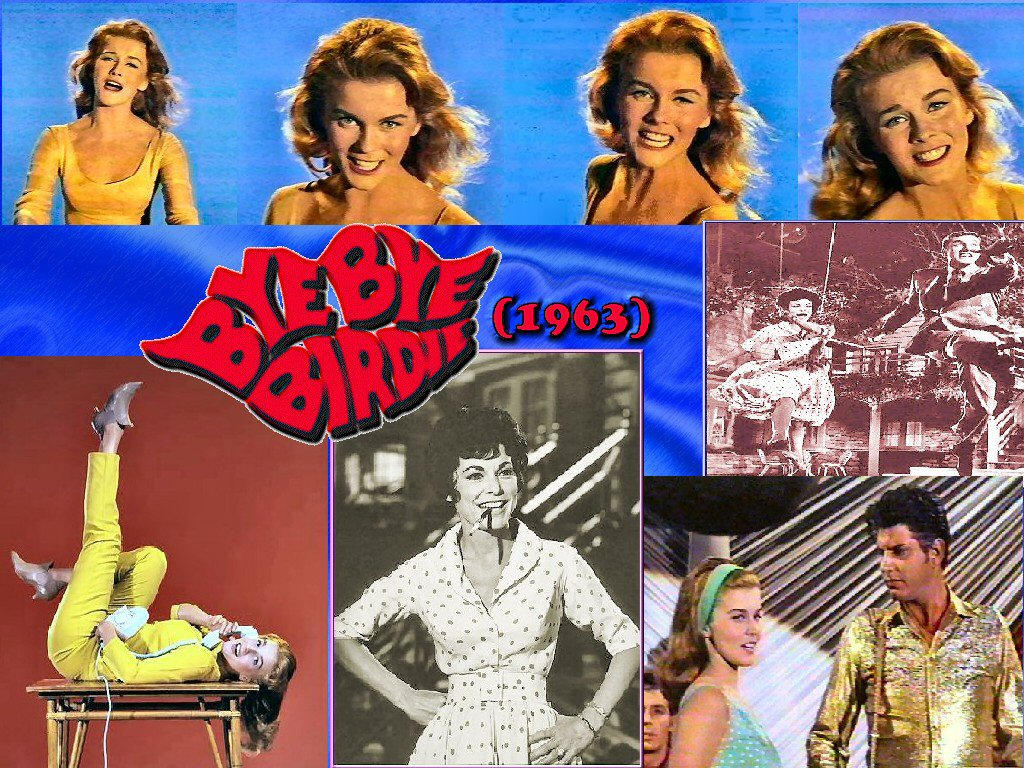
I recently watched the 1963s musical Bye Bye Birdie and wanted to quickly share some of my favorite costume moments from this wonderfully bright and colorful film (if you haven’t seen it, the camp factor is through the roof).

Conrad Birdie's Bathrobe from Bye Bye Birdie (Click for source)

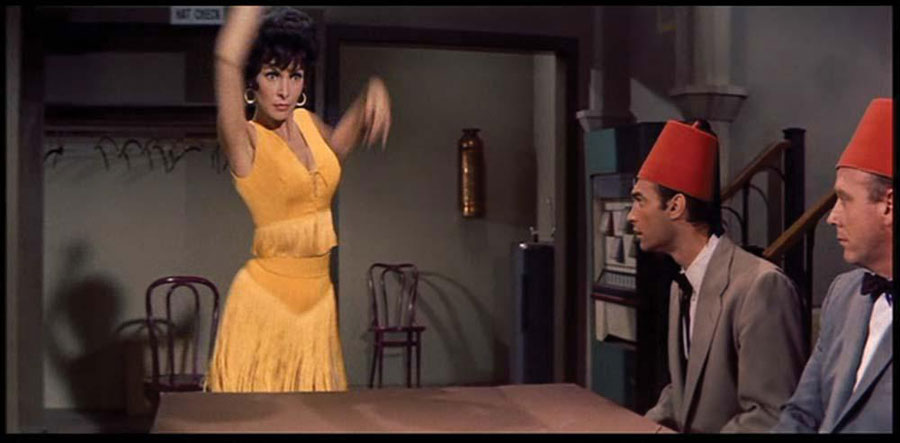
The costumes — executed by Pat Barto and Marjorie B. Wahl — include some pretty outrageous ensembles. Hearthrob Rock ‘n Roll star ‘Conrad Birdie’ (quite clearly modeled on Elvis) has some of the loudest costumes (including the tiger-print bathrobe seen on the right and an Elvis-esque gold lame suit), but the costumes of both Kim (Ann-Margret) and Rosie (Janet Leigh) have greater significance – both to film history and popular culture at large.

Many will be familiar with the theme song to Bye Bye Birdie from it’s brief appearance in a Madmen Episode, where Ann-Margret’s character is explored as the epitome of innocence and sexuality. In her autobiography, My Story, Ann-Margeret explains a little more of that dichotomy and how it worked to her advantage when getting cast in the role (See photos above):

For whatever reason, director George Sidney decided that I was perfect for the part of Kim McAfee. He’d even selected me before we met, having spotted me dancing at the Sands in Las Vegas the previous New Year’s Eve. A while later, he sent me a script for Birdie, then arranged a meeting in his office. He always reminded me that he’d had to keep from smiling at how I’d put on a pleated skirt and flats to try and look sixteen. ‘I saw how you looked in Vegas,’ he confessed. ‘It wasn’t sixteen.'”

Rosie, the character played by Janet Leigh, is supposed to be a wiser “New York” woman in contrast to Kim, the innocent teen. Leigh was a natural blonde, and that didn’t quite work for the character’s image. In a contemporary newspaper clipping, Leigh is quoted as saying “In my present film, “Bye Bye Birdie” at Columbia…I play the role of Rosie De Leon, Spanish secretary and girl friend of Dick Van Dyke. Now, with my blond hair I don’t exactly look Latin, but wearing a black wig—vive la difference! And that’s where the fun comes in.” [Taken from a clipping in the Bye Bye Birdie folder from AMPAS].

In her 1984 autobiography, There Really Was a Hollywood, Leigh went on to discuss the importance of that wig to her later career, saying “When I was shooting Bye Bye Birdie, Blake Edwards had visited the set, and was fascinated by me in the black wig. He was preparing The Pink Panther (and a wig ended up serving as the disguise for the lady’s escapades) and approached me to do the film.”

From a historical perspective, Bye Bye Birdie highlights the growing influence of youth culture, the increasing importance of television and other mass media, not to mention the cult of celebrity. Many of the costumes include the familiar 1950s shirtwaist dresses, and some vaguely mod references. Here’s a good clip to get you started:

Resources:

Ann-Margret, with Todd Gold, My Story, New York: G.P. Putnam’s Sons 1994 p. 98

Leigh, Janet, There Really Was a Hollywood, Garden City, New York: Doubleday & Company, Inc., 1984 p. 300

Continue Reading

Interpreting History Through Costume: A CSA Western Region Symposium

I’m so excited to share with readers that the Costume Society of America’s Western Region has just released its registration flyer for the next regional symposium! To be held March 16-18 at the William S. Hart Ranch in Newhall, CA, “Interpreting History Through Costume” will include a wide range of activities and intellectually stimulating paper presentations.

The William S. Hart Ranch

For those unfamiliar, William S. Hart was a silent film star – primarily of cowboy movies and he became an avid collector of western art and artifacts (including costumes). His historic 1910 Ranch House will provide an exciting backdrop to the paper presentations.

This academic symposium includes presentations connecting fashion, history, theatre costume, national costume, gender, re-enactors, and much more (it also includes papers by my good friend and regular Worn Through contributor Brenna Barks, and former Smithsonian curator Shelly Foote). Highlights include:

  • A Comparison of Costumes Worn for Performances of Sheridan’s “The School for Scandal”
  • Fashioning Greek Identity-Representing “Greekness” in the 19th Century
  • Saris to Skirts: Negotiating National Identity through Costume
  • Collecting Japan: The Kimono and Textile Collection at the Clark Center for Japanese Culture
  • Dressing the Part: Mary Pickford’s Use of Costume

Additional activities include tours of the Hart Museum and a special costume display, a screening of the William S. Hart Film Tumbleweeds (1925), social time and opportunities to explore the Ranch (which is home to a heard of American Bison and other animals).

For complete details on the symposium and to register, download the flyer below.

Interpreting History Through Costume

March 16-18


Continue Reading