New York: Attend April In Paris Ball...Sloan Simpson, (Left), Mrs. John F. Kennedy, (Center), wife of the U.S. Senator from Massachusetts, and stage star Celeste Holm, pose prettily at the "Bal De La Soie" annual April In Paris Ball last night at the Waldorf Astoria. Miss Simpson and Mrs. Kennedy modelled in a highlight parade of 21 gowns especially designed for the ball by leading couturiers of Paris and flown from France. Miss Holm appeared in a cabaret scene during presentation of 10 tableaux depicting "Les Plaisirs De Paris." Luxurious furs and costly jewels were displayed in addition to gorgeous gowns. (April 21, 1954, Corbis).
After attending a CSA Western region event back in 2008 (see my review of “Fashion Conscious” at UC Davis), I became interested in the ethics of producing the fashions that eventually become fashion history. The conversation about the impact the fashion industry is having on our environment continues to grow and change, and this is being reflected in the cannon of literature covering the topic. Fashion & Sustainability by Kate Fletcher and Lynda Grose, smartly uses the second half of their book to discuss “ideas that are transforming the fashion system at root into something more sustainable.”
I don’t know about you, but whenever I hear the words “fashion system,” I immediately think of Roland Bathes. However, here are what Fletcher and Grose have to say on the subject when considering sustainability:
Betabrand's commuter cycling pants with reflective pockets and hems (a San Francisco Company)
“However much we innovate and act to improve the sustainability credentials of a piece of clothing, the benefits brought by these changes are always restricted by the behaviour of the person who buys it. Producing a garment with lower-impact fibre or better labour conditions, while important, changes the overall system very little, for these ‘better’ fibres and pieces are made into the same sorts of garments, sold by the same retailers and then worn and washed in the same way as before. Part Two of this book explores new ways of engaging with the process of sustainability in fashion, starting at a point that acknowledges the profound and multiple challenges inherent in bringing together sustainability, the fashion industry and our economic system based on growth.”
Fletcher and Grose go on to explore nine different concepts: Adaptability, optimized lifetimes, low-impact use, service and sharing, local, biomimicry, speed, needs and engaged – all of which present creative ways that various designers and innovators are thinking about the design and use of clothing. Not exactly Roland Barthes – but perhaps a bit more practical?
Join CSA Members and guests this summer for a special private curator-led tour of Colors of the Oasis: Central Asian Ikats at the historic Seattle Asian Art Museum (SAAM) in Seattle, WA on June 14, 2012. The show originated from the Textile Museum in Washington D.C. – a premiere institution – and it’s a unique opportunity for West-coasters to see it without having to travel very far.
Registration forms are due by June 28 – and at the low $30 registration price, tickets are bound to go fast. Hope to see you there!
June 23, 1930-Long Island, NY Winthrop-Garley society spectators at a Polo Game in Locust Valley, Long Island. Mrs. Robert Winthrop (via Corbis).
8/1/1934-Hollywood, CA: Marlene Dietrich and daughter Maria Sieber, at the Polo Matches in Los Angeles (Via Corbis).At the Meadow Brook Club, after the polo match, from left: Mrs. Burrall Hoffman, Mrs. Malcolm Stevenson, Mrs. William Goadby Loew, Mrs. Cornelius Vanderbilt, and Mrs. George Baker. Ca.1927, in Westbury, Long Island. by Pierre Mourgue (Via Corbis).Woman in Molyneux Coat at Polo Match Vogue Magazine, ca. 1929 by Leslie Saalburg (Via Corbis).
Sometimes, when walking through an exhibit an object will stop you dead in your tracks – it’s visual impact interrupting any previous thought you might have had. Such is the case with the 1885 Liberty & Co dress currently on display in the Legion of Honor as a part of their current exhibition, The Cult of Beauty: The Victorian Avant-Garde, 1860-1900 (on view through June 17, 2012).
Liberty & Co. Ltd., dress Striped washing silk lined with cotton, c. 1885, V & A
This dress – in a gallery which houses all seven of the items of dress for the exhibit – is sculptural, simple and elegant. It’s a part of the Victoria & Albert’s permanent collection and the fabric is manipulated to resemble high art, to my mind references both painting and sculpture. The fabric seems to move like liquid and it’s no surprise to learn that the gown was designed by a sculptor (Sir Hamo Thornycroft) for his wife. Being a Liberty & Co. dress, the fabric is really the focal point and the artist has done a wonderful job of displaying this delicate, cotton-lined silk to it’s best advantage.
For more on their story, including letters between the two about this dress, see the V & A website here.
The rest of the show is equally impressive, and the exhibition catalog describes the styles utilized by the Aesthetic Movement (Japonism, Neo-Classisism, and Pre-Raphaelite), it provides insights on the artists, designers, makers and writers of the era – from William Morris to Liberty & Co, to Oscar Wilde, Whistler, Gowin and Bearsley. It includes painting, furniture, decorative arts (a fair number of tea pots, ceramics, a beautiful punched fireplace, even wall-paper and textile designs), illustrations, books and other works on paper as well as examples of fashion and adornment. It is, in fact, comprehensive.
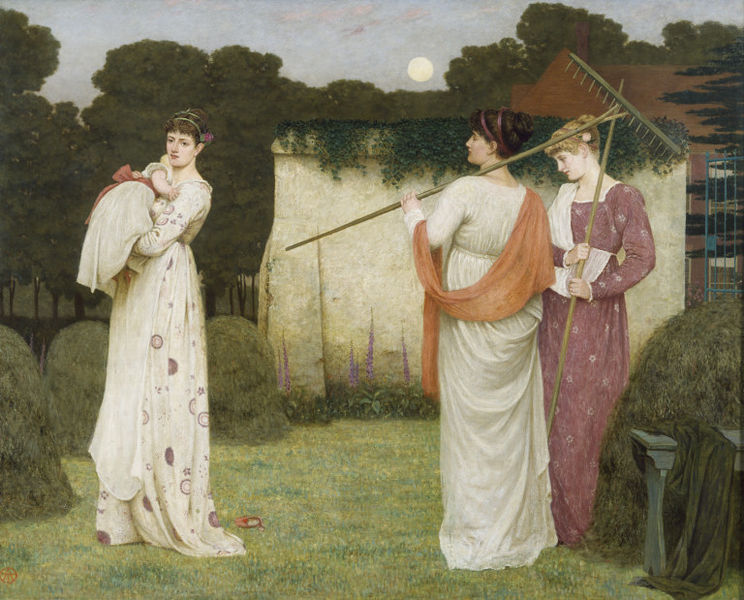
I fell in love with the dress on the left: Thomas Armstrong, "The Hay Field" Oil on Canvas, 1869, V & A.
Though fashionable dress and textile designs are scattered through-out the catalog (and exhibition) – two small sections focus on dress and jewelry-placing them within the greater context of the artists and art-forms of the movement.
Click here to purchase the exhibition catalog.
The first is an essay by Edwina Ehrman, Curator of Textiles and Fashion at the V & A, “Women’s Dress” and though short – it notes that the leaders of the Aesthetic movement (Edwin Godwin, William Morris, Walter Crane and Oscar Wilde) all argued in favor of “the beauty of the natural body and that a woman’s clothes should reflect her form and respect its physiology.”
She notes that “in the 1870s women wishing to dress artistically were recommended to look for inspiration in paintings, particularly those by the Pre-Raphaelite artists, and in books about period costume wher they would find attractive sleeve details and decorative combinations of colours and fabrics.”
If you can’t make it to see the exhibition in person in San Francisco, the catalog is highly illustrated and well-written – utilizing the V & A’s knowledgeable curators. I ended up both seeing the exhibit and getting the catalog – the lure of that one dress was too irresistible to pass up.
The Fashion World of Jean Paul Gaultier: From the Sidewalk to the Catwalk exhibit at the de Young has been getting a fair amount of media attention since it opened to the public on March 24. Much of the coverage focuses on the technology used for the mannequins, and indeed when I first saw them I was mesmerized – to the point that I forgot to look at the garments on display in the first gallery. I began to get concerned that the distraction of the display techniques would overpower the rest of the show. But, by the end of the first gallery, I had thankfully re-engaged with the content.
The Museum has been organizing large scale events, as well as academic explorations of the exhibition through events including a conversational lecture between Suzy Menkes and the designer; as well as historical perspective by Kimberly Chrisman-Campbell. In Menkes introduction of Gaultier, she takes a moment to clarify that the ‘tricks’ and cleverness often used by designers (both exhibition designers and fashion designers) are not the real value of the exhibition. She points out that the value is really in Gaultier’s focus on “technique, skill and handwork.” She also made sure to draw attention to Gaultier’s ability to capture a moment in time.
Her comments are by no means insignificant, and when speaking on “technique, skill and handwork,”she points out that “if you search, you can find them” –perhaps implying that they weren’t as much of a focus as they should be. While I was certainly drawn in and amazed by the technology -ultimately it was his focus on craft and design (and yes, details) that ultimately kept me engaged.
The exhibit features over 200 utterly captivating objects that I’d put in the category of contemporary art – several of the speakers at the press preview felt that way too. Gaultier’s work is both ‘of the moment’ and contains historical reference and I frequently found myself identifying a particular moment in history: the Madonna cone bra being the obvious iconic element.
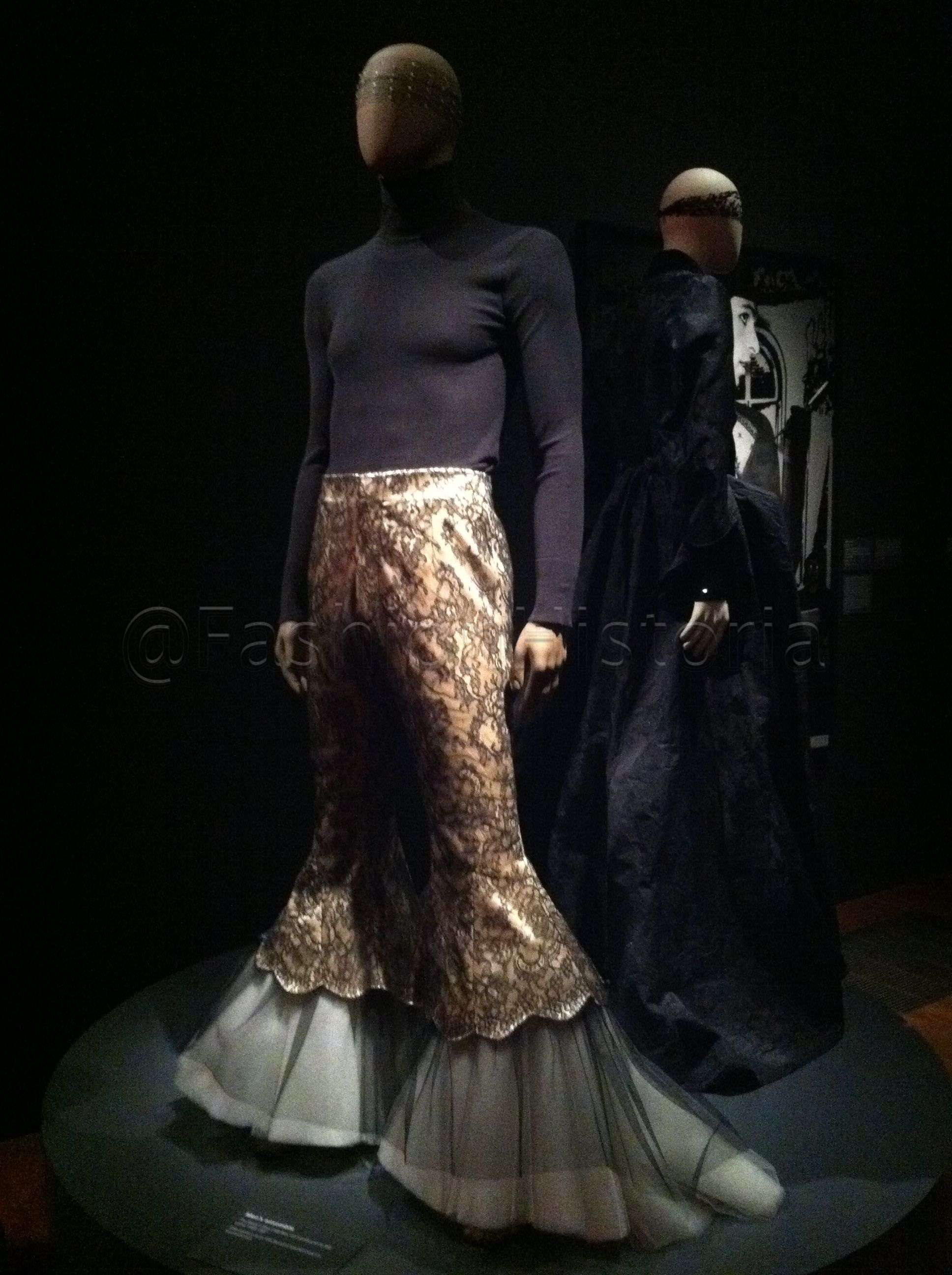
I also found historical references in a pair of men’s pants that reminded me of a Charles James ball gown; or the Red-beaded headdress in the shape of a schooner harkening Marie Antoinette; or a pair of women’s trousers with knife-pleates at the bottom which reminded me of some of Dior’s work from the 1950s. For those not able to see the show in person – there is a huge exhibition catalog (and Amazon is selling it at a discount: it’ll save you $50). For those of you who are able to see it (or who saw it in Montreal) – what’s your take on the mannequins?
Please enjoy the brief photo-tour
Devil in the details…
Men’s pants (that remind me of a Charles James ball-gown)
Actress Rosalind Russell said to Mourning Becomes Electra (1947) Costume Designer, Travis Banton “We have got to change these petticoats because they are going to make too much noise on the microphones; the taffeta will rustle.’” (Russell, Rosalind and Chris Chase. Life is a Banquet. New York: Random House, 1977, pg 144)