Happy Birthday 1st Birthday to FashionHistoria! I started this blog as an experiment, to see if a fashion history blog was something that just one person could manage. My idea was to highlight the fashion scholarship, history and activities of California and the West, including film costume history, the interwar years, yarn/craft arts and my other personal interest. Short but personal blog posts with an academic tone, and the occasional book or film review have also been my aim.
Almost 20,000 of you have read something here in the last year (that shocks the pants off of me!). There are a number of exciting projects coming down the pike, and I hope you’ll stick around to read about them. As always, your feedback and comments are encouraged.
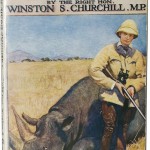
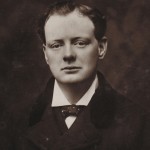
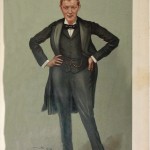
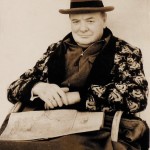
As the New York Times pointed out back in February (“Winnie the Posh”), there is a small, but growing number of new books devoted to Winston Churchill. Though their brief note (and image gallery) didn’t do much in terms of reviewing the new book Churchill Style: The Art of Being Winston Churchill by Barry Singer, the Wall Street Journal‘s article from last Saturday (“The Wonderful World of Winnie“) does go a little further:
“Churchill’s tastes for whiskey, Cognac, cigars and painting are well known, but Mr. Singer’s book—packed with the prime minister’s old order forms for suits, Champagne and cigars, and a wealth of archival images—unearths other, more surprising tastes, including a penchant for butterflies, roses, pink silk underwear, zippers (on anything), bricklaying and even jumpsuits.”
The article goes on to give brief quotes from the book on Churchill’s tastes for suiting, bowties, outerwear, undergarments, workwear, shoes and hats.
He loved his slippers and had them made at Hook, Knowles & Co. (via Chartwell Booksellers /Wall Street Journal)
Having the book in hand, and reading it over the last week – I find that Mr. Singer is a marvelous and succinct story teller. I’ve learned tremendous amounts about a man whom, until recently, I knew very little. Each chronological chapter is rich with not only illustrations, but also in tremendous stories. Each chapter is divided into short subtitled sections discussing things like “Home,” “Fashion,” “Dining,” and “Pastimes.” Of course, the sections on fashion were of interest to me – but surprisingly, the home sections revealed interesting textile tidbits as well. For example: as a teenager at boarding school in the 1880s, Churchill asked his mother to send him some Liberty fabrics to decorate his dorm room.
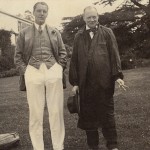
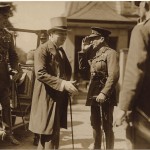
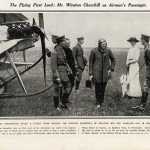
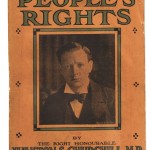
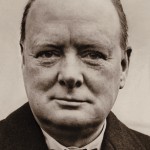
The book makes the political figure seem somehow more human and more knowable, by making his everyday life and everyday choices more readily accessible to us. The book was officially released to the public yesterday and is for sale at Amazon or your local bookstore. A few select images of Churchill, as depicted in the book, are below:
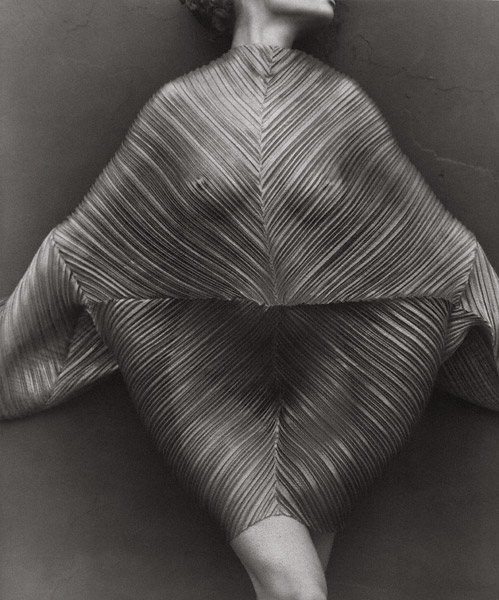
Following in the footsteps of other important fashion photographers such as George Hurrell, Horst P. Horst, Louise Dahl Wolfe, Irving Penn, and Richard Avedon, 1980s photographer Herb Ritts (1952–2002) is now the center of an exhibition titled Herb Ritts: LA Style, through August 26, 2012, at the Getty Center, West Pavillion in Los Angeles. Best known for his fashion photography, nudes and celebrity portraits in dazzling black and white his photographs seem to search for and elevate pure beauty.
The online component of the exhibition includes a brief overview, and of the above photograph, explains:
“To show off this dress by Issey Miyake, Ritts selected a dark backdrop and had model Karen Alexander adopt a ballet-like pose. Lighted from above, the semitranslucent fabric both reveals and obscures the contours of the model’s body. The photographer’s choice of the platinum printing process over the less expensive and more common gelatin silver process gives the photograph a significantly wider range of tones and a luxurious matte surface.”
Tomorrow evening, visual studies scholar Jonathan Katz will give a lecture titled “Aide/AIDS-mémoire: Herb Ritts and the Picture of Health.” His lecture will, in part, resituate “Ritts’s work in the social and cultural context of the worst years of the plague” and argue “that his commercial and critical import stem in large part from the fact that he was an openly gay photographer who nonetheless proffered a utopian dream…”
Those of you who follow me on Twitter know that I’ve been debating watching L’Amour Fou, the 2010 film on Yves Saint Laurent, for the last few weeks. This last weekend, I finally took the plunge. I have read a good deal on Yves Saint Laurent, but somehow seeing the information in a film made a greater impression on me. If you haven’t seen the film, and you are a fan of fashion history (or art history), I encourage you to watch:
On Thursday, May 10 at 12pm, The Commonwealth Club of California in San Francisco will play host to the Chavez Santiago family of the “famed weaving village of Teotitlan de Valle presents its story of this ancient art form, a family, a culture and preserving a way of life across generations.” The New York Times travel writer Freda Moon included them in her article “36 Hours: Oaxaca, Mexico” in January (they also have a wonderful slideshow that includes some great images of weaving).
Panelists for the Commonwealth Club talk include:
Caracol pattern rug dyed with pecan shells by Federico Chavez Sosa, Master Weaver, Teotitlan del Valle, Oaxaca, Mexico (Via Facebook)
Federico Chavez Sosa, Master Weaver in the Zapotec tradition
The Chavez Santiago family uses a “combination of traditional patterns and weaving techniques with modern colors and sensibilities.” The family also works to support their local community and the traditional Zapotec culture. I’m particularly interested in their commitment to using only 100% natural dyes in their work, which seems both forward-thinking and historically accurate.
Doors open at 11:30am, with the program beginning at noon. Tickets are free for Commonwealth Club members and cost $20 for non-members and $7 for students (with valid ID). Tickets can be purchased online here. Hope to see you there!
For a quick taste of the talk, here is a short film featuring Federico Chavez Sosa:
Royal Wedding. Tokyo, Japan: Japanese Crown Prince Akihito and his bride, the former Michiko Shoda, pose in traditional Japanese wedding costumes before their marriage here, April 10. After the wedding ceremony, the couple donned western-style clothing for the parade through Tokyo. April 10, 1959. (Corbis)
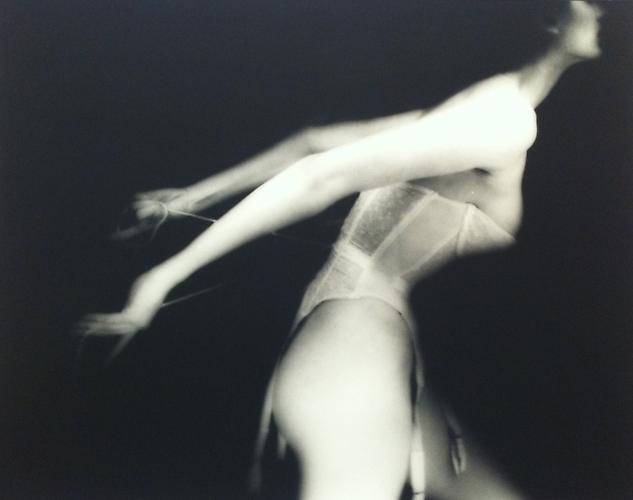
It's A Cinch: Carmen, New York, Harper's Bazaar 1951 gelatin silver print by Lillian Bassman (Peter Fetterman Gallery)The Well-Spent Dollar, girdle by Gossard, 1956
Lillian Bassman: Lingerie is a visually rich book of fashion photography, spanning sixty years of Bassman’s career (Bassman passed away just a few months ago in February 2012). If you want to understand anything about the way the fashionable silhouette has changed over those sixty years – a good start would be to look at the lingerie underneath.
The book includes eighty of Bassman’s black and white images, as well as an introductory essay by Eric Himmel, Vice President, Editor-in-Chief at Harry N. Abrams, Inc. He deftly places her in within the context of the fashion magazine world and greater historical events. He describes her working relationship with Alexy Brodovitch and Carmel Snow, art director and editor for Harper’s Bazaar – whom she began working with in 1948. Himmel’s introduction notes, “She was an inveterate observer of women and their ways.” and describes the role of lingerie photography in her career:
“Over time, the photography of women in lingerie became a part of Bassman’s regimen, akin to a painter’s weekly sessions with figure model and sketchbook. As the structured undergarments of the fifties gave way tot he more natural styles of the sixties, she captured a new freedom of movement in her models that replaced the languid sensuality of the earlier photographs. The jobs, both editorial and commercial, as well as sessions with friends to experiment, were occasions to represent the female figure, one of the oldest tasks in art, intimately familiar to Bassman from her days as an artist’s model. . . Each image has passed through many states on the way to its reproduction in this book, but none would be unpleasing to the thirty-one-year-old in her homemade bodice and skirt.”
Happily, the Peter Fetterman Gallery in Santa Monica is currently exhibiting Lillian Bassman: A Life through June 9 at and it includes her lingerie work as well as her other fashion photography. There’s also this marvelous video that Harper’s Bazaar put together – its insightful and reveals much about her career and process.
June 1, 1935: "Women Play Bowls A bowls match with participants wearing the latest fashion in beach pyjamas, England, 1935." Via Corbis
Initially introduced as fashionable women’s wear in 1922 by Paul Poiret as pajamas, they eventually evolved into casual wear worn for specific occasions– for sleeping, lounging and the beach (Watson, 2004). Lounging pajamas, according to Vogue, were for “when informal entertainments and masquerades are the order of the day.” Chanel helped with the general acceptance of women’s trousers, and was often seen wearing sailor-style pants. Pants of this era were loose with an elastic or drawstring waists with a side closure (Mendes & De La Haye, 1999).
The opening reception will be on April 21st from 1-3pm and the exhibition will also be open during the University’s Commencement, on Saturday May 19.
In scrolling through some of the artists profiles I was struck often by Dan Herrera‘s work and his interest in the body. Of his series “Estan de una Herencia Extraña” he notes “This work centers around the idea of skin, and thinking about skin as a continuous surface in relationship to time and movement. . . . Working in this way, the elasticity of both time and skin can be stretched – revealing curious illustrations of movement.” But it was his series “The Alchemists” which I found both aesthetically pleasing as well as engaging intellectually. An artist statement related to these images was absent from his portfolio, but they almost don’t need one. Enjoy, and for more visit his website.
"Corset" 2004 by Dan HerreraCreation, 2004 by Dan Herrera