This coming June my paper, “Icon: The Shirtwaist Dress in Good Housekeeping and other media,” will be included in the presentations at the upcoming conference: Women in Magazines: Research, Representation, Production and Consumption.
Sunday, May 20 at the UICC, 4pm Irish People, Irish Linen with Author Kathleen Curtis Wilson. Presented by the Irish Literary & Historical Society of the San Francisco Bay Area.
The Irish Literary & Historical Society welcomes Kathleen Curtis Wilson who will speak about her highly acclaimed book Irish People, Irish Linen – the story of the craft, industry, and traditions of the Irish linen trade. The story of Irish linen is a story of the Irish people. Many thousands of men and women made Irish linen a global product and an international brand. Into this cultural history Ms. Wilson weaves personal narratives and the words and songs of individual spinners, factory workers, and out-workers like Sarah McCabe, who created fabulous linen lace. The book has garnered high praise, with one scholar proclaiming “Kathleen Curtis Wilson eloquently describes the saga in her beautifully illustrated book on linen, the queen of fabrics.”
Ms. Wilson arrived at her passion for textile crafts early in life, captivated by a chest full of Japanese fabrics she found in her grandparents’ attic, she pursued weaving from the age of 12 under expert tutelage. She became a renowned authority on Appalachian crafts, and became increasingly drawn to the Scots-Irish roots of Southern textiles, and linen in particular. This took her on a path of discovery to Northern Ireland and the treasures of linen craft that have been handed down for generations. Please join us for this very special event, a reception will follow the presentation
When: Sunday May 20, 4pm
Where: The United Irish Cultural Center, 2700 45th Avenue, San Francisco, CA 94116. (Saint Francis Room)
Admission: $5 for visitors, free for ILHS members
More information: www.ILHSsf.org or call Kathy Hall, Membership Secretary ILHS at 650-235-6862
Last week, I was able to share with you my thoughts on the newly released book Schiaparelli and Prada: Impossible Conversations – and this week I’m happy to share that I have a copy of the book to GIVE AWAY to one lucky reader.
To enter simply leave a comment in the section below discussing your favorite Schiaparelli or Prada design (link to a photo if you can!)
Original caption: "The early fall bathing at Venice, California, where beauties cavort in beach costumes of abbreviated nature not sensed by the censor were treated to a rather unusual sight with Miss Marilyn McKinney appeared on the sands wearing a bething costume of oriental design and heavily beaded." October 10, 1922 via Bettmann/Corbis
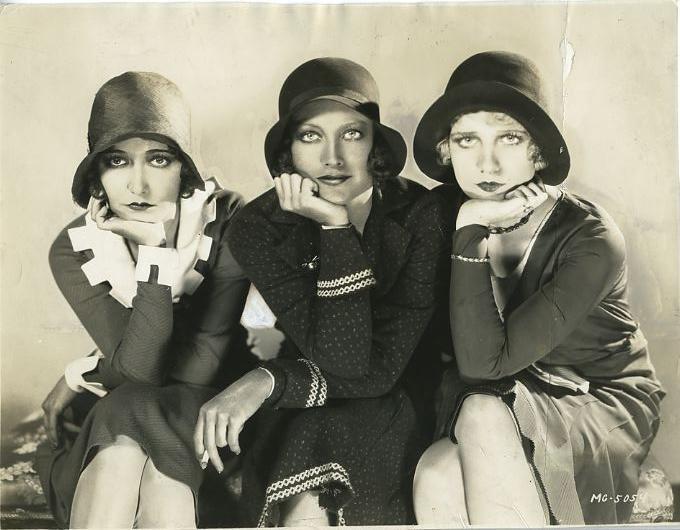
“David Cox, who had been [Gilbert] Clark’s assistant, stayed on until 1931 and became a fully-fledged designer. He did Joan Crawford’s famous beaded Charleston dress for Our Dancing Daughters and the rest of her films until the arrival of Adrian.
Anita Page, Joan Crawford, and Dorothy Sebastian in costumes by David Cox.
Six days before the film had its world premiere in New York on 6 October, an article appeared in the New York Evening Journal that was ostensibly written by Joan Crawford herself. More likely, it was the creation of an anonymous writer in the publicity department. In either case, this article, widely reprinted across the country, goes a long way toward establishing an image for the actress that would reverberate throughout her career at MGM:
‘Something new has entered the world of clothes and personal adornment. It is not just a change in fashion, a new style. It is a concrete, tangible thing. A spirit. The spirit of modernity. The spirit finds an expression of itself in the clothes we wear. They are modern. They are startling. They do not blend; they contrast. They do not conceal; they expose. They do not rustle; they swing. They do not curve; they angle. Perhaps this new feeling in the dress finds its first and most definite expression in the motion picture world. We are the first to exploit a style. The modern clothes spirit I am talking about is abundantly typified in the picture Our Dancing Daughters. My own wardrobe, and the wardrobe worn by Dorothy Sebastian and Anita Page, breathe the very essence of restless activity…the costumes of that particular production as the costumes of my own personal wardrobe.’
Excerpted from
This article was one of the final pieces of publicity in an exploitation onslaught that made Our Dancing Daughters a watershed film for the marketing and publicity departments at Metro-Goldwyn-Mayer.”
Choose from thousands of opera, theatre, dance, musical theatre and film-related items. These items are duplicate material from our library collection. Pay one admission for each time you pass through the Sale in the Main Gallery and take away as much as you can carry in one arm load. Individually priced items will be available for sale in the adjacent Reception Gallery. Proceeds benefit the preservation of MPD’s collections.
While the Met’s big gala for Schiaparelli and Prada: Impossible Conversationshas come and gone, the curatorial work and content of the show is the real treat for fashion historians, clothing and costume academics, and enthusiasts alike.
For the past two weeks I’ve been thumbing through the beautifully produced book that accompanies the exhibition. Curators Andrew Bolton and Harold Koda have paired with New Yorker writer Judith Thurman to provide some incredibly well-honed thinking on the two designers, explaining the process for the show; the structural construct behind it; and providing new analysis of the two vastly different and yet remarkably similar designers.
Schiaparelli and Pradawas developed, in part, to take advantage of the recent addition of a significant number of Schiaparelli pieces acquired from the Brooklyn Museum’s collection. Curators and staff had long wanted to put together a ‘conversation’ exhibition between two designers, and modeled the show on Miguel Covarrubias’s “Impossible Interviews” fictional series done for Vanity Fair in the 1930s. The ‘book within a book’ design concept provides space for the two designers statements on similar subject matter to create what the curators deem (appropriately enough) “a faintly surreal conversational tone.”
From "The Surreal Body" (Schiaparelli -right; Prada - left)
Schiaparelli and Pradais divided into seven sections examining varying types of ‘chic,’ (hard, ugly, naif) and ‘the body’ (classic, exotic, surreal) explored by the two designers, as well as a section called ‘waist up/waist down.’ The premise reminds me of a comparative literature class I once took in undergrad that focused on William Faulkner and Toni Morrison where the final project was to enact a fictional debate between the two authors. The result was a deeper and more nuanced understanding – and the same results are achieved with Schiaparelli and Prada.
Through this we learn how dis-similar the two views are on fashion as art (Schiaparelli: Pro; Parda: Con); yet how similar their interests were/are in narrative prints, the artistic avant garde, tromp l’oil, as well as both good and bad taste (perhaps the ‘bad taste’ element inspired the Mark Jacobs fiasco). I’ve yet to finish it, but I’m intrigued but what I’ve encountered so far.
For more of the visual comparisons made by the book, I’ve included some sample page-spreads below:
1/16/1932-Palm Springs, CA- Pola Negri, film actress, recuperating from her recent illness at Palm Springs, CA, had quite a chat with Na Glee Nonassa (the Peacemaker) Princess of the Navajo tribe of Native Americans living in that section. (via Corbis)
After years of plugging away at the academic study of dress and textiles, I am about to start a new position in my preferred field! My new job as the Marketing Director for the San Jose Museum of Quilts and Textiles begins tomorrow, and I’m so thrilled to be working in a museum, with textiles, and in the bay area!
For those who aren’t familiar, the San Jose Museum of Quilts and Textiles is a small museum with a big mission: to “promote the art, craft and history of quilts and textiles.” and they will celebrate their 35th Anniversary this year.
Haena Point (Hawaiian Sunset No. 1), By Mark Adams, Quilt, 1979 From the Collection of the Stanford Library of Art and Architecture
It all began in 1977, when the Santa Clara Valley Quilt Association opened in a Los Altos storefront. Now in its permanent home in downtown San Jose, the collection houses “850 quilts, garments and ethnic textiles, and a research library of more than 500 books on the history and making of quilts and textiles.”
If you’ve never seen an art quilt on a museum wall, you are missing out – quilts are a flexible form, that can work as painting, sculpture or artifact. I’ve seen quilts as portraits, landscapes, using the same painterly techniques as pointillism or impressionism and the fashion techniques of bead and ribbon work to create evocative masterworks of art. The museum also frequently exhibits non-quilt textiles, including fashion, crochet and knitwear, and tech-textiles.
Sea jellies crocheted with metal by Arline fisch at SJMQT
I can’t tell you just how excited I am about this opportunity. As I grow familiar with my new role, I’ll be sure to share exciting exhibitions, events, objects and opportunities with you.
Check out the Facebook page, and the list of upcoming exhibitions for a preview of what I’ll be working on – and if you happen to be down in the South Bay, be sure to pop by!


_03.jpg)