That Medieval Bra Business…

Lengberg Castle, East-Tyrol: 15th century linen “bra” in comparison to a longline-bra from the 1950´s

I don’t know how many of you read the CSA “Communities for the Study of Dress and Fashion Forum” Listserve, but there was quite a lively discussion last week about the now well-known 15th century ‘lingerie’ found in an Austrian castle. The most commonly cited article being from the Daily Mail, By Dalya Alberge. Much of the discussion on the forum was about the vocabulary being used: “bra,” “lingerie,” and other phrases normally used to describe twentieth and twenty-first century undergarments (not to mention hyperbole and sensationalistic writing). Listserve writers complained about the loss of educational opportunity, as well as the lack of contextualization for these pieces.

This University of Innsbruk article on the find, provides a little more of the cut-and-dry information of what was found, but here again also only uses modern-day terms to describe the objects (aside from a passing reference to a “Mieder” (German for corselette).

A woman hits her husband and puts on his underpants while he winds yarn in an engraving by Israhel van Meckenem, late 15th century.

The most informative article however, published a few days ago in the BBC History magazine, goes into considerable depth and provides a lot more context. That might be because it is written by Beatrix Nutz, a researcher at the Institute of Archaeology, University of Innsbruck (She is writing her thesis on the textiles from Lengberg). For example, Nutz explains:

There are some written medieval sources on possible female breast support, but they are rather vague on the topic. Henri de Mondeville, surgeon to Philip the Fair of France and his successor Louis X, wrote in his Cyrurgia in 1312–20: “Some women… insert two bags in their dresses, adjusted to the breasts, fitting tight, and they put them [the breasts] into them [the bags] every morning and fasten them when possible with a matching band.”

Nutz’s long, in-depth article is full of citations, quotes, and references – proving much more educational and satisfactory to this historian. She even provides the more accurate term, “breast bags” to describe the bra-like undergarments, and helps to fill in a lot of the gaps left by the more sensationalized articles. Hopefully, her work will seep into the general consciousness, despite its lack of sensationalism.

Feel free to leave your comments below.

Continue Reading

Undergardments: 1920-1929


c1925: Slips and bloomers, fashionable in the 1920s, and a corset, worn during the Victorian era.

The boyish silhouette of the 1920s required special undergarments. Generally, a bandeau was used to flatten the bust with a single piece of fabric. Corsets and girdles were still heavily boned. Corset substitutes were made of softer elastic and referred to as “step-ins.” Specialty corsets were created for wear during sports, dancing, and even pregnancy. Towards the end of the decade, as a natural shape became more popular, brassieres with cups and mild shaping were developed.

Loose-fitting bloomers or knickers were made of silk or rayon and were gathered just above the knee.  They came in a number of forms including one-piece camiknickers, teddy’s, step-ins, or just plain drawers (which resembled slightly flared, bifurcated skirts).  During the early years of the 1920s, calf-length petticoats were worn, but as hemlines rose, these garments were rendered obsolete.

Sources


Laubner, Ellie. Fashions of the Roaring Twenties. Atglen, PA: Schiffer Publishing Co., 1996. 15-17

Mendes, Valerie and Amy De La Haye. 20th Century Fashion. London: Thames & Hudson, 1999. 65

Riordan, Teresa. Inventing Beauty, New York: Broadway Books, 2004. 87

Continue Reading

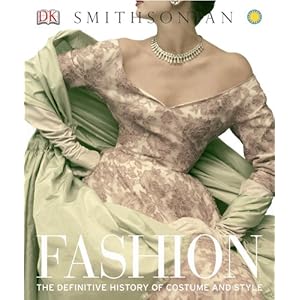
I’m in Print! “Fashion: The Definitive History of Costume and Style”

Due out in October of 2012, Fashion: The Definitive History of Costume and Style (DK publishers) was a joy to be a part of this past April and May.

I contributed several sections – including some writing on mod fashion, 1950s ball gowns and cocktail dress, as well as section on 1970s women’s trousers. You can pre-order a copy on Amazon now and get $20 off…


Continue Reading

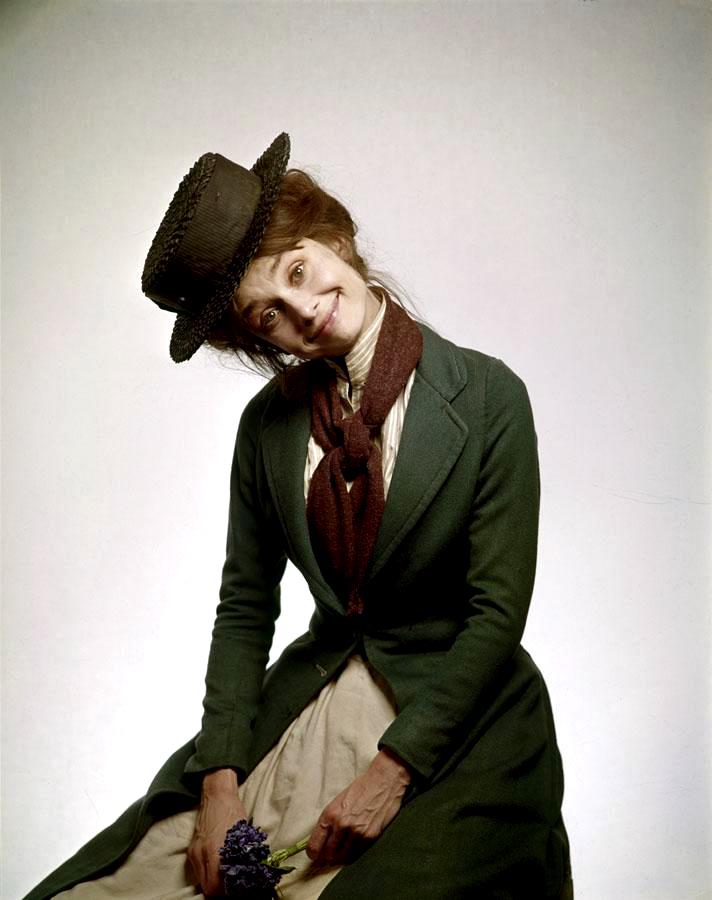
My Fair Lady (1964): Make-up and Hair

Audrey Hepburn as Eliza Doolittle (My Fair Lady, 1964) Costumes by Cecil Beaton

“The makeup people, led by the Westmore brothers, did a fine job de-glamorizing Audrey, with [Cecil] Beaton’s cooperation. Her hair had to be filled with an unpleasant substance known as Fuller’s earth—which was quite toxic—and she had to wear a special kind of kohl makeup and a drab foundation to make her look sallow and underfed. For the tests she also had to undergo the blackening of her fingernails and the backs of her hands, and her clothes were deliberately made large so that her frail figure would disappear in them…

Every scene had to be tested in costume again and again because the essence of the movie lay in the gradual transition of Audrey from goose to swan. Beaton stood over her like a Svengali, ordering, in his own words, ‘Strands of her hair to be placed in this direction or that, suggesting more or less eyelash, selecting a brooch or a trinket.’ Every hairstyle had to be argued over and decided upon. Finally, Audrey and Beaton jointly settled on Edwardian bangs like those worn by the famous British music hall star Gertie Millar. Audrey risked having her face look even more square than usual because she wanted total period authenticity, and deeply respected Beaton’s taste and experience…

She had particular fun choosing the right hat for the ascot scene. She and Beaton finally chose one that was replete with cloth poppies and antic bows and would tremble when she jumped up to see the horses.”

–Charles Higham, Audrey: The Life of Audrey Hepburn, New York: Macmillan Publishing Company, 1984.


Continue Reading

Book Giveaway: Balenciaga and Spain by Hamish Bowles

Enter to win a copy!

I told you to watch this space for more give-aways! Today’s contest is to win a copy of Balenciaga and Spain by Hamish Bowles. This is an exhibition catalog from the Fine Arts Museums of San Francisco’s exhibition last year. Worn Through writer, Lauren Michel reviewed the show back in May 2011 and included a number of wonderful photographs, plus an interview with Hamish Bowles.

To enter to win a copy of the lavishly illustrated book, I want to know which of his many inspirations speaks to you most. In the comments section below, tell me which Balenciaga design you love – and what inspired it (and be sure to include links to photos!)

Deadline for entry: June 20, 2012

Good Luck!


Continue Reading

“Miss Monroe refused to wear underclothes”

*

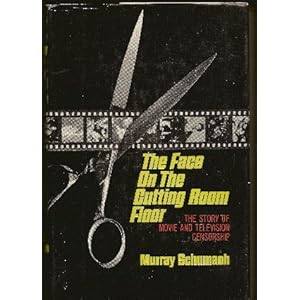
“What cannot be pushed past the censors with words is often tried with costume. Marilyn Monroe was an expert at this—often to the despair of designers. Miss Monroe refused to wear underclothes. She felt they inhibited the rotary motion of her hips, dulled the color of her skin and, in general, reduced her sex appeal. Even in a high-necked gown with long sleeves she managed to be so revealing that on one occasion beads had to be added as a sop to the censors.

“Miss Monroe’s favorite comment about the concern of censors with her cleavage was: ‘The trouble with censors is that they worry whether a girl has cleavage. They ought to worry if she hasn’t any.’ To make sure her cleavage was shown to best advantage, she would slyly pull down the décolletage before camera time. This infuriated some of her designers.”

–Schumach, Murray. “ ‘Boudoirs and Blood; sex,’ The Face on the Cutting Room Floor: The Story of Movie and Television Censorship, New York: Morrow, 1964. p. 167-168.

*Click for Image source.

Continue Reading

Win a Copy: The Cult of Beauty Exhibition Catalog

The Cult of Beauty: The Victorian Avant-Garde 1860-1900 ends its run at the Legion of Honor on June 17th. I previously reviewed the catalog back in April – and now, you have the opportunity to win a copy!

The catalog describes the styles utilized by the Aesthetic Movement (Japonism, Neo-Classisism, and Pre-Raphaelite), and provides insights on the artists, designers, makers and writers of the era – from William Morris to Liberty & Co, to Oscar Wilde, Whistler, Gowin and Beardsley.

To enter: In the comments section below, tell me who your favorite designer (fashion or decorative) from this period is, and more importantly, WHY? Include links to a particular design from this period if you can.

Deadline: Wednesday, June 6, 2012.

Continue Reading

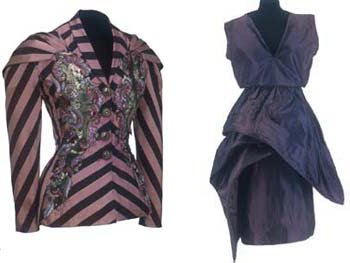
Schiaparelli & Prada: The Book Winner!

I am so happy that so many of you entered (10!) in the contest to win a copy of Schiaparelli & Prada! Below are some of the images that people submitted (in case you missed it). I was pleasantly surprised to see that many of you went to major museums to pull images for the contest (Costume Institute, Philadelphia Museum, FIDM Museum and Chicago History Museum were all included!) I’m also a little surprised that only one of you submitted a Prada image (tells me a good deal about the readers of this blog). In anycase, I guess I’d better tell you who won the book, no?

It was a hard choice, but the Winner is…….


Jacqueline !

Thanks to everyone for participating!

Continue Reading

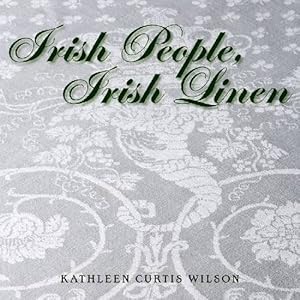
Irish People, Irish Linen: Sunday, May 20 in San Francisco

_

Sunday, May 20 at the UICC, 4pm Irish People, Irish Linen with Author Kathleen Curtis Wilson. Presented by the Irish Literary & Historical Society of the San Francisco Bay Area.

The Irish Literary & Historical Society welcomes Kathleen Curtis Wilson who will speak about her highly acclaimed book Irish People, Irish Linen – the story of the craft, industry, and traditions of the Irish linen trade. The story of Irish linen is a story of the Irish people. Many thousands of men and women made Irish linen a global product and an international brand. Into this cultural history Ms. Wilson weaves personal narratives and the words and songs of individual spinners, factory workers, and out-workers like Sarah McCabe, who created fabulous linen lace. The book has garnered high praise, with one scholar proclaiming “Kathleen Curtis Wilson eloquently describes the saga in her beautifully illustrated book on linen, the queen of fabrics.”

Ms. Wilson arrived at her passion for textile crafts early in life, captivated by a chest full of Japanese fabrics she found in her grandparents’ attic, she pursued weaving from the age of 12 under expert tutelage. She became a renowned authority on Appalachian crafts, and became increasingly drawn to the Scots-Irish roots of Southern textiles, and linen in particular. This took her on a path of discovery to Northern Ireland and the treasures of linen craft that have been handed down for generations. Please join us for this very special event, a reception will follow the presentation

When: Sunday May 20, 4pm

Where: The United Irish Cultural Center, 2700 45th Avenue, San Francisco, CA 94116. (Saint Francis Room)

Admission: $5 for visitors, free for ILHS members

More information: www.ILHSsf.org or call Kathy Hall, Membership Secretary ILHS at 650-235-6862

Continue Reading
1 8 9 10 11 12 19