Last week, I was able to share with you my thoughts on the newly released book Schiaparelli and Prada: Impossible Conversations – and this week I’m happy to share that I have a copy of the book to GIVE AWAY to one lucky reader.
To enter simply leave a comment in the section below discussing your favorite Schiaparelli or Prada design (link to a photo if you can!)
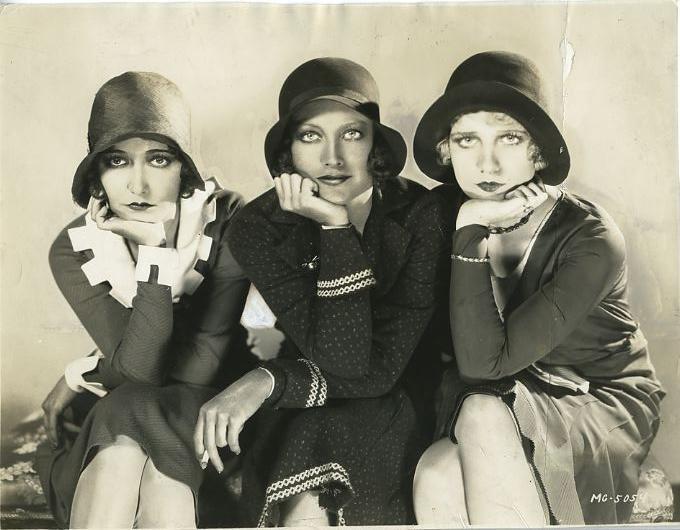
“David Cox, who had been [Gilbert] Clark’s assistant, stayed on until 1931 and became a fully-fledged designer. He did Joan Crawford’s famous beaded Charleston dress for Our Dancing Daughters and the rest of her films until the arrival of Adrian.
Anita Page, Joan Crawford, and Dorothy Sebastian in costumes by David Cox.
Six days before the film had its world premiere in New York on 6 October, an article appeared in the New York Evening Journal that was ostensibly written by Joan Crawford herself. More likely, it was the creation of an anonymous writer in the publicity department. In either case, this article, widely reprinted across the country, goes a long way toward establishing an image for the actress that would reverberate throughout her career at MGM:
‘Something new has entered the world of clothes and personal adornment. It is not just a change in fashion, a new style. It is a concrete, tangible thing. A spirit. The spirit of modernity. The spirit finds an expression of itself in the clothes we wear. They are modern. They are startling. They do not blend; they contrast. They do not conceal; they expose. They do not rustle; they swing. They do not curve; they angle. Perhaps this new feeling in the dress finds its first and most definite expression in the motion picture world. We are the first to exploit a style. The modern clothes spirit I am talking about is abundantly typified in the picture Our Dancing Daughters. My own wardrobe, and the wardrobe worn by Dorothy Sebastian and Anita Page, breathe the very essence of restless activity…the costumes of that particular production as the costumes of my own personal wardrobe.’
Excerpted from
This article was one of the final pieces of publicity in an exploitation onslaught that made Our Dancing Daughters a watershed film for the marketing and publicity departments at Metro-Goldwyn-Mayer.”
While the Met’s big gala for Schiaparelli and Prada: Impossible Conversationshas come and gone, the curatorial work and content of the show is the real treat for fashion historians, clothing and costume academics, and enthusiasts alike.
For the past two weeks I’ve been thumbing through the beautifully produced book that accompanies the exhibition. Curators Andrew Bolton and Harold Koda have paired with New Yorker writer Judith Thurman to provide some incredibly well-honed thinking on the two designers, explaining the process for the show; the structural construct behind it; and providing new analysis of the two vastly different and yet remarkably similar designers.
Schiaparelli and Pradawas developed, in part, to take advantage of the recent addition of a significant number of Schiaparelli pieces acquired from the Brooklyn Museum’s collection. Curators and staff had long wanted to put together a ‘conversation’ exhibition between two designers, and modeled the show on Miguel Covarrubias’s “Impossible Interviews” fictional series done for Vanity Fair in the 1930s. The ‘book within a book’ design concept provides space for the two designers statements on similar subject matter to create what the curators deem (appropriately enough) “a faintly surreal conversational tone.”
From "The Surreal Body" (Schiaparelli -right; Prada - left)
Schiaparelli and Pradais divided into seven sections examining varying types of ‘chic,’ (hard, ugly, naif) and ‘the body’ (classic, exotic, surreal) explored by the two designers, as well as a section called ‘waist up/waist down.’ The premise reminds me of a comparative literature class I once took in undergrad that focused on William Faulkner and Toni Morrison where the final project was to enact a fictional debate between the two authors. The result was a deeper and more nuanced understanding – and the same results are achieved with Schiaparelli and Prada.
Through this we learn how dis-similar the two views are on fashion as art (Schiaparelli: Pro; Parda: Con); yet how similar their interests were/are in narrative prints, the artistic avant garde, tromp l’oil, as well as both good and bad taste (perhaps the ‘bad taste’ element inspired the Mark Jacobs fiasco). I’ve yet to finish it, but I’m intrigued but what I’ve encountered so far.
For more of the visual comparisons made by the book, I’ve included some sample page-spreads below:
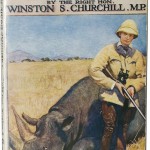
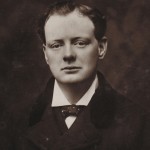
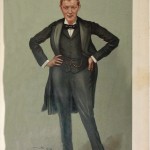
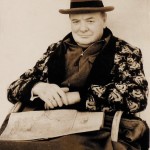
As the New York Times pointed out back in February (“Winnie the Posh”), there is a small, but growing number of new books devoted to Winston Churchill. Though their brief note (and image gallery) didn’t do much in terms of reviewing the new book Churchill Style: The Art of Being Winston Churchill by Barry Singer, the Wall Street Journal‘s article from last Saturday (“The Wonderful World of Winnie“) does go a little further:
“Churchill’s tastes for whiskey, Cognac, cigars and painting are well known, but Mr. Singer’s book—packed with the prime minister’s old order forms for suits, Champagne and cigars, and a wealth of archival images—unearths other, more surprising tastes, including a penchant for butterflies, roses, pink silk underwear, zippers (on anything), bricklaying and even jumpsuits.”
The article goes on to give brief quotes from the book on Churchill’s tastes for suiting, bowties, outerwear, undergarments, workwear, shoes and hats.
He loved his slippers and had them made at Hook, Knowles & Co. (via Chartwell Booksellers /Wall Street Journal)
Having the book in hand, and reading it over the last week – I find that Mr. Singer is a marvelous and succinct story teller. I’ve learned tremendous amounts about a man whom, until recently, I knew very little. Each chronological chapter is rich with not only illustrations, but also in tremendous stories. Each chapter is divided into short subtitled sections discussing things like “Home,” “Fashion,” “Dining,” and “Pastimes.” Of course, the sections on fashion were of interest to me – but surprisingly, the home sections revealed interesting textile tidbits as well. For example: as a teenager at boarding school in the 1880s, Churchill asked his mother to send him some Liberty fabrics to decorate his dorm room.
The book makes the political figure seem somehow more human and more knowable, by making his everyday life and everyday choices more readily accessible to us. The book was officially released to the public yesterday and is for sale at Amazon or your local bookstore. A few select images of Churchill, as depicted in the book, are below:
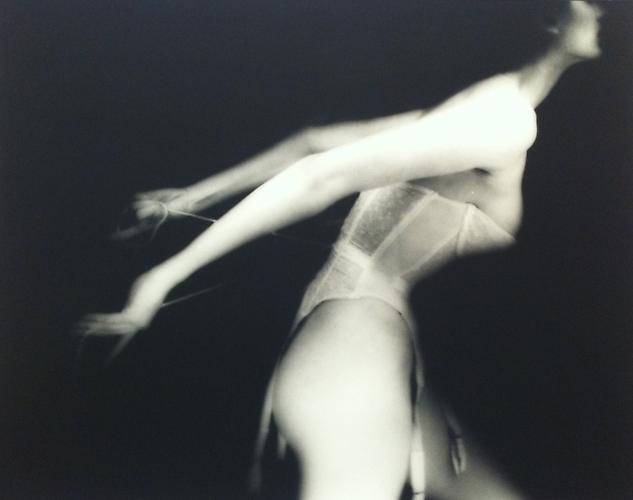
It's A Cinch: Carmen, New York, Harper's Bazaar 1951 gelatin silver print by Lillian Bassman (Peter Fetterman Gallery)The Well-Spent Dollar, girdle by Gossard, 1956
Lillian Bassman: Lingerie is a visually rich book of fashion photography, spanning sixty years of Bassman’s career (Bassman passed away just a few months ago in February 2012). If you want to understand anything about the way the fashionable silhouette has changed over those sixty years – a good start would be to look at the lingerie underneath.
The book includes eighty of Bassman’s black and white images, as well as an introductory essay by Eric Himmel, Vice President, Editor-in-Chief at Harry N. Abrams, Inc. He deftly places her in within the context of the fashion magazine world and greater historical events. He describes her working relationship with Alexy Brodovitch and Carmel Snow, art director and editor for Harper’s Bazaar – whom she began working with in 1948. Himmel’s introduction notes, “She was an inveterate observer of women and their ways.” and describes the role of lingerie photography in her career:
“Over time, the photography of women in lingerie became a part of Bassman’s regimen, akin to a painter’s weekly sessions with figure model and sketchbook. As the structured undergarments of the fifties gave way tot he more natural styles of the sixties, she captured a new freedom of movement in her models that replaced the languid sensuality of the earlier photographs. The jobs, both editorial and commercial, as well as sessions with friends to experiment, were occasions to represent the female figure, one of the oldest tasks in art, intimately familiar to Bassman from her days as an artist’s model. . . Each image has passed through many states on the way to its reproduction in this book, but none would be unpleasing to the thirty-one-year-old in her homemade bodice and skirt.”
Happily, the Peter Fetterman Gallery in Santa Monica is currently exhibiting Lillian Bassman: A Life through June 9 at and it includes her lingerie work as well as her other fashion photography. There’s also this marvelous video that Harper’s Bazaar put together – its insightful and reveals much about her career and process.
June 1, 1935: "Women Play Bowls A bowls match with participants wearing the latest fashion in beach pyjamas, England, 1935." Via Corbis
Initially introduced as fashionable women’s wear in 1922 by Paul Poiret as pajamas, they eventually evolved into casual wear worn for specific occasions– for sleeping, lounging and the beach (Watson, 2004). Lounging pajamas, according to Vogue, were for “when informal entertainments and masquerades are the order of the day.” Chanel helped with the general acceptance of women’s trousers, and was often seen wearing sailor-style pants. Pants of this era were loose with an elastic or drawstring waists with a side closure (Mendes & De La Haye, 1999).
After attending a CSA Western region event back in 2008 (see my review of “Fashion Conscious” at UC Davis), I became interested in the ethics of producing the fashions that eventually become fashion history. The conversation about the impact the fashion industry is having on our environment continues to grow and change, and this is being reflected in the cannon of literature covering the topic. Fashion & Sustainability by Kate Fletcher and Lynda Grose, smartly uses the second half of their book to discuss “ideas that are transforming the fashion system at root into something more sustainable.”
I don’t know about you, but whenever I hear the words “fashion system,” I immediately think of Roland Bathes. However, here are what Fletcher and Grose have to say on the subject when considering sustainability:
Betabrand's commuter cycling pants with reflective pockets and hems (a San Francisco Company)
“However much we innovate and act to improve the sustainability credentials of a piece of clothing, the benefits brought by these changes are always restricted by the behaviour of the person who buys it. Producing a garment with lower-impact fibre or better labour conditions, while important, changes the overall system very little, for these ‘better’ fibres and pieces are made into the same sorts of garments, sold by the same retailers and then worn and washed in the same way as before. Part Two of this book explores new ways of engaging with the process of sustainability in fashion, starting at a point that acknowledges the profound and multiple challenges inherent in bringing together sustainability, the fashion industry and our economic system based on growth.”
Fletcher and Grose go on to explore nine different concepts: Adaptability, optimized lifetimes, low-impact use, service and sharing, local, biomimicry, speed, needs and engaged – all of which present creative ways that various designers and innovators are thinking about the design and use of clothing. Not exactly Roland Barthes – but perhaps a bit more practical?
Sometimes, when walking through an exhibit an object will stop you dead in your tracks – it’s visual impact interrupting any previous thought you might have had. Such is the case with the 1885 Liberty & Co dress currently on display in the Legion of Honor as a part of their current exhibition, The Cult of Beauty: The Victorian Avant-Garde, 1860-1900 (on view through June 17, 2012).
Liberty & Co. Ltd., dress Striped washing silk lined with cotton, c. 1885, V & A
This dress – in a gallery which houses all seven of the items of dress for the exhibit – is sculptural, simple and elegant. It’s a part of the Victoria & Albert’s permanent collection and the fabric is manipulated to resemble high art, to my mind references both painting and sculpture. The fabric seems to move like liquid and it’s no surprise to learn that the gown was designed by a sculptor (Sir Hamo Thornycroft) for his wife. Being a Liberty & Co. dress, the fabric is really the focal point and the artist has done a wonderful job of displaying this delicate, cotton-lined silk to it’s best advantage.
For more on their story, including letters between the two about this dress, see the V & A website here.
The rest of the show is equally impressive, and the exhibition catalog describes the styles utilized by the Aesthetic Movement (Japonism, Neo-Classisism, and Pre-Raphaelite), it provides insights on the artists, designers, makers and writers of the era – from William Morris to Liberty & Co, to Oscar Wilde, Whistler, Gowin and Bearsley. It includes painting, furniture, decorative arts (a fair number of tea pots, ceramics, a beautiful punched fireplace, even wall-paper and textile designs), illustrations, books and other works on paper as well as examples of fashion and adornment. It is, in fact, comprehensive.
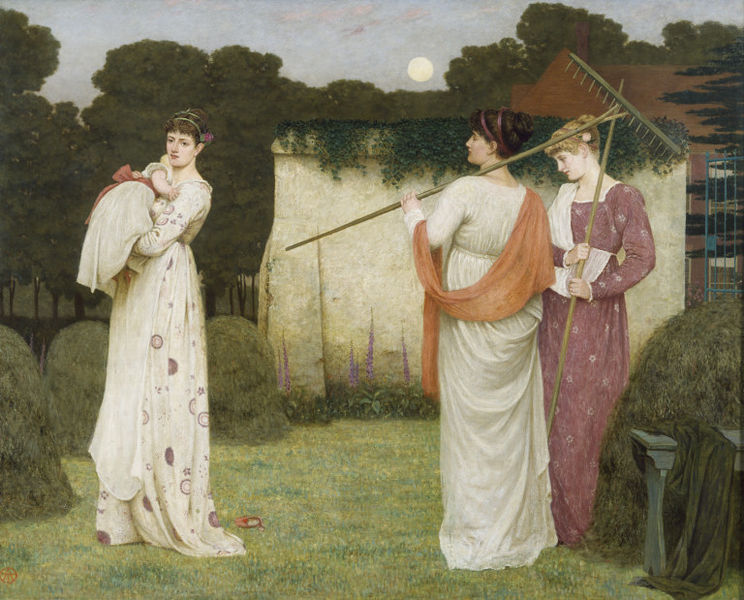
I fell in love with the dress on the left: Thomas Armstrong, "The Hay Field" Oil on Canvas, 1869, V & A.
Though fashionable dress and textile designs are scattered through-out the catalog (and exhibition) – two small sections focus on dress and jewelry-placing them within the greater context of the artists and art-forms of the movement.
Click here to purchase the exhibition catalog.
The first is an essay by Edwina Ehrman, Curator of Textiles and Fashion at the V & A, “Women’s Dress” and though short – it notes that the leaders of the Aesthetic movement (Edwin Godwin, William Morris, Walter Crane and Oscar Wilde) all argued in favor of “the beauty of the natural body and that a woman’s clothes should reflect her form and respect its physiology.”
She notes that “in the 1870s women wishing to dress artistically were recommended to look for inspiration in paintings, particularly those by the Pre-Raphaelite artists, and in books about period costume wher they would find attractive sleeve details and decorative combinations of colours and fabrics.”
If you can’t make it to see the exhibition in person in San Francisco, the catalog is highly illustrated and well-written – utilizing the V & A’s knowledgeable curators. I ended up both seeing the exhibit and getting the catalog – the lure of that one dress was too irresistible to pass up.
The Fashion World of Jean Paul Gaultier: From the Sidewalk to the Catwalk exhibit at the de Young has been getting a fair amount of media attention since it opened to the public on March 24. Much of the coverage focuses on the technology used for the mannequins, and indeed when I first saw them I was mesmerized – to the point that I forgot to look at the garments on display in the first gallery. I began to get concerned that the distraction of the display techniques would overpower the rest of the show. But, by the end of the first gallery, I had thankfully re-engaged with the content.
The Museum has been organizing large scale events, as well as academic explorations of the exhibition through events including a conversational lecture between Suzy Menkes and the designer; as well as historical perspective by Kimberly Chrisman-Campbell. In Menkes introduction of Gaultier, she takes a moment to clarify that the ‘tricks’ and cleverness often used by designers (both exhibition designers and fashion designers) are not the real value of the exhibition. She points out that the value is really in Gaultier’s focus on “technique, skill and handwork.” She also made sure to draw attention to Gaultier’s ability to capture a moment in time.
Her comments are by no means insignificant, and when speaking on “technique, skill and handwork,”she points out that “if you search, you can find them” –perhaps implying that they weren’t as much of a focus as they should be. While I was certainly drawn in and amazed by the technology -ultimately it was his focus on craft and design (and yes, details) that ultimately kept me engaged.
The exhibit features over 200 utterly captivating objects that I’d put in the category of contemporary art – several of the speakers at the press preview felt that way too. Gaultier’s work is both ‘of the moment’ and contains historical reference and I frequently found myself identifying a particular moment in history: the Madonna cone bra being the obvious iconic element.
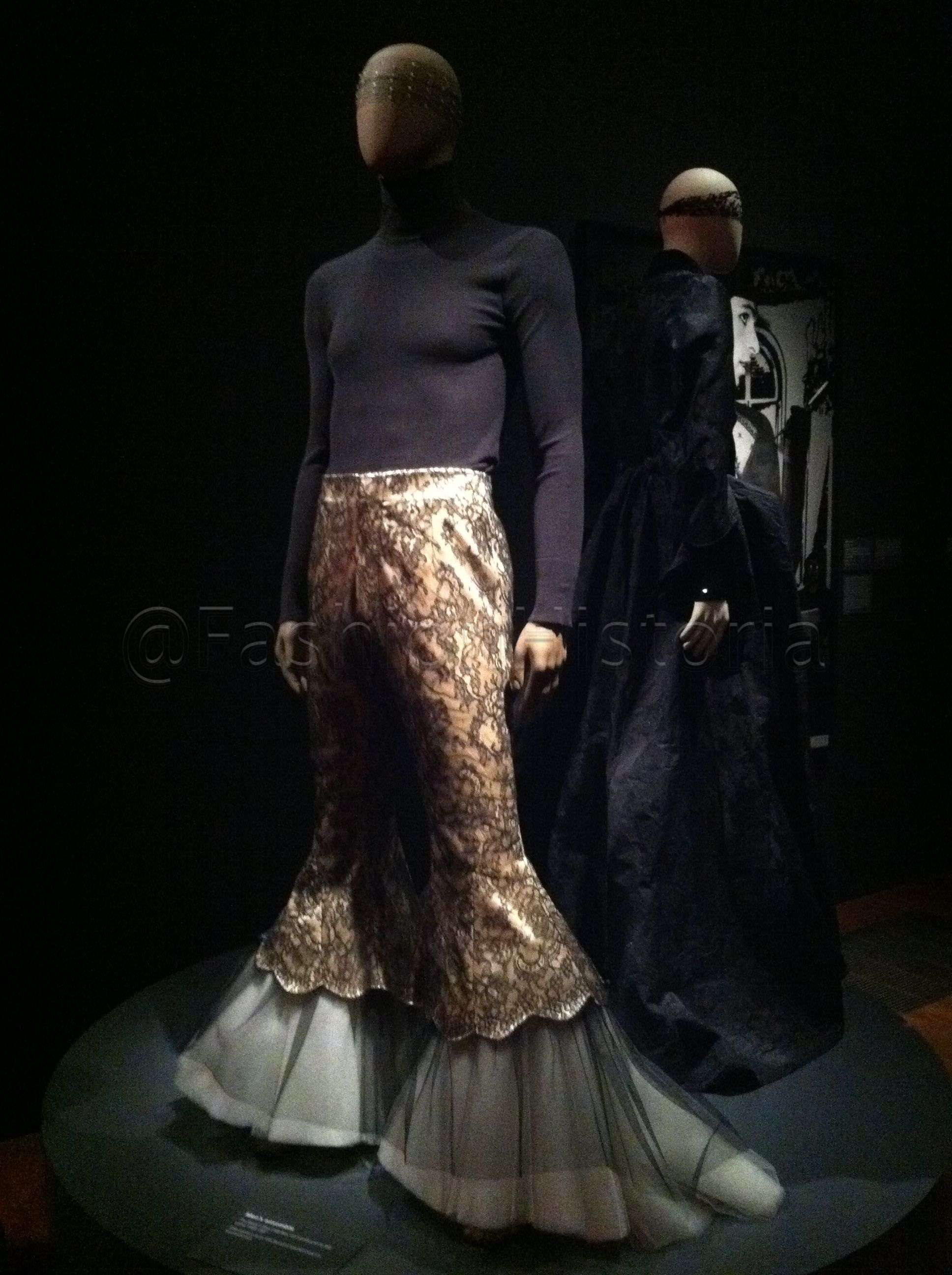
I also found historical references in a pair of men’s pants that reminded me of a Charles James ball gown; or the Red-beaded headdress in the shape of a schooner harkening Marie Antoinette; or a pair of women’s trousers with knife-pleates at the bottom which reminded me of some of Dior’s work from the 1950s. For those not able to see the show in person – there is a huge exhibition catalog (and Amazon is selling it at a discount: it’ll save you $50). For those of you who are able to see it (or who saw it in Montreal) – what’s your take on the mannequins?
Please enjoy the brief photo-tour
Devil in the details…
Men’s pants (that remind me of a Charles James ball-gown)


_03.jpg)