Making your own yarn?

Following up on my post last week from the Portlandia episode featuring the material culture of the 1890s, I thought I’d tell you about a little historic side-project I’ve been working on for the last month: Learning to spin wool into yarn.

What? Why would anyone want to do that when there are so many fabulous stores to buy yarn in already? Well – I’ll tell you – it’s not something I went out looking to do. By happenstance, I got a spinning wheel as a hand-me-down from a cousin (who found it in the garage of their newly purchased house), and for Christmas, my sister gave me a bag of fleece from a farmer friend of hers in Oregon. Suddenly, I had the materials I needed – so why not learn?

Of course, I had to do some research (yeah!) and started off with a few books from the library, some video’s on youtube, and trying to understand how the machine worked. These methods helped get me started, but I didn’t get very far. I clearly needed a class, and thankfully the Piedmont Yarn shop had one available. So, for the last month, I’ve been taking a once-a-week wool spinning class from Lou Grantham, of San Francisco Fiber.

I’ve learned about washing the wool (not too much soap, not too hot, don’t put the water down the drain); preparing the fiber (using paddle carders, flickers, dog-brushes and even a drum carder), drop spindles and spinning wheels, worsted and woolen, and the most fun (for me anyway) is the difference between long draw and short draw (long draw for short fibers, short draw for long fibers).

It’s like magic to watch this messy ball of fiber to into a nice sooth piece of yarn! The only thing I haven’t quite mastered is plying – but I think with some practice I’ll get there (and I do need to learn how to dye it). Thankfully, I still have three very full bags of fleece (yessir-yessir, three bags full) to practice with.

Continue Reading

Behind the costumes of Bye Bye Birdie (1963)

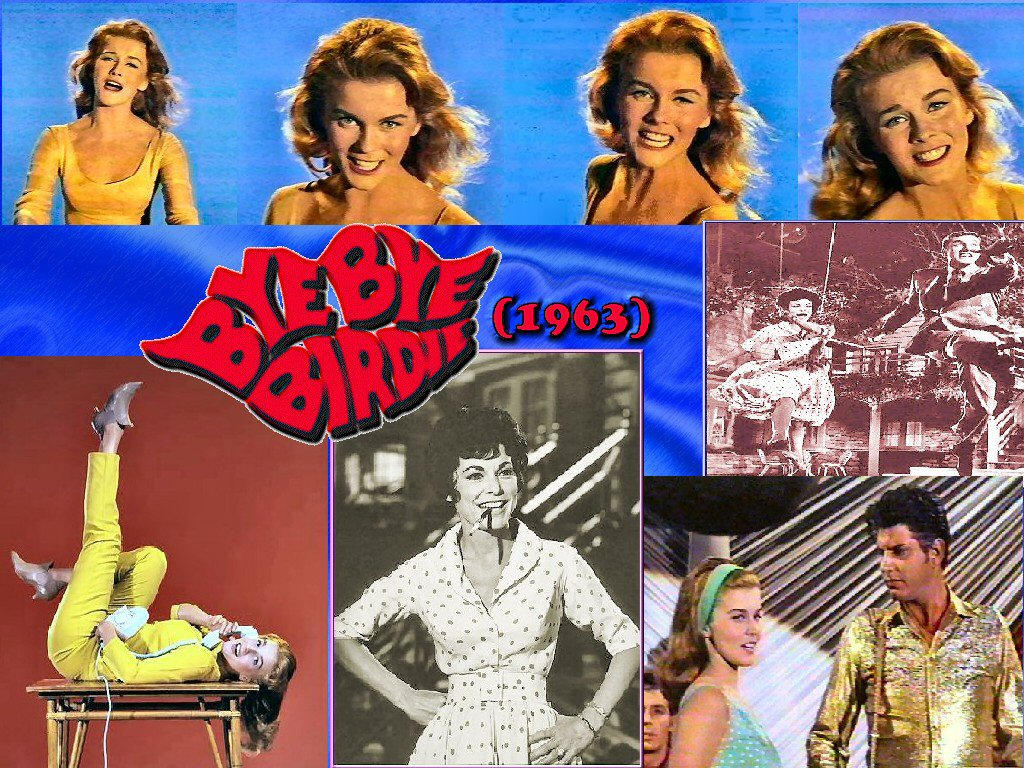
I recently watched the 1963s musical Bye Bye Birdie and wanted to quickly share some of my favorite costume moments from this wonderfully bright and colorful film (if you haven’t seen it, the camp factor is through the roof).

Conrad Birdie's Bathrobe from Bye Bye Birdie (Click for source)

The costumes — executed by Pat Barto and Marjorie B. Wahl — include some pretty outrageous ensembles. Hearthrob Rock ‘n Roll star ‘Conrad Birdie’ (quite clearly modeled on Elvis) has some of the loudest costumes (including the tiger-print bathrobe seen on the right and an Elvis-esque gold lame suit), but the costumes of both Kim (Ann-Margret) and Rosie (Janet Leigh) have greater significance – both to film history and popular culture at large.

Many will be familiar with the theme song to Bye Bye Birdie from it’s brief appearance in a Madmen Episode, where Ann-Margret’s character is explored as the epitome of innocence and sexuality. In her autobiography, My Story, Ann-Margeret explains a little more of that dichotomy and how it worked to her advantage when getting cast in the role (See photos above):

For whatever reason, director George Sidney decided that I was perfect for the part of Kim McAfee. He’d even selected me before we met, having spotted me dancing at the Sands in Las Vegas the previous New Year’s Eve. A while later, he sent me a script for Birdie, then arranged a meeting in his office. He always reminded me that he’d had to keep from smiling at how I’d put on a pleated skirt and flats to try and look sixteen. ‘I saw how you looked in Vegas,’ he confessed. ‘It wasn’t sixteen.'”

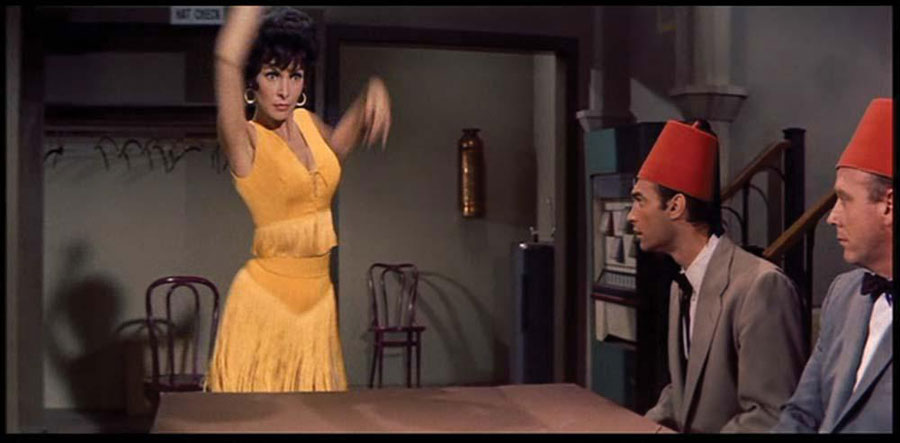
Rosie, the character played by Janet Leigh, is supposed to be a wiser “New York” woman in contrast to Kim, the innocent teen. Leigh was a natural blonde, and that didn’t quite work for the character’s image. In a contemporary newspaper clipping, Leigh is quoted as saying “In my present film, “Bye Bye Birdie” at Columbia…I play the role of Rosie De Leon, Spanish secretary and girl friend of Dick Van Dyke. Now, with my blond hair I don’t exactly look Latin, but wearing a black wig—vive la difference! And that’s where the fun comes in.” [Taken from a clipping in the Bye Bye Birdie folder from AMPAS].

In her 1984 autobiography, There Really Was a Hollywood, Leigh went on to discuss the importance of that wig to her later career, saying “When I was shooting Bye Bye Birdie, Blake Edwards had visited the set, and was fascinated by me in the black wig. He was preparing The Pink Panther (and a wig ended up serving as the disguise for the lady’s escapades) and approached me to do the film.”

From a historical perspective, Bye Bye Birdie highlights the growing influence of youth culture, the increasing importance of television and other mass media, not to mention the cult of celebrity. Many of the costumes include the familiar 1950s shirtwaist dresses, and some vaguely mod references. Here’s a good clip to get you started:

Resources:

Ann-Margret, with Todd Gold, My Story, New York: G.P. Putnam’s Sons 1994 p. 98

Leigh, Janet, There Really Was a Hollywood, Garden City, New York: Doubleday & Company, Inc., 1984 p. 300

Continue Reading

Spotlight on real Costume Design

For those who are enthusiastic about the field of costume design (whether you are an aspiring or working costume designer or you just love movie costumes), there’s a key publication you should be aware of: The Costume Designer. Published by the Costume Designers Guild (local 892), it is the professional union for working costume designers in Hollywood. The current issue celebrates the 25th issue published by the organization and includes a number of articles of interest.

Of course January is Oscar prep season, so many of the ads are promoting designers such as Sandy Powell, Sharen Davis, Deborah Hopper, and Jany Temime (among many others) – asking those voting in the Academy to consider them for the Best Costume Design Oscar. Two special articles include an excerpt from a book on footwear, and a short piece called Beauty in the Details that highlights Drive, The Playboy Club and W.E. (about Wallace Simpson). The best thing about this magazine? It’s free and you can download it as a pdf here:

The Costume Designer


Continue Reading

Vidal Sassoon and the 1960s five point cut

Actress Nancy Kwan with a haircut by Vidal Sassoon, published in Vogue 1968, Photography by Terry Donovan (Click for source)

Over the holiday break, I had a good bit of time on my hands to do some leisurely fashion research, reading and watching. I’ve been on a fashion documentary kick, and most recently watched Vidal Sassoon: The Movie. The film was initially conceived by Michael Gordon (founder of the now-famous salon and product line, Bumble and Bumble) as a short film to give to Sassoon upon his 80th birthday.

I have to say it’s one of the most well-done fashion biographies I’ve seen in a while. It provides wonderful context for the man’s personal history: discussing not only the social contexts of his upbringing (class-ism), religion, and world events) but also the contexts for his most famous haircut – the five point cut. It was popularized by the likes of designer Mary Quant, actress Nancy Kwan, models such as Peggy Moffitt and Grace Coddington (now an editor at Vogue), as well as by designer Rudi Gernreich.

I was struck by how thoughtful and mindful Vidal Sassoon was and is. He reminds me a lot of my grandfather. Sassoon is primarily self-educated, but he sought education in whatever form he could in order to succeed. At one point he even took elocution lessons at the Old Vic Theater in London to help him get rid of his Cockney accent. He is also yet another fashion industry professional fascinated by architecture (both Vidal Sassoon and Charles James had similar affinities for architecture, and geometry played significant roles in both of their design aesthetics).

The film also provides some behind the scenes on the production of the accompanying book, Vidal: The Autobiography. If you haven’t yet seen this marvelous little film (it opened in February 2011, but is now available on Netflix), I would encourage you to check it out (see clip below). It’s surprisingly inspiring.
Continue Reading

Walter Plunkett’s wild ideas for An American in Paris (1951)

Gene Kelly and Nina Foch in An American in Paris (Click for reference)

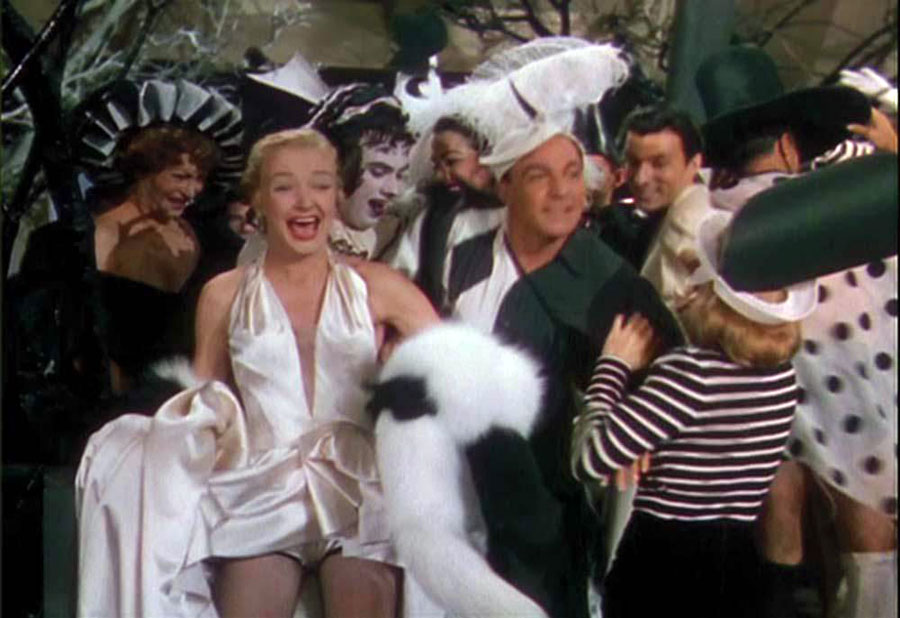
In the beaux arts ball sequence of ‘An American in Paris’ [Walter Plunkett] really went imaginative. His materials included newspapers, oilcloth, canvas and felt. The hats were even more extreme. They featured cardboard boxes, sofa pillows and bird cages. One, of papier-mache, took the form of a woman’s leg.”–Quigg, Jack. “Have Nothing to Wear? Use Ingenuity,” The Washington Post; Jul 8, 1951, pg. S10.

You can see a clip of the scene referenced (the New Year’s Eve party)  here.

A nice side-bar for this is that Nina Foch’s gown, according to the organizers of the recent Debbie Reynolds auction, was designed by Orry-Kelly for Walter Plukett in this scene. (Click the image below for more on that!)

Gene Kelly and Nina Foch in An American in Paris (Click for source)
Continue Reading

In Brief: Maharaja: The Splendor of India’s Royal Courts

This past weekend, I had the good fortune to be able to visit the San Francisco Asian Art Museum’s current, excellent, exhibition: Maharaja: The Splendor of India’s Royal Courts (on view through April 2012). This show is a somewhat smaller version of the 2009 version put on by the Victoria & Albert Museum in London.

Poshak (costume for a woman). About 1900. Silk brocade with gold thread, base metal and sequins. Private Collection. (via Asian Art Museum)

Each piece in the show is impressive: sumptuous materials, exquisite details and extravagant design make obvious that the Maharaja’s were a VERY wealthy bunch. By examining their lives as a whole, the objects included provide a cohesive picture of their worlds and lives.

Objects included in the exhibition include paintings, thrones, regal accessories, men’s and women’s costumes, and LOTS of jewelry, furniture, musical instruments, games and much more. Some of the most physically impressive objects include a full size all-silver carriage, an elephant throne and some of the biggest diamonds and sapphires I’ve ever seen (many many by Cartier). Everywhere you looked were examples of fine craftsmanship, and nearly everything was gilded, embroidered or otherwise embellished to emphasize wealth and power.

Necklace. Cartier Paris, special order, 1928. Reconstructed with some substitute stones in 2002. Platinum, diamonds, yellow zirconia, white zirconias, topazes, synthetic rubies, smoky quartz, citrine. Created for Sir Bhupindra Singh, Maharaja of Patiala. Nick Welsh, Cartier Collection © Cartier.

One word of advice though – take a magnifying glass to truly appreciate some of the amazingly small and detailed paintings (similar to detail to the recent illuminated manuscripts exhibition at the Getty). The exhibition itself was well-thought out, and the (free) audio-tour was great. The show included several informative videos that provided good context for the show, and the audio-tour offered additional videos if you wanted more information.

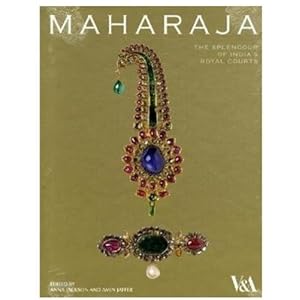
Can’t make it to see the show? You’re in luck, there is an exhibition catalog of the V & A’s version of the show (which I sensibly purchased). There’s also an audio-tour that you can easily download through iTunes.

Continue Reading

Marlon Brando on his rebellious ‘Wild Ones’ costume (1953)

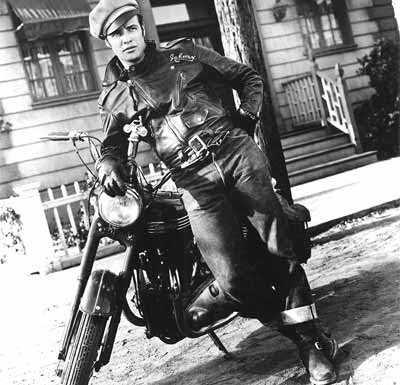
Marlon Brando in the Wild Ones (1953) (Click for source)

I had fun making it, but never expected it to have the impact it did. I was as surprised as anyone when T-shirts, jeans and leather jackets suddenly became symbols of rebellion… Sales of leather jackets soared, reminding me of It Happened One Night, when Clark Gable took his shirt off and revealed that he wasn’t wearing an undershirt, which created a disaster for the garment industry.”

–Marlon Brando (with Robert Lindsey) in Brando: Songs My Mother Taught Me, New York: Random House, 1994, p. 175-6.

Continue Reading

How the Million Dollar Mermaid costume almost killed Esther Williams

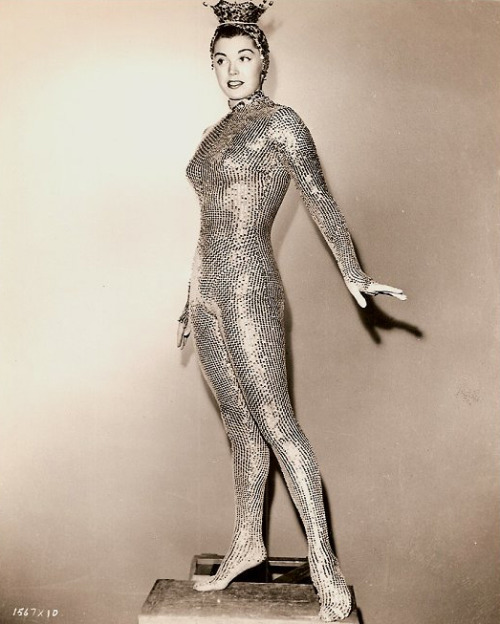
Esther Williams in “Million Dollar Mermaid” (1952) Click for source

“Designers Helen Rose and Walter Plunkett fitted me in an extraordinary swim costume—much like a diver’s body suit, only covered, including the soles of the feet, with gold sequins, fifty thousand of them—like chain mail. Atop a gold turban, which was wrapped around my head, they perched a gold crown. And it was the crown that held the dagger. . .”

“I took my position on the disk and the hydraulic lift started rising. Up…up…up I went, the pool, the crew dropping away. The lift finally jolted to a stop. I was perched on the height of a six-story rooftop. Acrophobia! Dizziness! My equilibrium was gone because my inner ear had never fully recovered from the seven broken eardrums I’d suffered through years of living underwater. I suddenly couldn’t tell if I was leaning or standing straight, and my mind—as well as my body—must’ve frozen up there. ‘We’re waiting, Esther!’ Busby barked. ‘Jump!’

I forced a smile for the camera and swan-dived from that tiny platform. Hurtling down, I muttered a silent, ‘Oh, shit.’ I suddenly realized what was going to happen next. The gold crown on my head. Instead of being made with something pliable like cardboard, it was lightweight aluminum, a lot stronger and less flexible than my neck.

I hit the water with tremendous force. The impact snapped my head back. I heard something pop in my neck. I knew instantly that I was in big trouble.

Totally unaware, Mervyn called out, “Great. . . Time for lunch.’ (219) Magic words. You only had to say it once. Everyone—Mervyn , Busby, the crew—trooped across the soundstage and within seconds vanished. Only Flossie Hackett, my wardrobe lady, remained, and only because it was her job to get my costume off for later shooting.

I could kick my legs, so I desperately treaded water; but my arms and shoulders were virtually paralyzed. The back of my neck was in screaming pain. In my mind’s eye I saw the headlines: ‘Esther Williams Drowns in MGM Studio Pool.’ I cried out, ‘Flossie, you’ve got to get some help for me.’

She thought I was joking. ‘C’mon, Esther, you’re such a kidder. I want to go to lunch. I’m hungry.’

Flossie, I’m really in trouble,’ I gasped. “Find two guys who can lift me out of the pool.’

Finally she believed I was serious. She ran to the big soundstange door and shouted, ‘I think Esther Williams is dead. She can’t get out of the pool.’

Some men came running in, quickly stripped off their shoes and shirts, and jumped in to pull me out. I was crying by that time, because the pain was so intense. They carried me to my dressing room. While we were waiting for the ambulance, Flossie carefully removed my gold fishnet bodysuit, rolling it down my body like pantyhose, and those fifty thousand tiny metal sequins were like little knives, nicking and cutting me. (Flossie was supposed to keep my costumes in good repair, so I’m sure the absurdity of peeling off the suit, instead of swiftly cutting it off, never crossed her mind.)

At the hospital, I blacked out from the pain. The X-rays showed that I had broken three vertebrae in the back of my neck. I’d come as close to snapping my spinal cord and becoming a paraplegic as you could without actually succeeding.”

-Esther Williams (with Digby Diehl). The Million Dollar Mermaid: An Autobiography, New York: Simon & Schuster, 1999 (219-220).


Continue Reading