
Tuesday Teaser: Maggy Rouff

THE HISTORY OF FASHION. . . MOSTLY.


Given that costume designers sometimes don’t get the credit they deserve, it’s nice to be able to tell you about a new authoritative archive that emphasizes the historical import of this often under-valued craft. Earlier this week I received notice that the Margaret Herrick Library (of the Los Angeles based Academy of Motion Picture Arts & Sciences: i.e. OSCAR!) had finally released its online archive of Production Art.
It’s not the entirety of the Graphic Arts collection, but much to my delight, it includes a good deal of film costume art! Of the 5,300 records in the database, nearly half include images. The database also includes “production design drawings, animation art, storyboards and paintings” and date from the 1920s to the present day.
It’s a huge resource for film costume historians, and thankfully provides credit for both costume designers, as well as illustrators (often two different individuals). As Library Director Linda Mehr notes:
“We’re very happy to be able to make this database more widely available to researchers, students and film enthusiasts. . . . Our hope is that it will bring much-deserved attention to the costume and production designers, sketch artists, animators, and other artists who have contributed so much to filmmaking.”

To give you just a quick snapshot of what’s available: The database includes nearly 40 records for Gilbert Adrian; 20 for Milo Anderson; almost 30 for Travis Banton; 70 for Marjorie Best; 19 for Howard Greer and many, many more.
Not surprisingly, my interest is in the illustrations by Natacha Rambova, Gilbert Adrian, Georges Barbier and Erte (and of course those depicting Rudolph Valentino and Alla Nazimova).
Though most images are rights-protected (i.e. you can see them on your computer screen, but can’t insert them into a blog post or save them to your computer), a few have been cleared for media purposes. Those interested in information on additional materials (or to make an appointment to view an item that does not yet include a reference image) are encouraged to contact graphic arts librarian Anne Coco at acoco@oscars.org. A full list of their databases is available here.
_

Jennifer Heath, a UC Press author (The Veil: Women Writers on Its History, Lore, and Politics

A native of Oakland, CA she earned a BS in Costume and Textile Design from University of California – Davis.
Her artists statement notes:
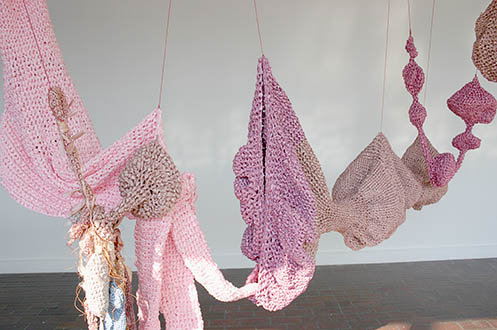
“My work addresses the issues of the transformation of the body and the spirit through the use of clothing forms applied to found objects or placed within a contextual environment. The use of old fabrics and found objects is important in creating a work or environment that evokes a feeling of loss, or distant memory.”
Not surprisingly, given her interest in crochet and sewing, her work reminds me of Ruth Asawa’s basket-like sculpture. Heath filled me in a little bit more on her recent work, Three Pillars: Liberty, Unity, Voice: “[It’s] huge. . . but based on the fashions of Marino Fortuny, the kind of Greek revival dresses that helped liberate women from corsets. To Mary, these are meaningful in terms of the Arab Spring (she is half Palestinian). The Three Pillars just went to a show in Kuwait. . . . Mary teaches fibre arts and fashion at UNCC.” Mariano Fortuny’s designs (worn by the likes of Lillian Gish and Isadora Duncan) and their influence on Tuma’s work seemed a unique connection. Happily I had a chance to ask Tuma about her work directly:

Fashion Historia: What is the significance of fashion history in your current piece, Three Pillars: Liberty, Unity, Voice?
Mary Tuma: “Fashion is a human rights issue. One can see this clearly in the current debate over the right or requirement of women of Islamic faith to wear head scarves. Mariano Fortuny’s work has always stood out in my mind as a great example of the fashionable un-corseted natural body of woman— a celebration of unaltered human form. For me, his work speaks volumes about woman’s right to exist in her natural form apart from cultural shackles. Of course Fortuny’s Delphos dresses (on which I based formal aspects of my piece Three Pillars) were inspired by ancient Greek statuary, which serves as a reference to a culture involved in early experiments in democracy. So, for that reason, the Fortuny model seemed very appropriate for a piece about the current “Arab Spring,” which is what Three Pillars addresses. For me, democracy is also a feminist issue, and is meaningless if it’s not. As the Arab World changes, it is my hope that women will step up and take an increasingly integral role in forming new governments and creating policy. So Three Pillars: Liberty, Unity, Voice (which also spells LUV by the way!) is my way of hoping to inspire feminism in the face of changes and to inspire women to stay in the dialogue.”
Fashion Historia: How did your education at UC Davis help prepare you for your work as an artist ?
Mary Tuma: “My education at UCD Design prepared me in many ways to function as an artist working in fiber materials and methods. Apart from learning to work with dyes, garment forms, etc., I took some very important classes that directed my thinking. History of Costume (with JoAnn Stabb) was one of these and it was where I first learned about Fortuny and his amazing work.
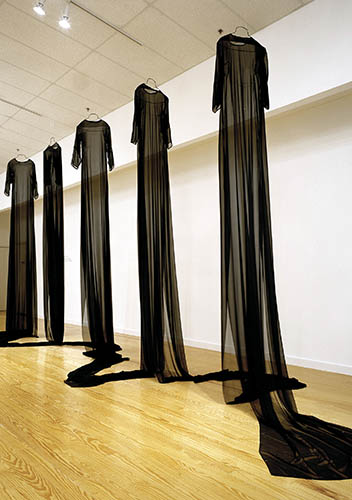
I have been fascinated since then with the mystery of the permanently pleated silk. Three Pillars was my first experiment in playing with permanently pleating silk after a student brought me an article from the web on how to “fake” it! The other two very influential classes were Textiles of the World 1 & 2…. These three courses have influenced my direction with my work in a sort of constant way. I did go on after earning my BS in Textile and Costume Design from UCD to study Women’s Fashion area at FIT [Fashion Institute of Technology] and Costume Design for Theater at Humboldt State University. Of course all of these experiences contributed to my knowledge base and have given me a unique perspective from which to work. My MFA is in Fine Art from the University of Arizona, where I studied Fibers with Gayle Wimmer. It was at the University of Arizona where I began to feel the difference between Art, Craft and Design and where I was able to negotiate between these areas to develop my practice.”
I’m thrilled to be able to share this unique use of fashion history in contemporary art. I think Mary Tuma’s work a new iteration of the 1980s ‘art to wear’ movement (which holds strong ties to California). I’d love to have your thoughts and comments on her work.
Additional Resources:
For more on Classicism in fashion see the Metropolitan Museum of Art Costume Institute’s online exhibition Goddess (2003).
For more on Mary Tuma, please see the Institute for Middle Eastern Understanding.
*Image above is of a Mariano Fortuny Delphose dress (1930) via the MET, CI (2009.300.2606, Brooklyn Museum Costume Collection at The Metropolitan Museum of Art, Gift of the Brooklyn Museum, 2009; Gift of the estate of Mary Boocock Leavitt, 1974)
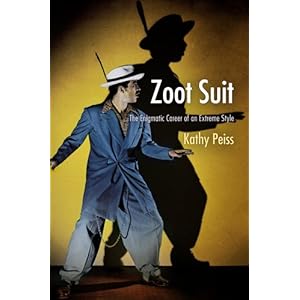
Over on Worn Through today is a book review by my good friend, Rachel Harris of Zoot Suit: The Enigmatic Career of an Extreme Style by Kathy Peiss (May 23, 2011, University of Pennsylvania Press). Click on the book cover to read the review!
English National Ballet.
Coupled with the coverage of the capsule collections Rodarte made for Pitti Uomo and Pitti W, it turned into quite a Rodarte-focused week around many blogs (see Exhibiting Fashion and The Fashion Informer for examples).
Newly open at the Museum of Craft and Folk Art in San Francisco is Wrapping Traditions: Korean Textiles Now ( from June 17-October 23, 2011) featuring 65 re-interpretations of the the traditional Korean textile Bojagi (Bo-Jah-ki), or ‘wrapping cloths’ by both Korean and international artists. It’s similarity to the western craft of quilting and patchwork, I was immediately drawn to the idea of this exhibition. According to the museum’s press materials:

“Traditional Bojagi was made from leftover pieces of cloths or papers, which were elaborately embroidered together and was a primarily non- professional activity, engaged in by women in a folk art tradition. Function determined the form and the result often created beautiful abstract patterns. Bojagi were made to protect and to decorate items and gifts wrapped inside them as alternatives to boxes and chests. Bojagi stored precious objects, clothing, bedding and covered food in the home. Although this folkloric custom continues in the country, today, the craft of Bojagi has had a great influence on contemporary artists from Korea and around the world. Wrapping Traditions: Korean Textiles Now brings together contemporary artists from Korea, and ten other countries that are inspired by this Korean folk art.”
Guest curator Chunghie Lee, adjunct faculty in the textile department at the Rhode Island School of Design, graciously agreed to answer a few questions I had for her about the exhibit:
Fashion Historia: Do you have a favorite piece in the show?
Chunghie Lee: “There are three that stand out to me the most. One conventional piece exemplifies what bogaji is and the other two because of the artist’s vision to push the meaning of bogaji and interpreted it in a whole different light. Interestingly, all three artists have completely, different backgrounds – one textile, one architecture, and the other a painter. Being Korean, and having a textile background Sora Lee’s ‘Harmony 2010’ work encompasses the traditional Samsol technique with all hand stitching, bring the calmness and serendipity atmosphere in life – 79” by 79” off-white work (raw silk). The work silently speaks of the patience and endurance that the no-name women might have lived in the past.

The second piece is done by a recent RISD student of mine, Kuzina Cheng. Having just completed her sophomore year at RISD, she pushed and challenged herself, making a 60 inch by 12 feet piece with pocketed flaps. The pockets fluttered when they were filled with wind and her piece stretched across to “wrap” the canal in Providence. The canal was where she found peace in her hectic school year, to her it was her precious place. She challenged to wrap something, which essentially cannot be wrapped or kept – water and wind. Upon first glance, one may not recognize the piece as bojagi inspired, but she has stayed true to the meaning behind bojagi in an innovative way. I was impressed by her thought process and that at such a young age, she had accomplished something so big.
The third artist focused in more on the unique characteristics of bojagi. She was very interested in the use of transparent fabrics and the use of light. Catherine O’Leary transformed bojagi into something functional and fashionable. Having a painting background, she works intuitively and picked up on the bojagi characteristics immediately. Her pieces are light and look mysteriously dimensional, as if able to float away if you didn’t grasp onto it tightly. These dresses are unlike anything ordinary, they move with the body and have voluminous bottom making one feel like they are in a fairytale. She is a natural talent, does as she goes, and because of that none of her pieces are the same and all one of a kind.”

Fashion Historia: Is Bojagi something you have a close personal connection with? Was it something you grew up around?
Chunghie Lee: “Contrary to what one might think, I did not grow up around bojagi. Even having been a fiber artist for most of my life (my undergraduate B.F.A. was furniture design and much later year M.F.A. on fiber-weaving and dyeing), I was oblivious to this cultural tradition. I was first exposed to it by my mother-in-law when she handed me down her precious clothes. At such a young age of 20, I didn’t realize the importance of it. It wasn’t until I was invited to come to the US as part of the Korea Metal and Fiber Artist exhibition in 1991. The tour lasted for 3 years and went across the US and parts of Canada. During the tour, I was unexpectedly asked to give a presentation about something Korean related. I quickly did some homework and looked into bojagi. As I researched into this deep rooted Korean tradition, I learned about the nameless woman and the male dominated society that Korea use to be. I had heard stories about it before, but never paid much attention. After the presentation, I have been working closely with bojagi. In 1999, I was lucky enough to be presented with another amazing opportunity, RISD had asked to me teach at their school. Speaking about it was one thing, but teaching it uncovered my passion for this Korean cultural tradition. Soon enough, without realization, I found myself in the middle of it all – I was spreading awareness about bojagi not only in the US but all over the world including from Canada to Europe and of course, Asia. It took me by surprise when I came across an article of myself being described as the bojagi ambassador. I think that was when it all hit me. Since then, I have been invited to shows and have held my own exhibitions. One of my major curated shows was held in France, in conjunction with the European Patchwork Meeting in Alsace, France, where I showcased works of bojagi, joomchi (Korean traditional textured paper) and quilt. To my surprise, people from nearly 50 countries attended the show. I still have two more one person show in this year, one in London and the other in Utania in the UK. Bojagi keeps bringing me unexpected surprises and countless opportunities, I cannot imagine my life without it now.”
Thanks so much to Chunghie Lee and the Museum of Craft and Folk Art for their help with this post. I’d love to hear from those who attend the show (open through October 23, 2011), for reactions and commentary. Below, are a selection of the 65 pieces included in the exhibit (Click one for a slideshow):


A few weeks ago, I was visiting a relative in a hospital in the rural Northern California town of Colusa. The halls of there were filled with various forms of art for sale. While most were paintings of local life, there was also the odd quilt or photograph. In one large display (pointed out to me by my mother -thanks Mom!), I came upon the  work of a former patient: Josephine Lanouette (May 26, 1917 to June 7, 2002).
A group of 10 beautiful illustrations dating to the early 1930s were up in the case. Most notable were the outfit pages in color seen here at the left (note the bottom left includes a flying outfit, swimming outfit, beach outfit and dancing outfit – labeled around the heads). Other pages included a study of 1930s hairstyles, glamorous scenes that looked right out of a movie set, single portraits, silhouettes, and an illustration of fashionable children playing in a yard, among others.
 According to the text accompanying the display, Jo began drawing fashion illustrations at the age of 14 because she couldn’t afford the clothes that she wanted. These illustrations were primarily of clothes dating from the early 1930s, and are strongly reminiscent of Hollywood’s glamorous leading ladies.
Several years ago, I read the book Some Wore Bobby Sox: The Emergence of Teenage Girls’ Culture, 1920-1945 by Kelly Schrum and couldn’t help remarking on the similarities. Chapter 5 in particular is particularly relevant: “A Guiding Factor in my Life”: Teenage Girls and the Movies:
Teenage girls used these materials [fan magazines and film stills] to personalize rooms, decorate belongings, construct scrapbooks, or trade images. Irene Scholfield, a high school student in Northern California in the late 1920s, lovingly drew pictures of movie stars based on movie magazine photographs … turning mass produced images into personal art. And she was not alone. Seniors in 1933 nostalgically remembered their younger high school days of ‘deskcovers hidden by drawings and photographs of moviestars.'” (155)
Josephine’s illustrations seem to fit right into Schrum’s book, both because of their link to Hollywood glamour as well as to teen culture during the depression era. The clothes she drew were SO glamorous! It’s unclear if she ended up pursuing any sort of career related to costume and fashion, though her obituary did note that she was “a former member of the Colusa Stagehands,” a local community theatre group.


Last week I came upon the most marvelous collection of Dance artifacts while I was doing a bit of research via Calisphere (a digital consortium of primary sources via the University of California) and the California Digital Library. The beauty of these illustrations stopped me dead in my tracks. Called the Paget-Fredericks Dance Collection, it includes about 2,000 drawings, photographs, paintings and memorabilia that date from between circa 1913 and 1945.
It is the collection of San Francisco born artist Joseph Rous Paget-Fredericks (for those interested, the Jerome Robbins Dance Division of the New York Public Library also houses a collection of his papers dating from 1920-1960). He was a student of Léon Bakst, and “his dance drawings and paintings were exhibited in Europe and the United States”(via the finding aid). He later published a book, I Shall always Love the West: Impressions of the Incomparable Anna Pavlova during her several Visits to California (1952).
Nearly 400 of these works are available online through the Online Archive of California (OAC). It includes works depicting great as well as unknown dancers in the 20th century – such as Isadora Duncan, Loie Fuller, Vaslav Nijinsky, Anna Pavlova and Ruth St. Dennis. Though not available, researchers should note that the collection includes illustrations of Adolph Bolm and Louisa Casati, among others. Happily, this collection also includes set and costume designs for Swan Lake at the SF Opera House, a number of productions at the Greek Theater in Berkeley and for a number of ballets and performances.
As I was scrolling through the collection, I came upon what appears to be a gold mine: “1964.020, Historic Dance Costumes“: this section included costumes belonging to Loie Fuler, Anna Pavlova and Isadora Duncan (even Marie Taglioni’s fan!) are included here (These are a part of 30 dance costumes on long term loan from the Fine Arts Museums of San Francisco). Sadly, no photographs of these pieces are included online.
In total though – it’s a vast collection – and I hope to find some time in the near future to see if any of it relates to my current research (which it might!). I could spend hours going through these photographs and illustrations, but I’ve chosen just a few to highlight here. Some of them have no captions, dates or titles. But some of real gems – including some pithy ones like “Isadora–far too heavy… if only she would cut down and diet!”.
Here is the story of a wedding dress recently donated to Lacis Museum of Lace and Textiles in Berkeley by Jeanne Lee, living in Ohio: 
“My father’s brother fought in the pacific during WWII. He stayed in the Philippines after war and married a widow with two children. They never had children together. He worked for CAL and every 7 years they would travel around the world and that always included a stop to see us. When they visited in 1969, I was living at home and planning a wedding. My fiance was in Vietnam and their visit was a bright spot in a very bleak year. Since they would be not be back in the states the following year, I shared all of the weeding plans . I had not purchased a dress but I had a picture. It was a plain white A-line with a simple veil. Aunt Gloria said that she would take the picture back to the Philippines and have the dress made. I was thrilled. When the dress arrived in Rochester many months later, I was stunned. This was not the dress in the picture and it was not me. It is lovely dress but… I found a cap and veil to match and I have never been tempted to dress in pearls and sequence since. I am sure Aunt Gloria thought I was too thin to wear a plain A-line dress. She added sleeves, raised the neckline, the satin panels and beading added dimension. It was a lovely gesture.”
* All images via Lacis

