Los Angeles-based fashion designers have a distinct style, much different than their New York counterparts. This April, Reuters noted: “The City of Angels has carved out a niche for itself as a host for casual brands like American Apparel and as a manufacturer of quick-turnaround ‘fast fashion’ and small orders for emerging designers. Fashion is the city’s largest manufacturing industry, and employs more people here than in New York.[1] (1)
This might be a surprising statement for those not familiar with the fashion world. Most would identify New York as the American fashion capital. But the fact is, California has long been a fashion leader, and this isn’t the first time the Golden State has eclipsed New York.
Two cataclysmic events, the Great Depression and World War II, created a change in the needs of American women. The active California lifestyle and the Hollywood film industry both affected the demand for a different style of women’s clothing. It was during this time that California established itself as a fashion capital.
American film played a large part in showcasing the California fashions in the 1920s, 1930s, and 1940s. The theaters were public places of congregation. Women would go after work to watch the news and see a feature film. Hollywood was providing entertainment to help citizens escape their glum realities of economic depression and war. Historically, this was a time when the entire film production took place in California. Actresses like Greta Garbo, Marlene Dietrich, and Mae West captivated audiences with their style and glamour. The movie industry, and its costume designers, exerted a direct influence on fashions that were available in stores.
Much like today, when actresses were seen on film, women clamored to imitate their styles. Independent fashion designers and manufacturers began sprouting up throught the Golden State. Vogue noted the growing power of California on the horizon: “Throughout the 1930s Vogue juggled issues of innovation and ideas with Paris on the one hand and Hollywood on the other, giving equal credence to both camps . . . Paris was working on a seasonal time scale, Hollywood was years in advance.”[2]
It is noteworthy that New York was not mentioned as an innovative fashion capital at the time. The popularity of the fashions seen in film spurred major department stores to feature pop-up California departments. However, the California departments were not permanent fixtures of the stores.[3]
California Fashions from 1941 Exude Fun and Youth. Pope, Virginia. California. New York Times: June 22, 1941, D6.
What made California fashion appealing was that it exuded fun, relaxation, and youthfulness. American women idolized youth, a much different ideal than that of Europe: “How we Americans rebel against looking our age. The French will trade adolescence for sophistication any day.”[4] The youthful look was achieved by using non-traditional fabrics, like unbleached muslin, and appliqués of flowers and horses. Youthfulness was, and still is, the most coveted quality of the American look. Hollywood films had created a young, attractive woman as the national ideal and symbol of patriotism.
The biggest California export during the 1930s was Play Clothes. Play clothes, or sports togs, originated in California. As the name suggests, play clothes allowed women freedom of movement while enjoying in activities the outdoors. They were appealing because they allowed for a lifestyle full of sports, gardening, and sunbathing – all popular activities in the Golden State. Virginia Pope of the New York Times makes it abundantly clear that Californians created and reigned supreme in this casual style:
“It began, if memory does not fail us, when women on the other side of the continent began to wear smocks of muslin in glorious hand-dyed shades over their beach togs or in their gardens. Some bright mind spied the styles and brought them back to Broadway. Since then, fashion scouts have been increasingly on the alert and have trekked westward in growing numbers.”[5]
Play clothes were durable, informal, and inexpensive. They were also easy to wear and wash: “The big idea is to play in togs that are comfortable and at the same time good looking; that are of smart fabrics which will stand hard wear, won’t crush easily, and will bear the rigors of the wash tub or manipulations of the cleaner.”[6]
California Slacks. Vogue: 15 April 1939, 54.
Aside from play clothes, California next biggest export were pants for women. Pants, or slacks, were much more important for the women of California than the rest of the country. Travelers to the West came back reporting having seen slack-clad women, well dressed ones, too, on the streets and in the shops of California cities. Clothing manufactures based in California carefully and strategically crafted and advanced the cut and fit of pants.
Pants, or slacks, for women were becoming an accepted wardrobe staple. However, certain regions were more open-minded to this change. California was a whole-hearted pioneer. Other vacation destinations including the Riviera and Palm Beach allowed women to wear pants. Slacks were not as accepted in northern East Coast cities, like New York and Boston. Slowly, the traditional dress codes were erodes to allow women to wear pants, although this took decades to be accepted across America.
Each year, American consumers accepted and purchased more California garments. Designers based in the Golden State brought a youthful elegance to the American Look. The women that flooded the workplace during WWII could also be smartly, and appropriately dressed. Women adopted a more functional wardrobe for work and now indulged in active pastimes.
Although the California may still have to defend its position as a fashion leader, the evidence is quite clear. Every time a woman wears pants or active wear, it is a legacy of the Golden State.
Born and educated in San Francisco, Louise Dahl-Wolfe would later work as a staff photographer for Harper’s Bazaar from 1936 through 1958. I recently came upon an extremely detailed account of her life and San Francisco beginnings on from this website (originally published in April 2010):
“Louise Dahl-Wolfe (1895 – 1989) was born in San Francisco. Aspiring to a career as a painter, she attended the California School of Design (now the San Francisco Art Institute). . . . After completing her studies, Dahl-Wolfe designed electric signs from 1921 to 1923; in 1924 she began working for a leading decorator. In 1921 she was invited to the studio of photographer Anne Brigman; this meeting prompted her to buy her first camera, an Eastman bellows camera with a reflector made from a Ghirardelli chocolate box. She used her mother as the subject of her first pictures. Early photographic adventures included taking shots of herself and some friends nude on a beach, using the soft-focus style of her mentor. After Dahl-Wolfe befriended another San Francisco photographer, Consuela Kanaga, who taught her to use a 314-by-414-inch Thorn-ton-Pickard English reflex camera with a Verito soft-focus lens, the two traveled together to Europe in 1927. . . .
Dahl-Wolfe returned to San Francisco in 1928 and began taking commercial black-and-white photographs. . . . After moving with her husband to New York, Dahl-Wolfe was introduced to Frank Crowninshield, then editor of Vanity Fair, who decided to publish her work. . . . This success led to the publication of her first black-and-white fashion work in Harper’s Bazaar in 1936 and her first color work a year later.”
My small hometown of Benicia, CA has a historical museum whose website includes several groups of ‘mystery’ vintage photographs. Though places, dates, and people aren’t always known. These photographs provide a remarkably clear record of what people were wearing in times gone by. I’d guess that the majority of the photographs on this website come from the interwar years, specifically the teens and twenties. There are pictures of the Benicia High sports teams, old cars, the fire department, and something called the “John Laurence Molfino Biography.”
My personal favorite though, is the selection of photos of a pageant dance held in an open field in 1923, that was VERY well attended.
According to the Oakland Tribune, the 1923 Solano County Historical Pageant was attended by 10,000 people. It seems that this Pageant was put on by a federation of several different women’s social clubs. Held in Benicia on May 11, 1923, the pageant included nine different episodes and required nearly five hours to watch the entire show.
Both the Solano Republican and the Oakland Tribune indicated that the dance director was Mrs. A. G. Bailey of Suisun. Though not all of the costumes are of this style, the photos I’ve included here SO strongly resemble the costumes and dance styles of Isadora Duncan and Loie Fuller – I can’t help wonder if either of them were involved somehow. Both women were in the Eastern Bay Area in the teens and twenties. At the very least, I suspect Mrs. Bailey had seen them perform. Interestingly, the composer of the music for the pageant, Dr. Douglas Wright, was from Berkeley – where much Bohemian artist activity was centered.
Via Benicia Historical MuseumVia Benicia Historical Museum
Via Benicia Historical Museum
Via Benicia Historical Museum
Via Benicia Historical MuseumVia Benicia Historical Museum
The Solano Republican goes on to explain that “The cunning little costume drawn by Miss Doddson is simple, but altogether charming.” Emma Doddson of Suisun was, in fact, the Artistic Director, for the entire show. I would guess that it was her vision that created these designs. Interestingly, the publicity manager – Miss E.C. Stove, arranged for rotating exhibits (including dresses) to travel to all the different towns involved to attract attendees.
Sabine Goerke-Shrode*, did a good bit of research on this event, and found in her 2004 article that a good portion of the remaining design, writing, organizing and construction work was done at Armijo High School. Other photos in this collection show young girls in traditional ballet costumes, as well as in period costume (as well as performers dressed as military, spanish and native american costumes).
Those interested in reading more about the Pageant itself can download this coverage of the event from the Oakland Tribune in 1923 (Click here to download the PDF). I’d love to hear from anyone who might have additional information on these photographs and as always, anyone with ideas is welcome to comment. For more of the photos, please visit the Benicia Historical Museum.
“SAN FRANCISCO, June 16 [1964]–THE ‘NEW’ SUIT–Model Evelyn Fry wears the last word in swim suits, a creation by designer Rudi Gernreich of Los Angeles which could be classed as a one-piece bathing suit. Orders for the suit are being taken a Nasimo’s North Beach Hi-Fashion shop prior to arrival of a suitable number of the garments. They are not expected to appear on public beaches in the immediate future.” Via the SF Public Library Historic Photos Collection
The Oakland Museum of California has recently updated their website and is now featuring (at the top of the page, no less) their historic costume collection. The costume collection online features about 450 objects online, and provides some details about the objects that appear. In browsing through the online collection, it seems heavy on shoes, hats and accessories – with few couture or designer garments (though James Gallanos is certainly present, as well as a few pieces from I. Magnin).
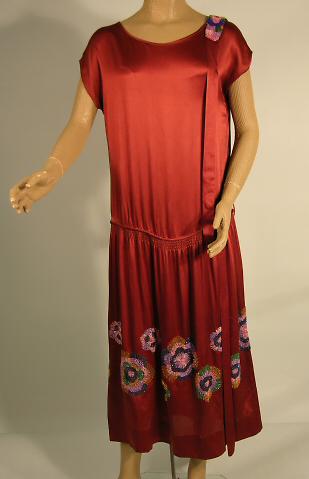
c. 1926-1927 *(see below for full catalog entry)
However, it does become clear that the focus is really on the history of California. Ethnic and Sportswear are included in this online selection, as well as artwear (including shoes by Gaza Bowen) and all types of uniforms (Military, nurse, employee, even campfire girl). A number of objects relate to the early days of the gay pride movement. Film costume is sparce, but it does include a pair of Eddie Murphy’s shoes from Beverly Hills Cop.
If you’re looking for a needle in a haystack, it’s certainly a place to start.
This brown satin dress–with a scoop neck and short sleeves–is decorated with bands of the self same brown satin, as well as beading done in the form of flowers. The beads are sewn directly to the dress, mostly 6 petal flowers in various combinations of blue, green, amber color, pink and purple beads; they form an eight inch band around the skirt, above the wide hem. The dress has a dropped waist, and the top of the skirt is shirred with four bands of stitching. A band of the satin (about 1 1/8 inches wide) drops from the proper left shoulder, front and back, is loose to the dropped waist, where it is caught with a horizontal band of machine stitching, and then falls free again to the hem. At the proper left shoulder a lozenge-shaped piece of beaded brown satin (centered with a 4 petal pink flower) is stitched to hold the decorative bands.
Mary Acelia Chamberlain, who wore this dress, graduated from the University of California, Berkeley in 1926. Although she taught in the San Francisco School System all her working life, she was also an accomplished musician, playing the violin. She performed at the Claremont Hotel. According to family history, she also entertained service men, playing the violin, while she was still in high school. She was bornn August 28, 1905 in Philadelphia, PA and moved to California at the death of her grandfather, before July of 1906. She died December 20, 2005 at the age of 100.
Used: Mary Acelia Chamberlain | University Of California, Berkeley | Claremont Hotel | Adult ~ female | Musician
Noir film costume design is often gone uncredited – but that doesn’t mean we can’t appreciate it. The San Francisco Silent Film Festival comes this weekend to the Castro Theatre in San Francisco, and one of its presentations is a Noir film called The Woman Men Yearn For, starring Marlene Dietrich.
“Before she shot into stardom with Josef Von Sternberg’s The Blue Angel (1930), Marlene Dietrich had a brief career in German silent films. The Film Noir Foundation is proud to co-present one of these rarely screened films, Kurt Bernhardt’s The Woman Men Yearn For (1929) at this year’s San Francisco Silent Film Festival. On his way to his honeymoon, a young industrialist encounters a seductive beauty (Dietrich), traveling with a mysterious male companion. When she begs the young man to help her, events spin out of control. For more information on the festival, running July 14 through 17, visit the SFSFF website.” See the full lineup here
On a related note, the Marelene Dietrch Collection Berlin includes a huge selection of her clothing and accessories. Those looking to research her film costume and offf-screen style should probably start here. The collection includes:
Over 3,000 textile items from the twenties to the nineties, including 30 film- and 40 show costumes, by among others Jean Louis, Travis Banton, Edith Head, Eddie Schmidt.
1,000 individual items from her private wardrobe, 50 handbags, 150 pairs of gloves, by among others: Elizabeth Arden, Balenciaga, Balmain, Chanel, Courrèges, Dior, Givenchy, Guerlain, Irene, Knize, Lee, Levis, Schiaparelli, Ungaro.
400 hats, 440 pairs of shoes by, among others: Agnés, Aprile, Cavanagh, Lilly Dache, Delman, Edouard, John Frederics, Massaro.
I recently discovered that the Conrad Mansion Museum in Kalispell, Montana is currently hosting a special costume exhibit titled At Home During Wartimes, on view through October 15, 2011. Special thanks to Tove Hermanson, who edits the Costume Society of America‘s monthly E-Newsletter, for alerting me (and all CSA members) to this unique exhibit.
According to the webpage, At Home During Wartimes includes both items worn on the front, as well those worn by the Conrad family at home during wartimes. The breadth of history is quite astounding, and goes as far back as the Civil and Spanish War America War, through WWI and WWII and into the Korean War. Uniforms as well as what ‘the folks back home’ were wearing are shown in an effort to provide insights into how wartime shortages and demands affected the clothing industry.
For further details, including address, hours visit www.conradmansion.com or call 406-755-2166 for more information and special event information. Details about the exhibit can be found on this Facebook page.
If you end up going – I’d love to hear more about the exhibit!
About a month ago, I found myself in Sacramento with time to waste. Rather quickly, I found myself quite a ways off the beaten path at a vintage shop called Lulu Forever. Once inside, it became clear that the buyer there has a great eye for both historically relevant and unique pieces: The shop held a wide range of clothing from a variety of time periods. Of particular note were the full skirted 1950s dresses, adorable pink polyester pants suits, and small (but well selected) section of menswear. I scrolled through the racks and found myself breathless with anticipation: what would I find on the next hanger? One piece caught my eye before I’d even entered the store: a textbook perfect example of mod fashion.
Grey Mod Dress
The grey mini-dress, shown below, with a white peter pan collar and single front pocket represented the epitome of the 1960s “mod” style. It referenced a number of well known designers and images.
Mod dress at Lulu Forever, Sacramento
Both Haute Couture and pop culture reference can be found here. A high fashion dress created by Yves Saint Laurent in 1958 for Dior (though it retained the heavy under structure despite appearing loose and ‘free’) is remarkably similar to the dress at Lulu’s. Though it can also be easily compared to the work of commercial designer Mary Quant in the early 1960s (as well as her own personal style). Yet a third reference draws comparisons to 1960s popular film, specifically Anthea Sylbert’s costume designs for Rosemary’s Baby (1968). Of course, the look was also parodied by John Waters in the movie Hairspray (1988, CD Van Smith).
Yves Saint Laurent for Dior, 1958 (Costume Institute, MET)Mary Quant, c.1965 (via Monpti Parapluie)
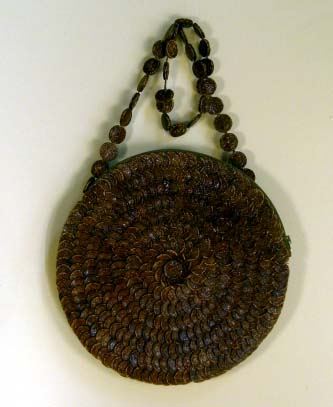
Cork Purse
Though I’d previously explored the use of cork as an alternative material for shoes, I had not realized that it was also used for handbags-perhaps by individuals rather than commercially.
Square purse of cork, at Lulu Forever
As I’d not really encountered cork handbags ‘in the wild’, a little researching was required. I found a nearly identical version for sale on etsy, and a circular example in a private collection. All appeared to be made of recycled materials (soda or wine corks) and a pre-fab zippered purse. Ferragamo is said to have created the first wedge shoe in 1936. [i] Wood and cork were used to create these soles and were frequently covered with cloth, leather and decorated with sequins, embroidery or bows. [ii] Due to a shortage of steel in 1936, which Ferragamo used usually used to reinforce the arches of his shoes, he created a sole made from a wedge of cork-leading to the trend for platform sandals in the 1930s and 1940s. [iii]
It’s easy to see that given these shortages and the cost of traditional materials, recycling wine-bottle and soda-pop cork could be an easy and innovative (admittedly, more research could be done on the use of recycled materials during the depression era). I’d love to hear from those who might be working in this area.
High cork platform shoes with gold kid strap, ca. 1937, photograph by Cecil Beaton (Conde Naste)Vintage 1930's Cork linings from bottle caps are glued into a zippered purse (Via Janet Cooper Designs)
As an aside, Lulu Forever also contained a zip-up, striped, polyester, shorts-jumper with labels from Lacoste for I.Magnin. I fell in love with it and I could not leave without buying it (I wore it to a BBQ on the 4th of July). If you ever find yourself in Sacramento, I’d suggest a visit – you just might find an icon there yourself.
[i] Mendes, Valerie and Amy De La Haye. 20th Century Fashion. London: Thames & Hudson, 1999. 86
[ii] Probert, Cristina. Shoes in Vogue Since 1910. New York: Abbeville Press, 1981, 28
[iii] Pattison Angela and Nigel Cawthorne. A Century of Shoes: Icons of Style in the 20th century Australia: Universal International, 1997. 10.




 *
*
 I recently discovered that the Conrad Mansion Museum in Kalispell, Montana is currently hosting a special costume exhibit titled At Home During Wartimes, on view through October 15, 2011. Special thanks to