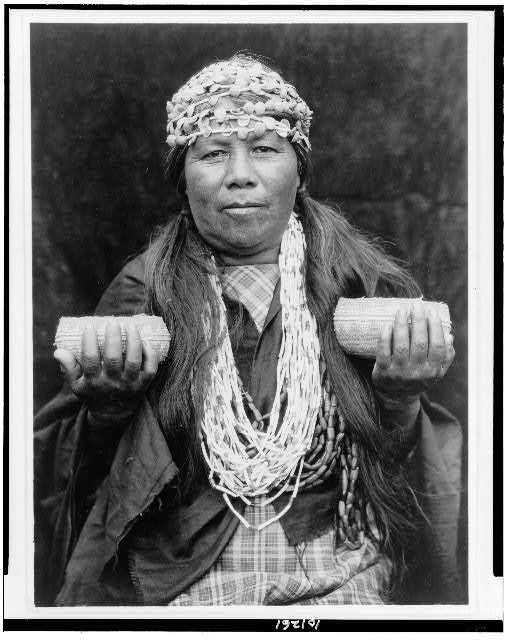
Athapascan Hupa woman from northwestern California, half-length portrait, standing, facing front, wearing shell headbands, necklace, and holding up two baskets. Photo by Edward S. Curtis, c1923. Library of Congress
Clara Bow In "IT" 1927, costume designed by Travis Banton
As I have said and repeat, my aim is for the legitimate. When a woman is required to dress for golf in a certain scene there is really no point in making her seem ready for a dance at the country club. When she is fitted with a bathing suit it should at least look suitable for water. Keeping this in mind,… I then muster new fashions which are the outcome of many trips to Paris, London and other points of fashion and modify and adjust them to the needs of the role.”
–Travis Banton quoted in Harrison, Helen. “Hollywood’s Own Revolt,” Screenland, March 1935, 33.
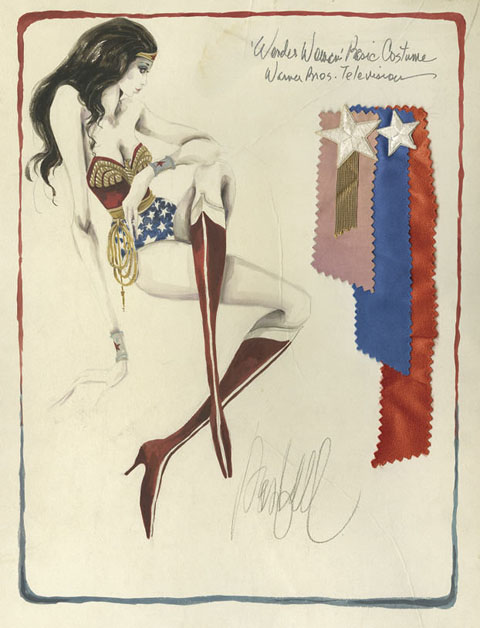
Wonder Woman costume sketch by Donfeld (sold in 2005 for $2,390 at auction)
So really, I am fascinated that there is going to be another iteration of Wonder Woman (apparently in 2015, and possibly starring Christina Hendricks of Madmen fame, to be directed by Nicholas Winding Refn). The original series, starring Lynda Carter, ran from 1975-1979 and the costumes were designed by Donfeld. Donfeld, who died in 2007, was nominated for four Academy Awards and designed costumes for films including “They Shoot Horses, Don’t They?” and “Prizzi’s Honor.”
1980s Underoos ad.
Photographic evidence suggests that I loved Wonder Woman so much as a kid, that I had and wore a pair of Wonder Woman Underoos (at a costume party of some sort – possibly a birthday). Apparently, Christina Hendricks had the underoos too. But I wonder – did Donfeld have anything to do with this childrens design?
I’m curious to know who will design the costumes for the newest version of Wonder Woman, and how her look might reflect ‘current’ fashion (if the story-line holds to the 1940s, might the costumes reflect that more ‘accurately’?)
“Over the years, Wonder Woman’s costume, like her character and physique, has been reworked and even reinvented according to prevailing fashions. One of the more drastic redesigns appeared on the cover of Wonder Woman No. 178, October 1968, where the heroine wears an implausibly short mini-dress and a pair of impossibly high thigh-high boots. Bernhard Willhelm evoked this “Mod” look in ensembles from his spring/ summer 2008 collection, although with their star-spangled patterns they also suggested Wonder Woman’s original patriotic costume.”
I’m also curious if the designer for the new Wonder Woman will be able to capitalize on merchandising opportunities, as Madmen designer Janie Bryant has done.
A side note: Director Nicholas Winding Refn is still in the ‘hoping’ stages of production, and thinks he might be closer with a remake of Logan’s Run to star Ryan Gosling. Franlkly, I’m not excited about that idea.
Behind Every Great Mad Man Is Janie Bryant: Ad Age Chats With the Designer About the Popular TV Series — and Her Other Endorsements and Plans, Advertising Age, Sept 8, 2011.
Some readers will be familiar with my good friend, Katie Netherton, who has previously written guest book reviews for me elsewhere. Katie earned her Masters degree from New York University in Visual Culture: Costume Studies in 2002. Most recently she worked on the historic documentation project at the Brooklyn Museum and the Gordon Conway archive at The University of Texas’s Harry Ransom Center.
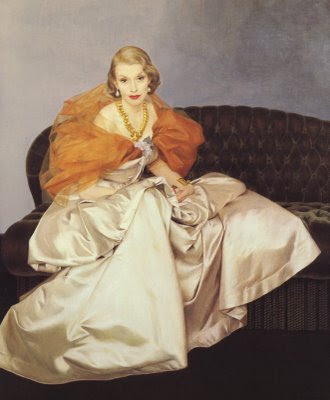
Millicent Rogers in Charles James (Via Stirred, Straight Up, with a Twist Blog)
While we were at NYU, Katie researched and wrote a paper on Millicent Rogers and was in fact the one who brought this book to my attention almost a year ago. The Wall Street Journal recently discussed the book in an article titled “She Wore it Well.” It was also recently tauted in Women’s Wear Daily, who points out this tasty tidbit about Rogers: “When she moved to Hollywood in 1946, Rogers stayed at Valentino’s former house, Falcon’s Lair” and reminds us of her strong connection to the master American couturier, Charles James. The author of Searching for Beauty, Cherie Burns, who recently guest blogged for Huffington Post on the connection between Charles James and Millicent Rogers, has a number of upcoming events scheduled for September and October in Taos and Santa Fe, New Mexico, including the Millicent Rogers Museum.
I’m very pleased to share with you Katie Netherton’s review:
Cherie Burns’ new book, “Searching for Beauty: The Life of Millicent Rogers,” explores the life of style icon Millicent Rogers, a fashion risk taker, art collector, jewelry maker, elegant decorator, and pinnacle of taste and flair. The author seeks to reveal Rogers’ character instead of strictly talking about her style and fashion sense, as many of the previous writings on Millicent Rogers have done. It’s refreshing, and well-deserved. Besides her impeccable collection of fashion and relationships with several important designers, Rogers had many accomplishments worth discovering as well. She was extremely creative and spent her life looking for ways to express herself. She was also very generous, with both her time and resources. She was a mother, a daughter, a wife, and an independent woman in a time when many women strictly followed the rules.
At times, Burns’ writing can seem disjointed, as if snippets from The New York Times and The Washington Post society columns were cut and pasted. But, no author has done such an in-depth job when it comes to sorting out the (sometimes hard to believe) details of Rogers life. Because so many of the well-known stories about Rogers seem to have been passed down over time without a known source, they seem more like legend than fact. By using first-hand accounts from family and friends, including time spent perusing unpublished family photographs, the author is able to shed some light on Rogers’ life and develop her character for the reader. There is little written about Rogers’s personal life, particularly about her personality. Time consuming as I’m sure it was, Burns has done an impeccable job bringing her to life.
Mary Millicent Rogers was born into a prosperous family. Her father, Henry (Harry) Huttleston Rogers, Jr., was the only son of Henry Huttleston Rogers, who along with William and John D. Rockefeller, presided over Standard Oil. Her mother was Mary Benjamin, also from a prominent family. Burns dives right in exploring Millicent’s debutante years and her several marriages and divorces over a short period of time. This well-researched section of the book is filled with quotes from various newspapers and family recollections. This time in Rogers’ life developed her sense of independence, but also reinforced her tie to her family’s money.
A brunette most of her life, Millicent sported a flapper’s short haircut when she stepped out as a soon-to-be young divorcée in 1926. She married again the following year. (The Peralta-Ramos Family archives via St. Martin's Press)
Burns slogs through Rogers’ marriages to Austrian Count Ludwig Salm von Hoogstraeten, Argentinean ArturoPeralta-Ramos and American Ronald Bush Balcom. Rogers had three children: Peter with Salm and Arturo and Paul with Peralta-Ramos. Her last marriage to Balcom ended in 1941. Although she never married again, Rogers had several relationships with public figures such as Ian Fleming, Roald Dahl and Clark Gable. Burns delves into these relationships as well, providing clarity where no other work on Rogers does.She paints a picture of an independent woman who was never fully satisfied with one man, one location, one of anything. It wasn’t that she didn’t love her husbands (or her lovers), but that she was always on the move to what was next, what would open her world just a bit more, whether that was a new relationship or a new house. Burns writes about Rogers as a real person, with heartaches and failed relationships, family dysfunctions and complicated mother-son relationships, and at the end of the day, a woman on a life-long quest for happiness.Burns does an excellent job unearthing Rogers’ generosity. Whether it’s her involvement with recuperating soldiers at her house in Virginia during World War II or her efforts to support the work of the Indians of Taos, she could be selfless when it came to her time and money. She was always willing to help, and seemed to feel that it was important to offer her resources for good.
A display of jewelry at the Millicent Rogers Museum
It is enjoyable to read about Rogers’ time in Taos, particularly since Burns lives in Taos herself. The reader can truly see the author’s love for her home. It lends an air of truth to her description of how Rogers must have felt upon her arrival at the Western outpost. Rogers’ time in Taos, although short, seems to be where she felt most at peace. The rheumatic fever she caught as a child and that plagued her throughout her life was beginning to catch up with her. Her untimely death at age 50 brought her adventurous life to an end. She never once let her fragile health get in the way of exploring new vistas. She was buried in Taos, wrapped in an Indian blanket and wearing some of her favorite Indian jewelry that she had been so avidly collecting. A fitting resting place for an extraordinary woman.
Burns includes a bibliography, never before seen photographs and extensive endnotes, all helpful for those interested in Rogers’ life. She gives Millicent Rogers the kind of attention she deserves, and now her life can be remembered not only for how stylish it was, but also for its generosity, vivacity and kindness.
Further Reading on Millicent Rogers:
In My Fashion by Bettina Ballard, New York: David McKay Company, Inc., 1960.
The Glass of Fashion by Cecil Beaton, London: Artillery House, 1989.
Fine Indian Jewelry of the Southwest: The Millicent Rogers Museum Collection by Shelby J. Tisdale, Santa Fe: Museum of New Mexico Press, 2006.
The Power of Style by Annette Tapert and Diana Edkins, New York: Crown Publishers, 1994.
Mrs. Ryie Yoshizawa, teacher, fashion designing class, Manzanar Relocation Center, California / photograph by Ansel Adams. 1943. Library of Congress.
“Mrs. Ryie Yoshizawa and class of women students at table with fabric and dressmaking equipment. Students are: Satoko Oka, Chizuko Karnii, Takako Nakanishi, Kikiyo Yamasuchi, Masako Kimochita, Mitsugo Fugi, Mie Mio, Chiye Kawase, and Miyeko Hoshozike.”
Kilim, 18th century, Turkey, Anatolia. Wool, cotton; slit tapestry weave. 56 x 138 inches. The Caroline and H. McCoy Jones Collection. Gift of Caroline McCoy-Jones (FAMSF, de Young Museum)
Opening September 10 and running through June 10 at the Fine Arts Museums of San Francisco, de Young Museum, The Art of the Anatolian Kilim: Highlights from the McCoy Jones Collectionincludes two dozen of the finest examples of design types and regional styles. More importantly, these kilims are a part of the de Youn’gs permanent collection and are considered to be the most important group of Anatolian kilims outside Turkey.
Kilim, 18th–19th century Turkey, Anatolia Wool; slit tapestry weave 335.3 x 180.3 cm (132 x 71 in.) The Caroline and H. McCoy Jones Collection Gift of Caroline McCoy-Jones (FAMSF, De Young)
Curator Jill D’Alessandro explains, “The first presentation of works from this collection in 1990 signified a breakthrough in the appreciation of this weaving tradition. Not only was it the first time a Western museum had mounted a major exhibition dedicated to Anatolian kilims, but it was also the first time that kilims of this age, rarity and fragility were seen by the public; subsequently, the Anatolian kilim entered into the pantheon of the textile arts. With more than 20 years passing since this important collection made its public debut, many visitors, scholars and textile enthusiasts will be able to enjoy and study them for the first time.”
Ms. Cootner will illustrate how these kilims, once used to furnish houses, tents, and mosques, embody the architecture of color. Basic to this function is slit-tapestry’s huge capacity for color expression and the special character of each individual shade. The wonderful patterning only emphasizes the compelling interactions between and within colors.”
September, 17, 2011 to February 4, 2012 at Lacis Museum of of Lace & Textiles
The Fall textile exhibit will focus on THE KNITTED LACE OF ESTONIA and its manifestations in relation to the alternate Estonian knitting disciplines, as well as the knitted lace in the cultures of Russia, Shetland, Germany and other geographic enclaves where lace knitting became the spirit of the soul.
Nancy Bush, sharing her love of Estonia, will be taking a curatorial role and will develop educational programs coordinated with the exhibit. September 17, 2011 to February 4, 2012, with a Friday evening opening party on September 16.
An invitation is extended to lace knitters, who have ventured into the cultural knitted laces of the exhibit and who would like to share their accomplishments, to submit photos of their work for consideration as to inclusion in this exhibit.
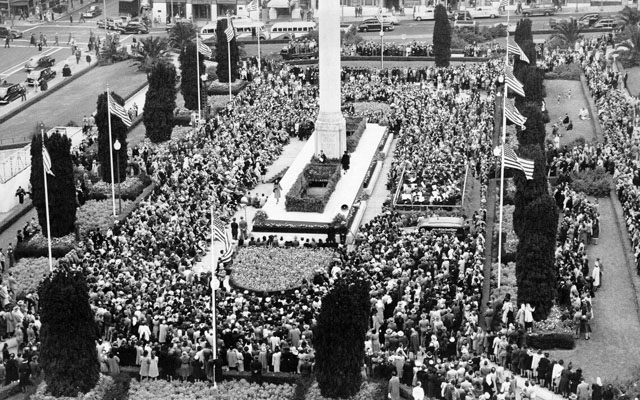
Sept 24, 1947: "That 'new look' came to Union Square today when O'Connor, Moffat staged an outdoor fashion show for a noon throng of fashion-conscious women. There were some men there, too. They came to see the comely models displaying the controversial 1947 fashions in dresses, and the controversial 1647 fashions worn by Linda Darnell in 'Forever Amber.' There was a band, a floral display, and pigeons - of course." (via the San Francisco History Center, San Francisco Public Library)





September, 17, 2011 to February 4, 2012 at Lacis Museum of of Lace & Textiles