Small Collection Highlight: Sacramento Valley Museum

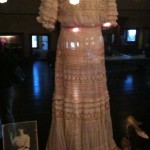
I spent this past Friday and Saturday in the small town of Williams, CA. For those who don’t know it, it is on I-5, at the exit for Clear Lake. It’s primarily a farm town – but its history is long and well preserved in the former school house, now known as the Sacramento Valley Museum. My family’s roots go back to this particular town to at least 1920, but we were in the surrounding area as early as 1885.

The museum is a large two-story building and it contains all manner of historical every-day objects. It had a special Veterans Day memorial on view (which included example uniforms and paraphernalia from every major conflict). The permanent exhibitions areas include farming equipment, Williams High Alumni collections (including band uniforms), Masonic paraphernalia, as well as rooms organized by theme: kitchen, bathroom, bedroom, children’s rooms as well as businesses such as apothecary, general store and happily for me, the clothing boutique (all including objects from varying time periods). Shocking -and somehow comforting-to know just how long the same pharmacy (Fouch’s) has been in existence here.

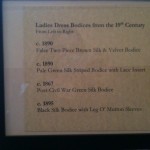
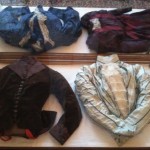
Of particular note were the Model-T car, the dusters in the tack room (circa 1900), and some fine examples of corsets, dresses, and women’s accessories. Somehow, the things worn and used by real people (rather than the rich-and-famous) are always of greater interest to me. They seem more authentic, and by extension, more important to study and understand.

If you ever find yourself in the area, I’d encourage a visit – it’s a unique way to step back in time and smaller, lesser-known collections need your support to survive. Hope you enjoy these quick snap-shots:
Continue Reading

Faye Dunaway on Costume Designer Theadora Van Runkle, 1929-2011

“After I got the role of Bonnie [in Bonnie and Clyde, 1967], Arthur [Penn] and I started talking about what she might wear. I thought jeans, maybe, pants of some sort since they were robbing banks and making quick getaways. But Warren [Beatty] and Arthur wanted to put her in dresses, great costumes that would give her style. They had decided to give Theadora Van Runkle, who was a young sketch artist with a great eye, a shot at designing the costumes. Soon after I met Theadora, who was to affect my own sense of style and become a good friend during these fast times. Until I met Theadora, clothes, and getting to a certain look, creating an effect had just been part of the job. She taught me just how much fun it can be. I like Theadora immediately. She was smart, funny, a very independent spirit, and a genius when it came to clothing design.”

— Faye Dunaway. Looking for Gatsby: My Life. New York: Simon & Schuster, 1995. (128-129)

Continue Reading

Mae West on skinny women, c.1934

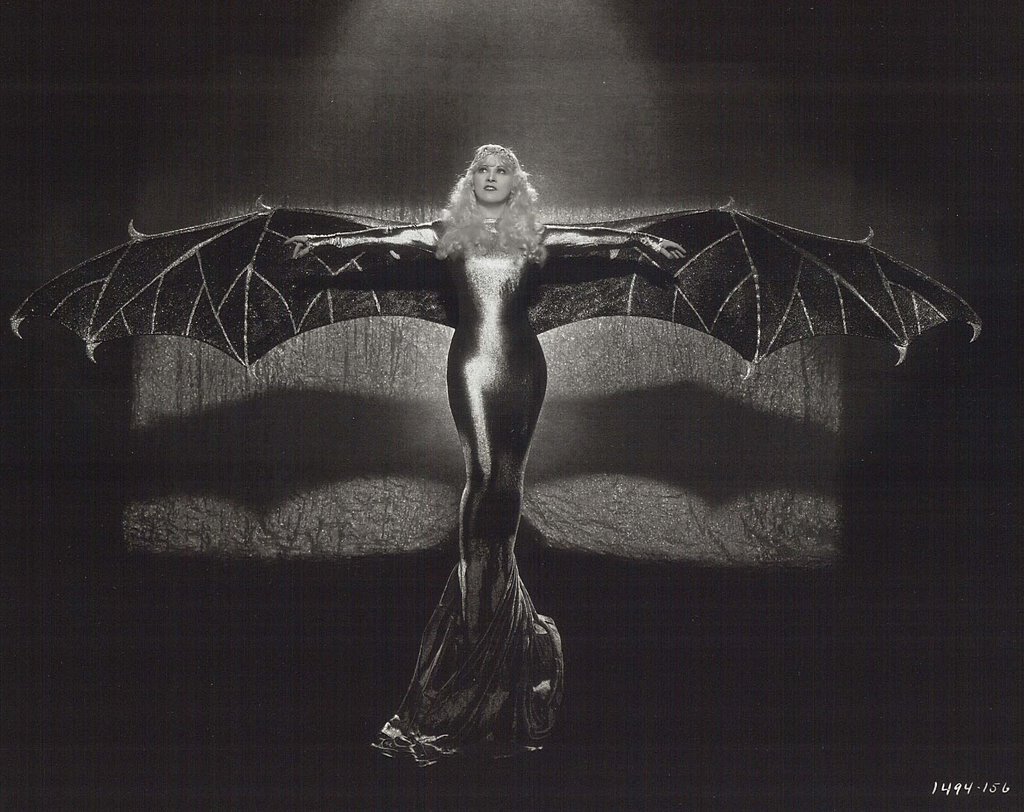
Actress Mae West, in "It Aint No Sin" c.1934 (Click for Source)

Author Maurice Leonard explains that for Mae West, “her rotundity was exaggerated by her shortness. Giving vent to her frustration to Ruth Biery, she complained that Hollywood had tried to alter her shape when she had first arrived, and viewed the slim Hollywood beauties around her with dissatisfaction:

“I never saw so many poles in my life! I wondered how Hollywood men could stand them. But everyone said I had to get thin. I figured they knew this racket and I didn’t, so I went on one of them Hollywood diets…It was pretty bad, but I’d been through a lot for art’s sake so taking off twenty pounds or more was just one more piece of the routine. I got down to 103 pounds. I stood in front of the mirror to study the results. I didn’t like it. I didn’t look—well, you know, voluptuous. And that isn’t all, I didn’t even look healthy. And man or woman, you got to look healthy to look right. Half-starved women can’t have no life in them any more than a half-starved dog.”* (141)

–Maurice Leonard in  Mae West: Empress of Sex. New York: Birch Lane Press, 1991. 141.

*Mae West in Movie Classic, April 1934.


Continue Reading

Exhibition Notice: Mottainai: The Fabric of Life (Portland)

Opening today at the Japanese Gardens in Portland, Oregon is Mottainai: The Fabric of Life, Lessons in Frugality from Traditional Japan.

“This exhibition of antique Japanese folk textiles from the Meiji period (1868-1912) is comprised of selections from the private collections of Stephen Szczepanek (suh-PAN-ecks) of Sri in Brooklyn and Kei Kawasaki of Gallery Kei in Kyoto. The exhibition demonstrates the remarkable ability of the Japanese to not only make do with the very little they had, but to make art with it.

For generations before the “Economic Miracle” took place in the decades following World War II, Japan was a poor country. People recycled everything. Nothing was wasted, and the word “mottainai” (waste nothing!) was a ubiquitous exclamation used by every frugal parent to warn children about wasting a bite of food or a scrap of cloth or paper.

All of the textiles and garments on view were made from bast fibers foraged from the forest, or patched and quilted together from second-hand scraps of cotton garments of city-dwellers who traded their hand-me-downs with the farmers for rice and vegetables.The exhibition represents a wide variety of traditional textile making and decorating techniques, including sashiko stitching, bast fiber weaving and dyeing, and patchwork quilting, the latter referred to as boro.”

This short exhibition only runs through November 27 – so see it while you can. Learn more about the textiles and objects included here.

Continue Reading

Mrs. D.W. Griffith on early film costume practices

Linda Arvidson (Mrs. D. W. Griffith) circa 1910-1915

“Any one with ‘clothes’ had a wonderful open sesame. A young chap whom we dubbed ‘the shoe clerk’ – who never played a thing but ‘atmosphere’ –got many a pay-check on the strength of his neat, tan, covert cloth spring overcoat—the only spring overcoat that ever honored the studio (An actor could get along in the spring with his winter suit and no overcoat!)

Clothes soon became a desperate matter, so Biograph consented to spend fifty dollars for wearing apparel for the women. Harry Salter and I were entrusted with the funds and told to hunt bargains. We needed negligees, dinner dresses, ball gowns, and semi-tailored effects. The clothes were to be bought in sizes to fit, as well as could be, the three principal women. (71)

In that day, on Sixth Avenue in the Twenties, were numbers of shops dealing in second-hand clothing, and Mr. Salter and I wandered among them and finally at a little place called ‘Simone,’ we closed a deal. We got a good batch of stuff for the fifty – at least a dozen pieces—bizarre effects for the sophisticated lady, dignified accoutrements for the conventional matron, and simple softness for young innocence.

How those garments worked! I have forgotten many, but one—a brown silk and velvet affair—I never can forget. It was the first to be grabbed off the hoot—it was forever doing duty. For it was unfailing in its effect. Arrayed in the brown silk and velvet, there could be no doubt as to one’s moral status—the maiden lady it mad obviously pure; the wife faithful; the mother, self-sacrificing.

Deciding, impromptu, to elaborate on a social affair, Mr. Griffith would call out: ‘I can use you in this scene, Miss Bierman, if you can find a dress to fit you.’ The tall, lean actresses, and the short ones found that difficult, and thus, unfortunately, often lost a day’s work. Spotting a new piece of millinery in the studio, our director would thus approach the wearer: ‘I have no part for you, Miss Hart, but I can use your hat. I’ll give you five dollars if you will let Miss Pickford wear your hat for this picture.’ Two days of work would pay for your hat, so you were glad to sit around while the leading lady sported your new head-piece. You received more on a loan of your clothes, sometimes, than you did on a loan of yourself. Clothes got five dollars always, but laughter and merry-making upstage went for three.” (72)

–Linda Arvidson (Mrs. D.W. Griffith). When the Movies Were Young, New York: E.P. Dutton & Company, 1925. pgs 71-72

Below is an early film (by D.W. Griffith) The Adventures of Dollie, starring Linda Arvidson and Harry Salter.

Continue Reading