

Tuesday Teaser: Louise Dahl-Wolfe
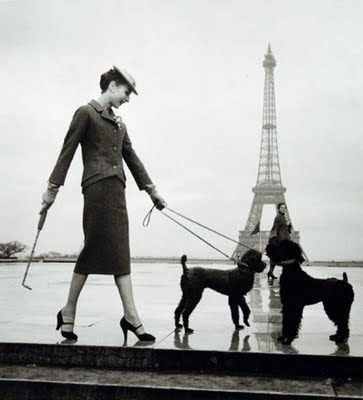
Born and educated in San Francisco, Louise Dahl-Wolfe would later work as a staff photographer for Harper’s Bazaar from 1936 through 1958. I recently came upon an extremely detailed account of her life and San Francisco beginnings on from this website (originally published in April 2010):
“Louise Dahl-Wolfe (1895 – 1989) was born in San Francisco. Aspiring to a career as a painter, she attended the California School of Design (now the San Francisco Art Institute). . . . After completing her studies, Dahl-Wolfe designed electric signs from 1921 to 1923; in 1924 she began working for a leading decorator. In 1921 she was invited to the studio of photographer Anne Brigman; this meeting prompted her to buy her first camera, an Eastman bellows camera with a reflector made from a Ghirardelli chocolate box. She used her mother as the subject of her first pictures. Early photographic adventures included taking shots of herself and some friends nude on a beach, using the soft-focus style of her mentor. After Dahl-Wolfe befriended another San Francisco photographer, Consuela Kanaga, who taught her to use a 314-by-414-inch Thorn-ton-Pickard English reflex camera with a Verito soft-focus lens, the two traveled together to Europe in 1927. . . .
Dahl-Wolfe returned to San Francisco in 1928 and began taking commercial black-and-white photographs. . . . After moving with her husband to New York, Dahl-Wolfe was introduced to Frank Crowninshield, then editor of Vanity Fair, who decided to publish her work. . . . This success led to the publication of her first black-and-white fashion work in Harper’s Bazaar in 1936 and her first color work a year later.”
Read the full article here.
Those interested in researching Dahl-Wolfe’s work should check the Louise Dahl-Wolfe Collection at the Center for Creative Photography, University of Arizona in Tucson and the Fashion Institute of Technology in New York City.
Mary Lynn Stewart on Russian Embroidery in Interwar France

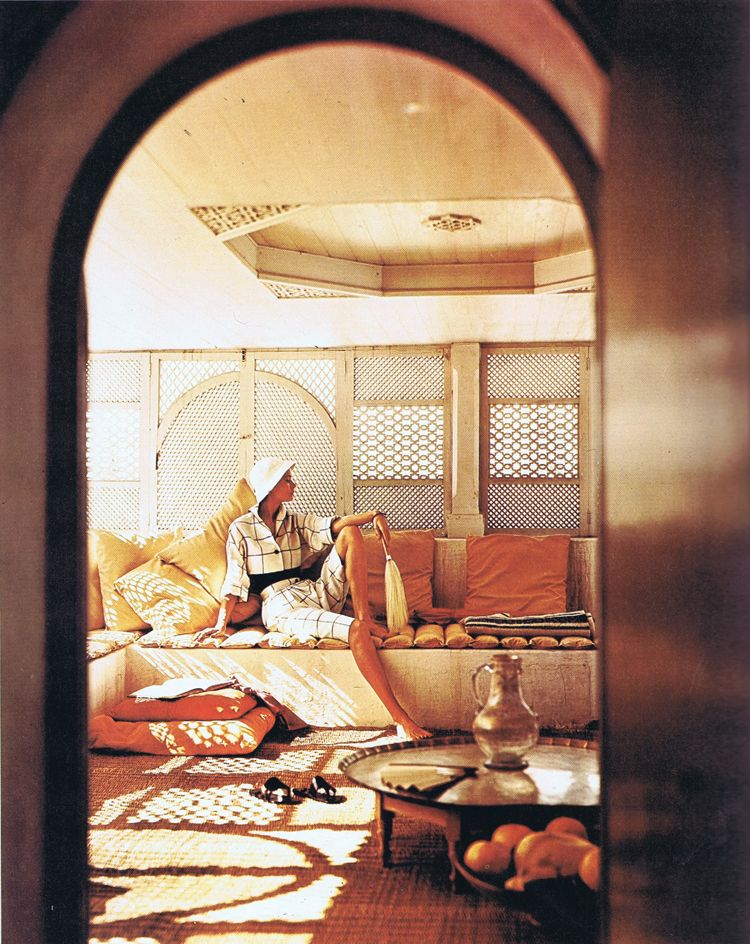
“During the war, when rich fabrics were scarce, embroidery was the principal form of ornamentation on dresses. For a few years after the war, couture houses were starved of fine fabrics. Most available textiles were plain, but couturiers compensated by embellishing them with rich embroidery. Chanel made tunics in black and other dark colors adorned with vividly coloured, ‘exotic’ – meaning in this case, Russian – embroidery. After the White Russians arrived in Paris, Russian women, including aristocrats, supported their families by embroidering Slavic motifs. …” (Stewart, Mary Lynn.“Marketing Fabrics & Femininity in Interwar France,” Textile History. 35(1), 90-111, 2004. 98).
Historic Photos: 1923 Dance Pageant held in Benicia
My small hometown of Benicia, CA has a historical museum whose website includes several groups of ‘mystery’ vintage photographs. Though places, dates, and people aren’t always known. These photographs provide a remarkably clear record of what people were wearing in times gone by. I’d guess that the majority of the photographs on this website come from the interwar years, specifically the teens and twenties. There are pictures of the Benicia High sports teams, old cars, the fire department, and something called the “John Laurence Molfino Biography.”
My personal favorite though, is the selection of photos of a pageant dance held in an open field in 1923, that was VERY well attended.

1923 Solano Historical Pageant
According to the Oakland Tribune, the 1923 Solano County Historical Pageant was attended by 10,000 people. It seems that this Pageant was put on by a federation of several different women’s social clubs. Held in Benicia on May 11, 1923, the pageant included nine different episodes and required nearly five hours to watch the entire show.
Both the Solano Republican and the Oakland Tribune indicated that the dance director was Mrs. A. G. Bailey of Suisun. Though not all of the costumes are of this style, the photos I’ve included here SO strongly resemble the costumes and dance styles of Isadora Duncan and Loie Fuller – I can’t help wonder if either of them were involved somehow. Both women were in the Eastern Bay Area in the teens and twenties. At the very least, I suspect Mrs. Bailey had seen them perform. Interestingly, the composer of the music for the pageant, Dr. Douglas Wright, was from Berkeley – where much Bohemian artist activity was centered.


- Via Benicia Historical Museum


The Solano Republican goes on to explain that “The cunning little costume drawn by Miss Doddson is simple, but altogether charming.” Emma Doddson of Suisun was, in fact, the Artistic Director, for the entire show. I would guess that it was her vision that created these designs. Interestingly, the publicity manager – Miss E.C. Stove, arranged for rotating exhibits (including dresses) to travel to all the different towns involved to attract attendees.
Sabine Goerke-Shrode*, did a good bit of research on this event, and found in her 2004 article that a good portion of the remaining design, writing, organizing and construction work was done at Armijo High School. Other photos in this collection show young girls in traditional ballet costumes, as well as in period costume (as well as performers dressed as military, spanish and native american costumes).
Those interested in reading more about the Pageant itself can download this coverage of the event from the Oakland Tribune in 1923 (Click here to download the PDF). I’d love to hear from anyone who might have additional information on these photographs and as always, anyone with ideas is welcome to comment. For more of the photos, please visit the Benicia Historical Museum.
*Additional photos on Pageant can be found here.
Resources:
1. Goerke-Shrode, Sabine. “Helping to make their Communities Better,” Historical Articles of Solano County, September 19, 2004.
2. Goerke-Shrode, Sabine. “Pageant showed panorama of early Solano” Historical Articles of Solano County, October 3, 2004.
3. Goerke-Shrode, Sabine. Images of Fairfield. Arcadia Publishers, 2005.
4. Henry, Rideout and Wadell. Berkeley Boehia: Artists and Visionaries of the Early 20th Century. Salt Lake City: Gibbs Smith Publisher, 2008.
5. “10,000 see pageant at Benicia,” Oakland Tribune, May 20, 1923, pg. A.
Research Resource: Costume at the Oakland Museum
The Oakland Museum of California has recently updated their website and is now featuring (at the top of the page, no less) their historic costume collection. The costume collection online features about 450 objects online, and provides some details about the objects that appear. In browsing through the online collection, it seems heavy on shoes, hats and accessories – with few couture or designer garments (though James Gallanos is certainly present, as well as a few pieces from I. Magnin).
However, it does become clear that the focus is really on the history of California. Ethnic and Sportswear are included in this online selection, as well as artwear (including shoes by Gaza Bowen) and all types of uniforms (Military, nurse, employee, even campfire girl). A number of objects relate to the early days of the gay pride movement. Film costume is sparce, but it does include a pair of Eddie Murphy’s shoes from Beverly Hills Cop.
If you’re looking for a needle in a haystack, it’s certainly a place to start.
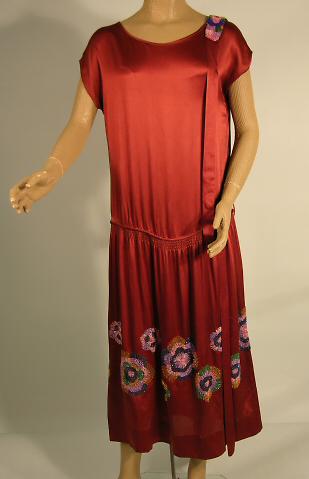
*Catalog Entry: 2008.78.3 c. 1926-1927
This brown satin dress–with a scoop neck and short sleeves–is decorated with bands of the self same brown satin, as well as beading done in the form of flowers. The beads are sewn directly to the dress, mostly 6 petal flowers in various combinations of blue, green, amber color, pink and purple beads; they form an eight inch band around the skirt, above the wide hem. The dress has a dropped waist, and the top of the skirt is shirred with four bands of stitching. A band of the satin (about 1 1/8 inches wide) drops from the proper left shoulder, front and back, is loose to the dropped waist, where it is caught with a horizontal band of machine stitching, and then falls free again to the hem. At the proper left shoulder a lozenge-shaped piece of beaded brown satin (centered with a 4 petal pink flower) is stitched to hold the decorative bands.
Mary Acelia Chamberlain, who wore this dress, graduated from the University of California, Berkeley in 1926. Although she taught in the San Francisco School System all her working life, she was also an accomplished musician, playing the violin. She performed at the Claremont Hotel. According to family history, she also entertained service men, playing the violin, while she was still in high school. She was bornn August 28, 1905 in Philadelphia, PA and moved to California at the death of her grandfather, before July of 1906. She died December 20, 2005 at the age of 100.
Used: Mary Acelia Chamberlain | University Of California, Berkeley | Claremont Hotel | Adult ~ female | Musician
Fashion in Motion: San Francisco Scenes (ca. 1920’s)
Exhibition: At Home During Wartimes (Kalispell, MT)
 I recently discovered that the Conrad Mansion Museum in Kalispell, Montana is currently hosting a special costume exhibit titled At Home During Wartimes, on view through October 15, 2011. Special thanks to Tove Hermanson, who edits the Costume Society of America‘s monthly E-Newsletter, for alerting me (and all CSA members) to this unique exhibit.

According to the webpage, At Home During Wartimes includes both items worn on the front, as well those worn by the Conrad family at home during wartimes. The breadth of history is quite astounding, and goes as far back as the Civil and Spanish War America War, through WWI and WWII and into the Korean War. Uniforms as well as what ‘the folks back home’ were wearing are shown in an effort to provide insights into how wartime shortages and demands affected the clothing industry.
For further details, including address, hours visit www.conradmansion.com or call 406-755-2166 for more information and special event information. Details about the exhibit can be found on this Facebook page.
If you end up going – I’d love to hear more about the exhibit!
Fashion History Find: Sacramento Mod, Deco and More

About a month ago, I found myself in Sacramento with time to waste. Rather quickly, I found myself quite a ways off the beaten path at a vintage shop called Lulu Forever. Once inside, it became clear that the buyer there has a great eye for both historically relevant and unique pieces: The shop held a wide range of clothing from a variety of time periods. Of particular note were the full skirted 1950s dresses, adorable pink polyester pants suits, and small (but well selected) section of menswear. I scrolled through the racks and found myself breathless with anticipation: what would I find on the next hanger? One piece caught my eye before I’d even entered the store: a textbook perfect example of mod fashion.
Grey Mod Dress
The grey mini-dress, shown below, with a white peter pan collar and single front pocket represented the epitome of the 1960s “mod” style. It referenced a number of well known designers and images.

Both Haute Couture and pop culture reference can be found here. A high fashion dress created by Yves Saint Laurent in 1958 for Dior (though it retained the heavy under structure despite appearing loose and ‘free’) is remarkably similar to the dress at Lulu’s. Though it can also be easily compared to the work of commercial designer Mary Quant in the early 1960s (as well as her own personal style). Yet a third reference draws comparisons to 1960s popular film, specifically Anthea Sylbert’s costume designs for Rosemary’s Baby (1968). Of course, the look was also parodied by John Waters in the movie Hairspray (1988, CD Van Smith).


Cork Purse
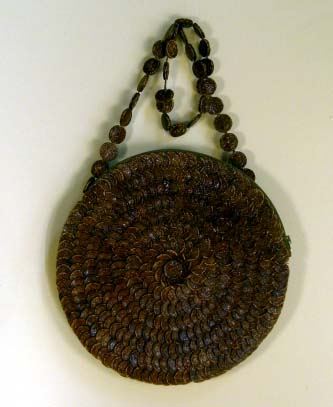
Though I’d previously explored the use of cork as an alternative material for shoes, I had not realized that it was also used for handbags-perhaps by individuals rather than commercially.

As I’d not really encountered cork handbags ‘in the wild’, a little researching was required. I found a nearly identical version for sale on etsy, and a circular example in a private collection. All appeared to be made of recycled materials (soda or wine corks) and a pre-fab zippered purse. Ferragamo is said to have created the first wedge shoe in 1936. [i] Wood and cork were used to create these soles and were frequently covered with cloth, leather and decorated with sequins, embroidery or bows. [ii] Due to a shortage of steel in 1936, which Ferragamo used usually used to reinforce the arches of his shoes, he created a sole made from a wedge of cork-leading to the trend for platform sandals in the 1930s and 1940s. [iii]
It’s easy to see that given these shortages and the cost of traditional materials, recycling wine-bottle and soda-pop cork could be an easy and innovative (admittedly, more research could be done on the use of recycled materials during the depression era). I’d love to hear from those who might be working in this area.

As an aside, Lulu Forever also contained a zip-up, striped, polyester, shorts-jumper with labels from Lacoste for I.Magnin. I fell in love with it and I could not leave without buying it (I wore it to a BBQ on the 4th of July). If you ever find yourself in Sacramento, I’d suggest a visit – you just might find an icon there yourself.
[i] Mendes, Valerie and Amy De La Haye. 20th Century Fashion. London: Thames & Hudson, 1999. 86
[ii] Probert, Cristina. Shoes in Vogue Since 1910. New York: Abbeville Press, 1981, 28
[iii] Pattison Angela and Nigel Cawthorne. A Century of Shoes: Icons of Style in the 20th century Australia: Universal International, 1997. 10.
Happy 4th of July!

New Historic Film Archive (and Costumes) Now Online

Given that costume designers sometimes don’t get the credit they deserve, it’s nice to be able to tell you about a new authoritative archive that emphasizes the historical import of this often under-valued craft. Earlier this week I received notice that the Margaret Herrick Library (of the Los Angeles based Academy of Motion Picture Arts & Sciences: i.e. OSCAR!) had finally released its online archive of Production Art.
It’s not the entirety of the Graphic Arts collection, but much to my delight, it includes a good deal of film costume art! Of the 5,300 records in the database, nearly half include images. The database also includes “production design drawings, animation art, storyboards and paintings” and date from the 1920s to the present day.
It’s a huge resource for film costume historians, and thankfully provides credit for both costume designers, as well as illustrators (often two different individuals). As Library Director Linda Mehr notes:
“We’re very happy to be able to make this database more widely available to researchers, students and film enthusiasts. . . . Our hope is that it will bring much-deserved attention to the costume and production designers, sketch artists, animators, and other artists who have contributed so much to filmmaking.”

To give you just a quick snapshot of what’s available: The database includes nearly 40 records for Gilbert Adrian; 20 for Milo Anderson; almost 30 for Travis Banton; 70 for Marjorie Best; 19 for Howard Greer and many, many more.
Not surprisingly, my interest is in the illustrations by Natacha Rambova, Gilbert Adrian, Georges Barbier and Erte (and of course those depicting Rudolph Valentino and Alla Nazimova).
Though most images are rights-protected (i.e. you can see them on your computer screen, but can’t insert them into a blog post or save them to your computer), a few have been cleared for media purposes. Those interested in information on additional materials (or to make an appointment to view an item that does not yet include a reference image) are encouraged to contact graphic arts librarian Anne Coco at acoco@oscars.org. A full list of their databases is available here.
AMPAS Production Art Database
_