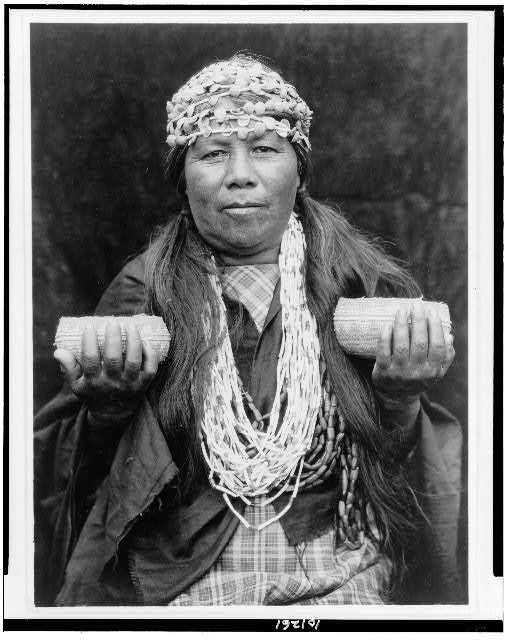
Athapascan Hupa woman from northwestern California, half-length portrait, standing, facing front, wearing shell headbands, necklace, and holding up two baskets. Photo by Edward S. Curtis, c1923. Library of Congress
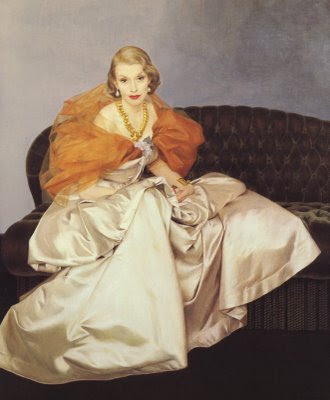
Edward Steichen (1819-1972), Fashion photograph, Vogue, 1930.
Western dress requires the body to give clothes meaning, and Western art had always accommodated itself to this need until the possibilities of abstract vision made themselves available to Western eyes, After that, clothes could aim at an ideal shape of their own, to which a body was truly subordinate — a box, a cylnder, a pyramid–and they could be shown to achieve it in a painting or a fashion illustration. Actual bodily shapes, always apt for distortion, now had the further task of turning themselves into detached patterns of their own mind’s eye. This is harder discipline than corseting and padding. Fashion photography, now advancing in the hands of masters such as Steichen and De Meyer, was able to aid the trend and offer black-and-white compositions of compelling authority — all the stronger because the camera now officially represented truth and such creations could not be considered distorted in the same way a drawing could. The ideal simplified shape of a sleek body was now not only indicated by the trend of abstract graphic design but confirmed on film. Since that time, women have had to be slender.”
I’m very pleased to announce that the winner of our “Pick your favorite German fashion icon” Facebook contest is reader Helen Steele – Congratulations!
Helen’s winning entry says: “I’d have to pick Brigitte Helm, the actress from Metropolis. As Maria/Robot she features in some of cinema’s most iconic images. She also wears a rather covetable collared dress in the film, very A/W 2011! Her own style encapsulated both the ‘vamp’ look of the silent cinema era and a softer, more elegant Art Deco style.”
Some readers will be familiar with my good friend, Katie Netherton, who has previously written guest book reviews for me elsewhere. Katie earned her Masters degree from New York University in Visual Culture: Costume Studies in 2002. Most recently she worked on the historic documentation project at the Brooklyn Museum and the Gordon Conway archive at The University of Texas’s Harry Ransom Center.
Millicent Rogers in Charles James (Via Stirred, Straight Up, with a Twist Blog)
While we were at NYU, Katie researched and wrote a paper on Millicent Rogers and was in fact the one who brought this book to my attention almost a year ago. The Wall Street Journal recently discussed the book in an article titled “She Wore it Well.” It was also recently tauted in Women’s Wear Daily, who points out this tasty tidbit about Rogers: “When she moved to Hollywood in 1946, Rogers stayed at Valentino’s former house, Falcon’s Lair” and reminds us of her strong connection to the master American couturier, Charles James. The author of Searching for Beauty, Cherie Burns, who recently guest blogged for Huffington Post on the connection between Charles James and Millicent Rogers, has a number of upcoming events scheduled for September and October in Taos and Santa Fe, New Mexico, including the Millicent Rogers Museum.
I’m very pleased to share with you Katie Netherton’s review:
Cherie Burns’ new book, “Searching for Beauty: The Life of Millicent Rogers,” explores the life of style icon Millicent Rogers, a fashion risk taker, art collector, jewelry maker, elegant decorator, and pinnacle of taste and flair. The author seeks to reveal Rogers’ character instead of strictly talking about her style and fashion sense, as many of the previous writings on Millicent Rogers have done. It’s refreshing, and well-deserved. Besides her impeccable collection of fashion and relationships with several important designers, Rogers had many accomplishments worth discovering as well. She was extremely creative and spent her life looking for ways to express herself. She was also very generous, with both her time and resources. She was a mother, a daughter, a wife, and an independent woman in a time when many women strictly followed the rules.
At times, Burns’ writing can seem disjointed, as if snippets from The New York Times and The Washington Post society columns were cut and pasted. But, no author has done such an in-depth job when it comes to sorting out the (sometimes hard to believe) details of Rogers life. Because so many of the well-known stories about Rogers seem to have been passed down over time without a known source, they seem more like legend than fact. By using first-hand accounts from family and friends, including time spent perusing unpublished family photographs, the author is able to shed some light on Rogers’ life and develop her character for the reader. There is little written about Rogers’s personal life, particularly about her personality. Time consuming as I’m sure it was, Burns has done an impeccable job bringing her to life.
Mary Millicent Rogers was born into a prosperous family. Her father, Henry (Harry) Huttleston Rogers, Jr., was the only son of Henry Huttleston Rogers, who along with William and John D. Rockefeller, presided over Standard Oil. Her mother was Mary Benjamin, also from a prominent family. Burns dives right in exploring Millicent’s debutante years and her several marriages and divorces over a short period of time. This well-researched section of the book is filled with quotes from various newspapers and family recollections. This time in Rogers’ life developed her sense of independence, but also reinforced her tie to her family’s money.
A brunette most of her life, Millicent sported a flapper’s short haircut when she stepped out as a soon-to-be young divorcée in 1926. She married again the following year. (The Peralta-Ramos Family archives via St. Martin's Press)
Burns slogs through Rogers’ marriages to Austrian Count Ludwig Salm von Hoogstraeten, Argentinean ArturoPeralta-Ramos and American Ronald Bush Balcom. Rogers had three children: Peter with Salm and Arturo and Paul with Peralta-Ramos. Her last marriage to Balcom ended in 1941. Although she never married again, Rogers had several relationships with public figures such as Ian Fleming, Roald Dahl and Clark Gable. Burns delves into these relationships as well, providing clarity where no other work on Rogers does.She paints a picture of an independent woman who was never fully satisfied with one man, one location, one of anything. It wasn’t that she didn’t love her husbands (or her lovers), but that she was always on the move to what was next, what would open her world just a bit more, whether that was a new relationship or a new house. Burns writes about Rogers as a real person, with heartaches and failed relationships, family dysfunctions and complicated mother-son relationships, and at the end of the day, a woman on a life-long quest for happiness.Burns does an excellent job unearthing Rogers’ generosity. Whether it’s her involvement with recuperating soldiers at her house in Virginia during World War II or her efforts to support the work of the Indians of Taos, she could be selfless when it came to her time and money. She was always willing to help, and seemed to feel that it was important to offer her resources for good.
A display of jewelry at the Millicent Rogers Museum
It is enjoyable to read about Rogers’ time in Taos, particularly since Burns lives in Taos herself. The reader can truly see the author’s love for her home. It lends an air of truth to her description of how Rogers must have felt upon her arrival at the Western outpost. Rogers’ time in Taos, although short, seems to be where she felt most at peace. The rheumatic fever she caught as a child and that plagued her throughout her life was beginning to catch up with her. Her untimely death at age 50 brought her adventurous life to an end. She never once let her fragile health get in the way of exploring new vistas. She was buried in Taos, wrapped in an Indian blanket and wearing some of her favorite Indian jewelry that she had been so avidly collecting. A fitting resting place for an extraordinary woman.
Burns includes a bibliography, never before seen photographs and extensive endnotes, all helpful for those interested in Rogers’ life. She gives Millicent Rogers the kind of attention she deserves, and now her life can be remembered not only for how stylish it was, but also for its generosity, vivacity and kindness.
Further Reading on Millicent Rogers:
In My Fashion by Bettina Ballard, New York: David McKay Company, Inc., 1960.
The Glass of Fashion by Cecil Beaton, London: Artillery House, 1989.
Fine Indian Jewelry of the Southwest: The Millicent Rogers Museum Collection by Shelby J. Tisdale, Santa Fe: Museum of New Mexico Press, 2006.
The Power of Style by Annette Tapert and Diana Edkins, New York: Crown Publishers, 1994.
Mrs. Ryie Yoshizawa, teacher, fashion designing class, Manzanar Relocation Center, California / photograph by Ansel Adams. 1943. Library of Congress.
“Mrs. Ryie Yoshizawa and class of women students at table with fabric and dressmaking equipment. Students are: Satoko Oka, Chizuko Karnii, Takako Nakanishi, Kikiyo Yamasuchi, Masako Kimochita, Mitsugo Fugi, Mie Mio, Chiye Kawase, and Miyeko Hoshozike.”
Berliner Chic offers a wealth of theoretical references, a historical framework, and a rich bibliography, as well as plenty of charming anecdotes, engaging stories, and ample photographs. One can imagine the reader packing this book before a trip to Berlin and using it as an alternative travel guide.”
—Mila Ganeva, University of Chicago and author of Women in Weimar Fashion.
By happy accident I have just received a spare copy of this enticing new book and I’d like to share that wealth with you! To enter to win a copy of Berliner Chic: A Locational History of Berlin Fashion by Susan Ingram and Katrina Sark, simply:
August 19, 1922. Mrs. Mallory Successfully Defends Title. Photo shows Mrs. Molla Mallory who successfully defended her title as National Women's Tennis Champion by defeating Miss Helen Wills, the sixteen-year old California girl in straight sets at Forest Hills on Saturday. Miss Wills made a gallant fight but was obviously nervous and was forced to bow to the veteran player. ( Bettmann/CORBIS)
Augu 4, 1925: Miss Helen Wills, National Women's Tennis Champion, is entered in the Women's Annual New York State Championship, which opened at the Westchester-Biltmore Country Club, Rye, New York. With practically the same field that competed in the tournament at Seabright, N.J., it is very possible that Miss Wills will again meet Miss Elizabeth Ryan of England and California in the finals. The court conditions at Rye will be more favorable to Miss Wills than those at Seabright last week, but she will find Miss Ryan a dangerous opponent. Miss Helen Wills, made at the Westchester-Biltomore Country club. (Underwood & Underwood/CORBIS)July 15, 1927: Portrait of Helen Wills Moody Miss Helen Wills, of California, returns home after her successful tour during which she won the women's tennis title at Wimbledon. (Underwood & Underwood/CORBIS)c1934: Professional tennis player Helen Willis Moody sitting in profile in a black armchair, with short wavy hair over her ears, and a pronounced nose. (Conde Naste/Corbis)
For more images of California’s own Helen Wills Moody, follow this link.
Myrna Loy in a Dolly Tree design (the Thin Man, 1934)
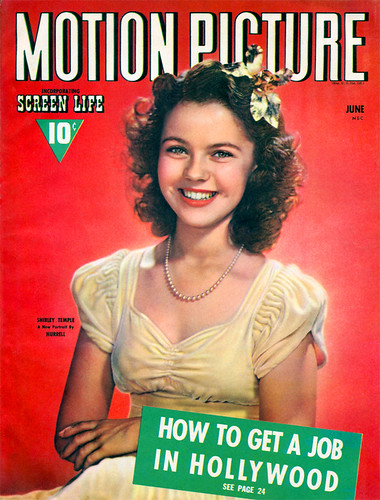
In Motion Picture magazine, June 1942, this funny little article was posted about costume designer Dolly Tree. She was probably best known for her work in the 1920s and 1930s – most notably The Thin Man series starring William Powell and Myrna Loy (For more on her early work in illustration, do travel over to this fascinating post at the Jazz Age Club). The brief piece below offered 1942 readers the unique opportunity to learn about the field of ‘costume design’ as a career directly. Including qualifications, income, and hazards of the position. I’d love to hear comments from those currently in the field to find out how much still rings true.
Motion Picture Magazine. (June 1942. 63(5): 27):
Top designer Dolly Tree can tell you hers is nice work, but the competition in this field is plenty tough”
Motion Picture Magazine, June 1942
Title
Designer
Working
Conditions
Assistants start at $50 a week. Top designers get $1,500 to $2,000. They keep regular office hours, but can never limit their work to those hours. They’re constantly getting rush calls for designs, both day and night. They have no guild.
Qualifications
First and foremost: tact. You have to please everybody. Also, you have to be a rapid sketch artist, with original and dramatic ideas. You must have an infinite knowledge of materials and dyes. And you must know dress construction, to be able to guide seamstresses.
Preparation
Start by designing, and making, your own clothes. You’ll discover how much you need to learn about costuming, materials and actual manufacture. Then go to some good school of design and, after you graduate, get a job—and experience—with some successful designer.
Getting Started
Know some influential person, and impress that person with your ideas. That’s how Natalie Visart became De Mille’s designer at 22. She learned he was going to film Cleopatra, did research on things Egyptian, whipped up hundreds of sketches—and got the job.
What Lies Ahead
With Hollywood fast becoming THE fashion capital, any successful Hollywood designer can stepout and open a profitable salon. (In fact, Adrian just has.) But, remember—the competition is keen and only the best designers succeed.
Beware!
The competition is the cut-throat kind. Just when you think you’re doing all right, some smooth-talking newcomer from Paris or New York will talk you right out of a job, unless you can succeed in out-talking him first.
1939: "Janet Gaynor and Adrian Married. Hollywood, California: Pictured as they recently danced here are film star Janet Gaynor and Gilbert Adrian, Hollywood fashion expert. The couple are Mr. and Mrs. now for they motored to Yuma, Arizona and were married there August 14th. The couple are en route to Mexico for a honeymoon." (Corbis)
Los Angeles-based fashion designers have a distinct style, much different than their New York counterparts. This April, Reuters noted: “The City of Angels has carved out a niche for itself as a host for casual brands like American Apparel and as a manufacturer of quick-turnaround ‘fast fashion’ and small orders for emerging designers. Fashion is the city’s largest manufacturing industry, and employs more people here than in New York.[1] (1)
This might be a surprising statement for those not familiar with the fashion world. Most would identify New York as the American fashion capital. But the fact is, California has long been a fashion leader, and this isn’t the first time the Golden State has eclipsed New York.
Two cataclysmic events, the Great Depression and World War II, created a change in the needs of American women. The active California lifestyle and the Hollywood film industry both affected the demand for a different style of women’s clothing. It was during this time that California established itself as a fashion capital.
American film played a large part in showcasing the California fashions in the 1920s, 1930s, and 1940s. The theaters were public places of congregation. Women would go after work to watch the news and see a feature film. Hollywood was providing entertainment to help citizens escape their glum realities of economic depression and war. Historically, this was a time when the entire film production took place in California. Actresses like Greta Garbo, Marlene Dietrich, and Mae West captivated audiences with their style and glamour. The movie industry, and its costume designers, exerted a direct influence on fashions that were available in stores.
Much like today, when actresses were seen on film, women clamored to imitate their styles. Independent fashion designers and manufacturers began sprouting up throught the Golden State. Vogue noted the growing power of California on the horizon: “Throughout the 1930s Vogue juggled issues of innovation and ideas with Paris on the one hand and Hollywood on the other, giving equal credence to both camps . . . Paris was working on a seasonal time scale, Hollywood was years in advance.”[2]
It is noteworthy that New York was not mentioned as an innovative fashion capital at the time. The popularity of the fashions seen in film spurred major department stores to feature pop-up California departments. However, the California departments were not permanent fixtures of the stores.[3]
California Fashions from 1941 Exude Fun and Youth. Pope, Virginia. California. New York Times: June 22, 1941, D6.
What made California fashion appealing was that it exuded fun, relaxation, and youthfulness. American women idolized youth, a much different ideal than that of Europe: “How we Americans rebel against looking our age. The French will trade adolescence for sophistication any day.”[4] The youthful look was achieved by using non-traditional fabrics, like unbleached muslin, and appliqués of flowers and horses. Youthfulness was, and still is, the most coveted quality of the American look. Hollywood films had created a young, attractive woman as the national ideal and symbol of patriotism.
The biggest California export during the 1930s was Play Clothes. Play clothes, or sports togs, originated in California. As the name suggests, play clothes allowed women freedom of movement while enjoying in activities the outdoors. They were appealing because they allowed for a lifestyle full of sports, gardening, and sunbathing – all popular activities in the Golden State. Virginia Pope of the New York Times makes it abundantly clear that Californians created and reigned supreme in this casual style:
“It began, if memory does not fail us, when women on the other side of the continent began to wear smocks of muslin in glorious hand-dyed shades over their beach togs or in their gardens. Some bright mind spied the styles and brought them back to Broadway. Since then, fashion scouts have been increasingly on the alert and have trekked westward in growing numbers.”[5]
Play clothes were durable, informal, and inexpensive. They were also easy to wear and wash: “The big idea is to play in togs that are comfortable and at the same time good looking; that are of smart fabrics which will stand hard wear, won’t crush easily, and will bear the rigors of the wash tub or manipulations of the cleaner.”[6]
California Slacks. Vogue: 15 April 1939, 54.
Aside from play clothes, California next biggest export were pants for women. Pants, or slacks, were much more important for the women of California than the rest of the country. Travelers to the West came back reporting having seen slack-clad women, well dressed ones, too, on the streets and in the shops of California cities. Clothing manufactures based in California carefully and strategically crafted and advanced the cut and fit of pants.
Pants, or slacks, for women were becoming an accepted wardrobe staple. However, certain regions were more open-minded to this change. California was a whole-hearted pioneer. Other vacation destinations including the Riviera and Palm Beach allowed women to wear pants. Slacks were not as accepted in northern East Coast cities, like New York and Boston. Slowly, the traditional dress codes were erodes to allow women to wear pants, although this took decades to be accepted across America.
Each year, American consumers accepted and purchased more California garments. Designers based in the Golden State brought a youthful elegance to the American Look. The women that flooded the workplace during WWII could also be smartly, and appropriately dressed. Women adopted a more functional wardrobe for work and now indulged in active pastimes.
Although the California may still have to defend its position as a fashion leader, the evidence is quite clear. Every time a woman wears pants or active wear, it is a legacy of the Golden State.