Originally titled, Orchids on Your Budget when it was published in 1937, this reprint of the depression era, no-nonsense advice book is a good read – both for the economically challenged and those craving a greater understanding of women’s lives in the 1930s.
Author Marjorie Hillis via NYPL
Author Marjorie Hillis (1889-1971) was already a best-selling author when this book came out. Her 1936 book, Live Alone and Like It, “sold 100,000 copies at a time when almost nobody had two pennies to rub together.” (New York Times Review of Books, 1981). She was well-known for her pithy, straight-talking style advice that had been featured in both Good Housekeeping and Vogue.
“A new mode is a complicated thing. It’s made up of colors and fabrics and skirt lengths and waist lengths and relative proportions and a hundred details. The untrained woman’s eye doesn’t take them in at a glance. As a matter of fact, she doesn’t have to take them all in, but she ought to take in more than she does. What usually happens is that a dress or a suit or a coat that is new in every detail looks pretty funny to her. ‘That,’ she thinks, ‘would be fine for Miss Ina Claire or Mrs. Harrison Williams, but I’d look as if I’d gone a little mad if I should wear it.’ She may be right. But she’s not right when, instead, she buys a dress that, in all but one or two new points, has all the familiarity of a dear old family friend. She’ll enjoy wearing it for about six weeks and then, lunching at the country club, she’ll feel suddenly dowdy beside Mrs. Smith’s smart little number.” (37-38)
Hillis goes on to offer advice for building a wardrobe based on practicality and longevity, warning against organdy and velvet evening frocks, and focusing on those that can be used for multiple purposes. Here is her take on the “Little Black Evening Dress“:
The Little Black Evening Dress is, of course, the great standby of nine-tenths of the economically minded women in the country, and it has done its part nobly for a couple of decades. It doesn’t soil easily, isn’t remembered like a color, is appropriate anywhere, and can be varied by contrasting jackets, jewels, flowers, scarfs, and slippers till it dies on its feet. The idea may not excite you, but if you’re really going in for saving money, you’d better get one anyway. In a few short months, you’ll probably love it like a sister, though you would be heartily sock of anything else.” (48)
For a 1937 review of the book from the Oakland Tribune, read this:
Young, Marian. "You To Get the Little Extras Out of Life," Oakland Tribune: 1937 Aug 20, pg. 73
Covering 1900 to the present, 100 Ideas that Changed Fashion by Harriet Worsley provides a creative and concise overview of fashion history. It is a part of the “100 ideas” series from UK publisher Laurence King (distributed by Chronicle Books in the US). Other books in the series will discuss architecture, graphic design and film.
In 100 Ideas that Changed Fashion, author Harriet Worsley provides very brief, but highly illustrated entries arranged chronologically. This title is similar in structure to a number of small but sweeping overviews of fashion history, including:
This new work not only brings us up-to-date (2010), but also presents the history from a unique vantage point. To quote Worlsey’s introduction, “each idea had to be something that rerouted the course of fashion and without which womenswear would not be what it is today.” (6)
The end result is a well-curated and highly synthesized work presenting not only key inventions (such as nylon and the zipper), but also their trajectory: That is, how these ideas shaped and changed future fashion along a timeline. Politics, economics, material culture and history also played key roles in the selection of entries. While some of the entries are tride-and-true staples of fahsion history texts (“Bias Cut,” “Little Black Dress,” “Chanel No. 5”), other entries are unexpected, more inclusive and decidedly welcome (“Protest Dress,” “False Eyelashes,” “Raw Photography,” “Logo Worship,” “Deconstruction and Antwerp,” “Dance Dress,” and “Black is Beautiful”). These new additions provide a breadth and depth of history – especially in regards to ethnic diversity that is often missing in similar works.
This is not to say that the book is without problems – a lack of footnotes and skimpy bibliography are two notable issues for the die-hard historian. There are also some odd repetitions between entries (such as separate entries for “Celebrities” “Hollywood and the Talkies”, and “Pop Stars” as well as “Influential Street Fashion” and “Streetwear”). Conversely, there are entries that might be a little too sweeping (“Sport,” “Hip Hop,” “Global Influences,” and “The Internet”).
These issues notwithstanding, 100 Ideas that Changed Fashion furthers the ongoing conversation about fashion history’s most significant contributions. It is a welcome addition to the body of literature aimed at making material culture and fashion history digestible to an average reader .
Here’s a brief sample to wet your appetite:
“Idea No. 24: False Eyelashes
Where would flirtatious brides and red-carpet beauties be today without their false eyelashes? Some of the first falsies were created in 1916 by the American film director D.W. Griffith for his leading lady, Seena Owen.
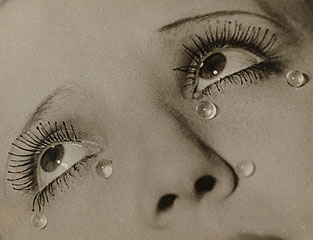
Glass Tears by Man Ray (1932) Via Getty Museum
He wanted her lashes to be so long that they brushed her cheeks when she blinked. Griffith asked a wig-maker to attach some interwoven human hair to a fine piece of gauze, which was glued to her eyelids. The effect was extraordinary.
However, it was not until several decades later that false eyelashes really took off for the woman on the street. They became popular in the 1950s, and by the 1960s were a fashion essential. Lipstick was worn pale, meaning that he focus of the face had to be a pair of childlike wide yes. The waif-like supermodel Twiggy often wore false eyelashes above and below her eyes, or sometimes attached to her bottom lashes alone. The model Jean Shrimpton and actresses Marianne Faithfull, Sophia Loren , and Elizabeth Taylor were all renowned for their luscious lashes, and the singer Dusty Springfield became known for her ‘panda-eyed’ look.
The 1960s versions were made of bristle-like plastic: Their staying power was limited, and they tended to fall off. Salvation came in the 2000s when the Japanese invented individual fake lashes that could be glued on to real eyelashes, one by one. These were like hair extensions for the eyes, lasting up to two months. Today false lashes are as popular as earrings and lipstick. Shu Uemura created a set of paper-clip style lashes with Dutch fashion designers Viktor & Rolf, and in 2009 the UK band Girls Aloud launched their own range of false lashes in collaboration with Eyelure. Flirting has never looked so good.” (55)
Leonard Maltin’s blog highlights this exhibit honoring Cecil B. DeMille (one that has been on display at the USC School of Cinematic Arts since September). The building is open to the public, and the exhibit continues through March 16.
Maltin notes, of the above Rambova sketch:
“Natacha Rambova (née Winifred Shaughnessy) is best remembered as Rudolph Valentino’s wife, but she was also a talented artist who designed memorable sets and costumes for a handful of films including DeMille’s Forbidden Fruit (1921). Several of her original ink-and-watercolor originals are on display at USC.”
As many of you know, the focus of much of my research has been on Natacha Rambova’s design career (including her costumes for Broadway, Opera, film, as well as fashion ) I knew these sketches existed, but still I wish I had a trip planned to Los Angeles to see them in person.
I recently received a note from a reader, describing her trouble finding information on upcoming fashion and textile exhibitions on view in California. So, I thought I’d share what I know with readers. Quite a variety of exhibits are available across the western states: exhibitions of film costumes, exhibits using old techniques in new ways (embroidery and knitting), historical design aesthetics (including ‘California’ design and the Aesthetic movement), as well as contemporary body art (tattoos!). Quite the range to choose from. Please feel free to comment if you’ve been to any of these or others you think readers should know about:
The FIDM Museum is proud to present the twentieth anniversary Art of Motion Picture Costume Design exhibition. Celebrating the art and industry of costume designers, this exhibition will present more than 100 costumes from twenty films released in 2011. The exhibition includes selected costumes from all five 2011 Academy Award® Nominees for Costume Design: W/E, Hugo, Jane Eyre, The Artist, and Anonymous. The exhibition also showcases classic film costumes from the FIDM Museum collection and the Department of Recreation and Parks, City of Los Angeles, Historic Hollywood Collection. Some of these same costumes were featured during the first Art of Motion Picture Costume Design exhibition in 1993.
Common Places features three objects from LACMA’s permanent collection which transform printed works on paper into one-of-a-kind embroideries: a seventeenth-century valance, a cigarette silks quilt, and Alighiero Boetti’s Mappa. The resulting textiles articulate contemporary aspects of global phenomena and suggest that far from being a recent development, globalization has deep historical roots that extended into the home and everyday life.
This exhibition is the first major study of California midcentury modern design. With more than 300 objects—furniture, ceramics, metalwork, fashion and textiles, and industrial and graphic design—the exhibition examines the state’s role in shaping the material culture of the entire country. Organized into four thematic areas, the exhibition aims to elucidate the 1951 quote from émigré Greta Magnusson Grossman that is incorporated into the exhibition’s title: California design “is not a superimposed style, but an answer to present conditions…It has developed out of our own preferences for living in a modern way.”
A world-class collection of Anatolian kilims given to the Fine Arts Museums of San Francisco by H. McCoy Jones and his wife, Caroline, is showcased in a choice exhibition of two dozen of the finest examples. Presented in the textile arts gallery at the de Young, the Anatolian flat-woven kilims on view, dating from the 15th to the 19th century, include a variety of design types and regional styles, as well as superb examples of artistic and visual prowess. The kilims in the Fine Arts Museums of San Francisco’s permanent collection are considered the most important group of Anatolian kilims outside Turkey.
Over the past 40 years, Mary Lee Hu has affirmed her distinctive voice in the world of jewelry with her elegant, voluptuous creations. Using wire the way hand weavers use thread, Hu has blazed a trail as both artist and innovator, exploring the nexus between metalsmithing and textile techniques. Keen to metal’s ability to bend and manipulate light within a textured surface, Hu’s work is a testament to her sophisticated eye for weightless and rhythmic lines, translated into body adornment. Featuring more than 90 exquisite earrings, rings, brooches and neckpieces drawn from public and private collections internationally, this retrospective traces Hu’s evolution from her experimental designs of the 1960s to today’s creations full of light and movement.
The Cult of Beauty: The Victorian Avant-Garde, 1860–1900 is the first major exhibition to explore the unconventional creativity of the British Aesthetic Movement, tracing the evolution of this movement from a small circle of progressive artists and poets, through the achievements of innovative painters and architects, to its broad impact on fashion and the middle-class home. The superb artworks on view encompass the manifold forms of Victorian material culture: the traditional high art of painting, fashionable trends in architecture and interior decoration, handmade and manufactured furnishings for the “artistic” home, art photography and the new modes of dress.
Order and Border
Through Oct. 21, 2012
Seattle Art Museum (Seattle, WA)
Stripes are a fundamental visual element, appearing naturally in vertical lines as trees and in manmade products of all kinds, from street dividers to ornate fabrics. The stripe is so basic it is rarely given isolated attention. This installation examines how stripes decorate and structure objects, bodies and spaces. It follows the many ways that stripes are formulated—swirling, rigid, ragged, skinny or bold—and shows how they appear in a wide range of media from a multitude of cultures. These objects help us recognize the range of meanings that a stripe holds, from a minor design feature to the sign of a significant mythic journey.
Featuring work by ten artists—five known for tattoo and five known for printmaking—Indelibly Yours explores the kinship between marking on skin and the practice of drawing on a printing plate.
Opening today is FIDM’s annual Art of Motion Picture Design exhibition, produced in association with the Costume Designers Guild, which exhibits the Academy Award® nominated costume designs. This year’s nominees include:
To prepare for The Artist, Bridges watched Clara Bow in 1927's It and Joan Crawford in 1928's Our Dancing Daughters. The costume designer and director Michel Hazanavicius are also fans of the 1928 Marion Davies film Show People. "It's a slice of life at MGM from that period," says Bridges. (Click for source)
Lisy Christl for Anonymous
Mark Bridges for The Artist
Sandy Powell for Hugo
Michael O’Connor for Jane Eyre
Arianne Phillips for W.E
The exhibition not only includes the nominted designs, but also presents more than 100 costumes from twenty films released in 2011! Since this year marks the 20th anniversary of the annual exhibition, curators pulled out all the stops and include much more than just this year’s nominees. The exhibition also includes a showcase of classic film costume — including pieces worn by Fred Astaire, Ingrid Bergman, Jean Harlow, Marlene Dietrich and other Hollywood legends.
A few Sunday’s ago, I had the pleasure of joining a select group of Costume Society of America Western Region members for a behind-the-scenes tour of the Levi Strauss & Co archives in San Francisco.
In the Levi Strauss archives
This was a tour that had been years in the making, and thanks to the generosity of Lynn Downey (the company archivist) and to the organizer (CSA Western President Shelly Foote) the program was a great success.
The weather couldn’t have been more idyllic, and when we arrived at the archives, a beautiful array of clothing from throughout Levi’s history was laid out before us. Ms. Downey had brought out her favorite pieces and generously peppered her talk with contextual information – how each was linked to Western or California history at large, company history, or cultural history. Downey discussed everything from early western work-wear and the origin of the riveted pant, to the company’s foray into Khaki pants, women’s denim wear on dude ranches, to early children’s wear during the baby boom of the 1950s, collaborations (including shirts for the 1939 Worlds Fair and Winchester hunting wear), and clear through to Mod clothing of the 1960s, Leisure suits of the 1970s, the 1980s collector trend in Japan, and up through Christian Siriano’s design for Project Runway.
Some quick-facts to tease you:
More from inside the Levi Strauss archives
Levi Strauss did not have a store in the United States until 1991: they were only wholesale merchants until that point
In 1872 a Reno, NV tailor named Jacob Davis suggested that Strauss include rivets on denim pants to make them more sturdy. Although Strauss was not a manufacturer at this time he agreed to patent the design with the tailor. On May 20, 1873 the two gentlemen got the patent to make the first pair of mens riveted work pants.
The original name of the 501 jean was “XX”
The Levi Strauss archive acquired an 1880s pair of jeans (not the 501) with a ‘rule’ pocket, paying $46,500 after an intense bidding war
The oldest known riveted denim jacket (from the 1880s) was found in a ghost town in Southern California (and is now in their collection)
Ms. Downey generously spoke to our group for a little over an hour, and then allowed us to put on gloves and examine everything more closely. She offered to answer any questions we had about Levi myths, ‘things we had heard,’ and even offered to bring out additional items if we wanted.
After a number of questions and lively discussions, our group moved back into the public display area to look at the clothing, artifacts and ephemera on view to the public, which included the company’s recent movie and celebrity tie-ins, as well as a conservation video, and a brief history of the company.
I was thrilled with this unique opportunity to learn more about this historic western company. Happily for CSA Western Region members, a full report will be forthcoming in the next issues of the regional newsletter. Should you want to learn more about Levi’s, Ms. Downey has written a book providing the definitive history of Levi Strauss & Co. I’ve included below some of my photos from the behind-the-scenes tour. Enjoy!
The 10th Annual Noir City Film Festival starts tomorrow in San Francisco, and Eddie Muller (the Czar of Noir) is pulling out all the stops. The festival runs January 20-29 at its traditional home, the Castro Theatre, and features films from the 1930s-1960s. For the uninitiated, the Film Noir Foundation is dedicated to “rescuing and restoring America’s Film Noir Heritage” and they put on this amazing festival every year. Here are a few highlights to keep in mind when buying your tickets:
Angie Dickinson in Person (for a live interview on her career): Saturday night, January 21
Laura (1944) with costumes by Bonnie Cashin: Sunday, January 22
A brand new 35mm print of 1949’s The Great Gatsby, starring Alan Ladd: Saturday night, January 28
A special 10th anniversary celebration, Everyone Comes to Eddie’s, a swanky, sexy, and slightly sinister soiree in which the Swedish American Hall is transformed into a vintage 1940s-era nightclub: Saturday night, January 28, 2012.
Noir City Tours of San Francisco: Sunday, Jan. 22 and Wednesday, Jan. 25.
The original Maltese Falcon (1931) and a Dashiell Hammett Marathon: Sunday, Jan 29
More amazing vintage films that you’ve never seen and aren’t available anywhere else
Sorry to get gushy here kids, but I love this festival and its always got some great gems (not to mention some pretty amazing costumes!). Double-features abound so you really get your money’s worth. But if you can swing it, the Passport ($120) may be the way to go. More details (and a list of films) are available here:
Nov. 20, 1933: Fan Dance, Where is Thy Charm. It isn't very difficult to beleieve that these three charmers were selected as the most beautiful chorus girls in Hollywood. They are appearing in the Charles Roger's RKO production, Sitting Pretty. From left to right, they are: Helen Splane, Mae Madison and Peaches Jackson.
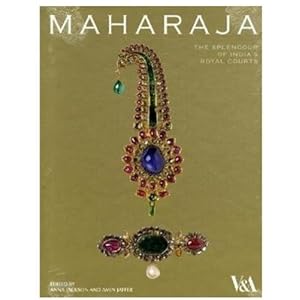
This past weekend, I had the good fortune to be able to visit the San Francisco Asian Art Museum’s current, excellent, exhibition: Maharaja: The Splendor of India’s Royal Courts (on view through April 2012). This show is a somewhat smaller version of the 2009 version put on by the Victoria & Albert Museum in London.
Poshak (costume for a woman). About 1900. Silk brocade with gold thread, base metal and sequins. Private Collection. (via Asian Art Museum)
Each piece in the show is impressive: sumptuous materials, exquisite details and extravagant design make obvious that the Maharaja’s were a VERY wealthy bunch. By examining their lives as a whole, the objects included provide a cohesive picture of their worlds and lives.
Objects included in the exhibition include paintings, thrones, regal accessories, men’s and women’s costumes, and LOTS of jewelry, furniture, musical instruments, games and much more. Some of the most physically impressive objects include a full size all-silver carriage, an elephant throne and some of the biggest diamonds and sapphires I’ve ever seen (many many by Cartier). Everywhere you looked were examples of fine craftsmanship, and nearly everything was gilded, embroidered or otherwise embellished to emphasize wealth and power.
One word of advice though – take a magnifying glass to truly appreciate some of the amazingly small and detailed paintings (similar to detail to the recent illuminated manuscripts exhibition at the Getty). The exhibition itself was well-thought out, and the (free) audio-tour was great. The show included several informative videos that provided good context for the show, and the audio-tour offered additional videos if you wanted more information.
Can’t make it to see the show? You’re in luck, there is an exhibition catalog of the V & A’s version of the show (which I sensibly purchased). There’s also an audio-tour that you can easily download through iTunes.