April 24, 1918, Los Angeles: Some of the "Bathing Beauties" from Mack Sennett's Keystone Studios surrounded by a curtain of confetti streamers. (Corbis)
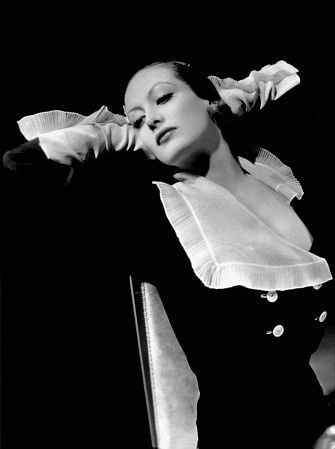
Publicity Still of Joan Crawford for Grand Hotel, 1932 (click for source)
“I played the prostitute [in Grand Hotel, 1932] and I felt that a more sensuous look was needed. Full, natural lip line and generous eyebrows—no bra, no girdle. Definite features were called for, and I found that I liked that look so much that I kept it.”
–Joan Crawford, My Way Of Life. New York: Simon and Schuster, 1971. 159.
“World War I – known at the time as “’The Great War” – officially ended when the Treaty of Versailles was signed on June 28, 1919, in the Palace of Versailles outside the town of Versailles, France. However, fighting ceased seven months earlier when an armistice, or temporary cessation of hostilities, between the Allied nations and Germany went into effect on the eleventh hour of the eleventh day of the eleventh month. For that reason, November 11, 1918, is generally regarded as the end of ‘the war to end all wars.’ . . . The original concept for the celebration was for a day observed with parades and public meetings and a brief suspension of business beginning at 11:00 a.m.”
Women on a dock welcome home a hospital ship of WWI ANZAC veterans. (Via Corbis)An Anzac World War I veteran is attended to by Randwick base nurses. (Via Corbis)
My good friend Dr. Kimberly Chrisman-Campbell is included (along with LA Times fashion critic Booth Moore) in this short selection from the Biography Channel’s Bio of Coco Chanel:
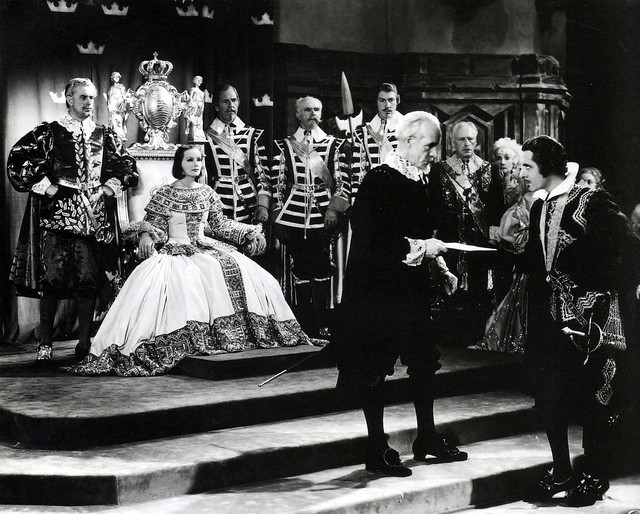
Greta Garbo as Queen Christina (1933) designed by Adrian
To prove the point that he always lets mind rule the clothes he designs, Adrian pointed out the case of ‘Queen Christina.’ Research disclosed the real woman had no interest in clothes and spent most of her life pursuing freedom in a man’s doublet and hose. Yet she was Queen, and as such, opulence was purposefully manifested at court functions. So, in creating clothes for this picture. Adrian expressed the cleverness of the real Queen, as well as the originality of Garbo before the cameras.”
–Harrison, Helen. “Adrian’s Fashion Secrets” Hollywood, September 1934.
Queen Christina costume, in Sweden (via Garbo Forever)
Chanel by Cassandre, 1942 (as seen in Amy De La Haye's new book)
The story of Coco Chanel has been told in many, many books over many many years — and all biographers have trouble figuring out what was true and what she made up. It has been said that she changed her past to suit her mood. Here, two authors from different backgrounds attempt to provide new perspectives:
by Linda Simon (October 1, Critical Lives – Reaktion Books)
This slim, lightly illustrated (black and white only) is a new contribution to Reaktion books “Critical Lives” series. According to the publisher, in this version of Chanel’s life “Linda Simon here teases apart the myth that Chanel and her adoring public collaborated to create, and explores its contradictions.” Kirkus, a publishing industry magazine, interviewed her about the book, and in an amazingly short review The Independent said:
“Too much of this book is devoted to Chanel’s love life, and not enough attention is given to her astonishing talent, although Simon’s assessment of the designer’s legacy – her fashion helped redefine ‘femininity as a sort of adolescent insouciance’ – is nicely put.”
Simon, who is an English professor, has previously written biographies of Alas B. Tolklas and William James – but has little fashion history/studies background. I’ll be very interested to see what other fashion scholars have to say about this retelling.
By Amy de la Haye (October, Thames & Hudson/Victoria & Albert Museum
Alternatively, Amy de la Haye – who has written a number of fashion history text and reference books – has also just come out with a new book: Chanel: Couture and Industry. For those unfamiliar, de la Haye is a curator and dress historian. She has a Senior Research Fellowship at the London College of Fashion (University of the Arts) and from 1991-1998 she was Curator of 20th Century Dress at the V&A.
Of the two books, this is the one to get. Heavily illustrated, with sidebars and call-outs, it is still slim and concise – explaining key stages of Chanel’s career (and continuing briefly into the Lagerfeld years) and the issues she dealt with (in a textbook style-layout ideal for students). Of particular note are the introductory chapter “Chanel: Subject and Media” and the call-out section “1939-53: War and the Aftermath.”
Chanel: Couture and Industry includes a helpful chronology, as well as highlights of Chanel ensembles included in the Victorian & Albert Museum. Copious full-color photographs, illustrations, art depicting the clothing she designed provide excellent evidence of her design prowess. It is far from dry reading, and includes fascinating tid-bits, discussions of her fashion designs, in addition to her style and her life.
Here’s a mix of vintage and more contemporary Chanel fashions (and Chanel herself) to wet your appetite:
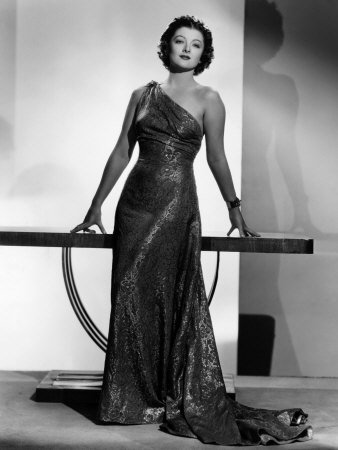
For those who are unfamiliar, Myrna Loy was discovered by Natacha Rambova and gave her a first film role in the late 1920s (changing her name, and giving her an ‘exotic’ look). However, she became famous for her roles opposite William Powell in The Thin Man series beginning in 1934 (see my post on the costume designer Dolly Tree for more on the costumes in this film).
Friday, October 7, 6pm. The Animal Kingdom(1932): Loy plays a beautiful and manipulative woman married to a reformed bohemian in this thoughtfully subversive pre-code comedy. Details here.
Myrna Loy, 'queen of the movies' (via Love Those Classic Movies)
Friday, October 14, 6pm. Penthouse(1933): A woman helps a lawyer vindicate an innocent man accused of murder in this blend of comedy and drama. Details here.
Friday, October 21, 6pm. Manhattan Melodrama (1934): with William Powell and Clark Gable, Two orphaned friends take wildly divergent paths, one into the district attorney’s office, the other into a life of crime — but they both love the same woman. Details here.
Friday, October 28, 6pm. Love Crazy (1941): William Powell teams with Myrna Loy in this comedy about a man who will do anything – even fake insanity – to prevent his wife from divorcing him. Details Here.
Can’t make any of those dates for screenings? There will be a few more in the Los Angeles and San Francisco area through the end of 2011 (Details forthcoming):
November 20, 2011, 1:00 PM – American Cinematheque (Los Angeles)
December 14, 2011 – Hollywood Heritage Museum in the Lasky-DeMille Barn, Hollywood, CAFebruary 21, 2012 – San Francisco Historical Society
Added bonus! Here’s a trailer of Manhattan Melodrama to wet your appetite:
Lifetime Television, in hopes of capitalizing on the success of Project Runway, is to begin a new series in November “Project Accessory” with Molly Sims as host. This got me thinking about the role that accessories have really played in the history and study of fashion. It’s not a foreign concept to me. This time last year, I asked a dear friend to write a book review of Accessories to Modernity: Fashion and the Feminine in Nineteenth-Century France.
While that book was through-written, a new publication from University of Minnesota Press plays directly into the zeitgeist and the newest recognition of the accessory in fashion. Released in August, Accesorizing the Body (edited by Cristina Giorcelli and Paula Rabinowitz ) is the first in a four-part series Habits of Being. The seires consists of extracts of the “best essays from the ongoing editions of Abito e Identita: ricerche de sortia letteraria e cultrurale, edited by Cristina Giocelli and published since 1995” now being published in English for the first time.
The first volume in the series, is wide ranging, and contributes research and theoretical discussions on various types of accessories-hats, shoes, vests, anklets, etc – but it is also deeply analytical, and for those who don’t speak Italian, will become a valuable resource for the analysis of accessories in a larger context. The essayists come from a variety of scholarly backgrounds – art history, semiotics literary studies, history fashion and even psychoanalysis. It is something I want to take my time in reading.
Zora Neale Hurston, photo by Carl Van Vechten (1938)
The essay “Coco, Zelda, Sara, Daisy, and Nicole: Accessories for new ways of being a woman” by Martha Banta, professor emeritus of English at the University of California, Los Angeles, is of particular interest and suggests connections between major figures in 1920s culture. Another essay on the poet Laura (Riding) Jackson, titled , “Precious Objects: Laura Riding, her tiara, and the petrarchan muse” is written by Becky Peterson – herself a poet and an alumni of the MFA program in English at Mills College (and now a graduate of the University of Minnesota). She looks at the role jewelry (and other precious objects) played in Riding’s poems. The essay, “Black Hattitude” looks at African American hat-wearing and attitude (specifically Zola Neale Hurston) and is written by Jeffrey C. Stewart, professor and chair of Black Studies at the University of California, Santa Barbara.
Cover of Report for a Corpse by Henry kane (New York: Dell Publishing Company Inc., 1949. Cover by Gerald Gregg.)
Still more essays intrigue: one looks at Spanish women’s clothing after the civil war, while another explores the image of the yellow Jewish star, and still another looks at the use of women’s shoes and anklets in images and film. There are more–on metaphysical sandals, cinematic jewels and futurist vests.
These are all relatively short essays, but extremely well written and thought provoking. The book covers a lot of ground and packs some pretty heavy hitting theory along with it, referencing Jacques Derrida, Karl Marx, Martin Heidegger, but also Ann Hollander, Joanne Entwistle, Colin McDowell, and James Laver.
It’s marvelous to read in such a digestible format, and I’m looking forward to the next volumes in the series.