Fashion shows in early cinema via Caroline Evans

“In 1904 a journalist described another type of worker, a member of a new female profession, the fashion mannequin, walking to work across Paris: …’This lovely woman with her slender, curvaceous figure, whose costume, one discerns, has come from a good dressmaker . . . hastens towards the rude de la Paix or the place Vendome. It is barely nine o’clock, but despite the morning hour and the sharp cold that stings the face, more than one passer-by turns round and slips while paying her a quick compliment.’

The four-minute Gaumont film starring Renee Carl, Une Dame Vrainment Bien (1908), made a comedy of just such a scene. A pretty woman exits from a clothing shop, promenades in the Paris streets, and piques masculine curiosity. All the men turn as she passes, setting in motion a comical chain reaction: Falls, collisons, and other blunders. The film is an instance in French film of the way that, as Constance Balides has argued in relation to American comedy films of the 1900s, everyday scenes of women walking through public places are turned into sexual spectacle . . .Perhaps the paucity of films of fashion modeling was due to the fact that, in the early 1900s, the mannequins, young women paid to walk to and fro in the elite fashion houses of the rue de la Paix and the place Vendome, were largely invisible to the general public. . .

–Caroline Evans, “The Walkies: Early French Fashion Shows as a Cinema of Attractions,” in Munich, Adrienne (ed) Fashion in Film. Indiana University Press, June 2011 (pgs. 112-113).

Continue Reading

Small Collection Highlight: Sacramento Valley Museum

I spent this past Friday and Saturday in the small town of Williams, CA. For those who don’t know it, it is on I-5, at the exit for Clear Lake. It’s primarily a farm town – but its history is long and well preserved in the former school house, now known as the Sacramento Valley Museum. My family’s roots go back to this particular town to at least 1920, but we were in the surrounding area as early as 1885.

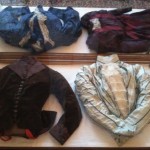
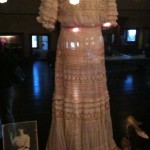
The museum is a large two-story building and it contains all manner of historical every-day objects. It had a special Veterans Day memorial on view (which included example uniforms and paraphernalia from every major conflict). The permanent exhibitions areas include farming equipment, Williams High Alumni collections (including band uniforms), Masonic paraphernalia, as well as rooms organized by theme: kitchen, bathroom, bedroom, children’s rooms as well as businesses such as apothecary, general store and happily for me, the clothing boutique (all including objects from varying time periods). Shocking -and somehow comforting-to know just how long the same pharmacy (Fouch’s) has been in existence here.

Of particular note were the Model-T car, the dusters in the tack room (circa 1900), and some fine examples of corsets, dresses, and women’s accessories. Somehow, the things worn and used by real people (rather than the rich-and-famous) are always of greater interest to me. They seem more authentic, and by extension, more important to study and understand.

If you ever find yourself in the area, I’d encourage a visit – it’s a unique way to step back in time and smaller, lesser-known collections need your support to survive. Hope you enjoy these quick snap-shots:

Continue Reading

Faye Dunaway on Costume Designer Theadora Van Runkle, 1929-2011

“After I got the role of Bonnie [in Bonnie and Clyde, 1967], Arthur [Penn] and I started talking about what she might wear. I thought jeans, maybe, pants of some sort since they were robbing banks and making quick getaways. But Warren [Beatty] and Arthur wanted to put her in dresses, great costumes that would give her style. They had decided to give Theadora Van Runkle, who was a young sketch artist with a great eye, a shot at designing the costumes. Soon after I met Theadora, who was to affect my own sense of style and become a good friend during these fast times. Until I met Theadora, clothes, and getting to a certain look, creating an effect had just been part of the job. She taught me just how much fun it can be. I like Theadora immediately. She was smart, funny, a very independent spirit, and a genius when it came to clothing design.”

— Faye Dunaway. Looking for Gatsby: My Life. New York: Simon & Schuster, 1995. (128-129)

Continue Reading

Veterans Day

Signing the Armistice that ended the First World War (Via Corbis)

Today is Veterens Day, and the US Department of Veterans Affairs explains:

“World War I – known at the time as “’The Great War” – officially ended when the Treaty of Versailles was signed on June 28, 1919, in the Palace of Versailles outside the town of Versailles, France. However, fighting ceased seven months earlier when an armistice, or temporary cessation of hostilities, between the Allied nations and Germany went into effect on the eleventh hour of the eleventh day of the eleventh month. For that reason, November 11, 1918, is generally regarded as the end of ‘the war to end all wars.’ . . . The original concept for the celebration was for a day observed with parades and public meetings and a brief suspension of business beginning at 11:00 a.m.”

Women on a dock welcome home a hospital ship of WWI ANZAC veterans. (Via Corbis)
An Anzac World War I veteran is attended to by Randwick base nurses. (Via Corbis)
Continue Reading

The Wednesday Word: Alexandra Palmer (1997)

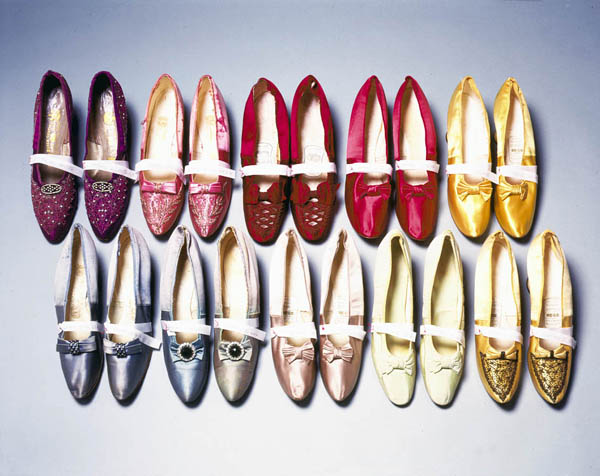
Bath Fashion Museum Shoes (Click for source)

“Voids in fashion scholarship can be partly explained by the fact that the study of dress often carries negative associations. The traditional study of dress history has been largely based on old art-historical methods of stylistic analysis, without integrating this with economic or social history. A contributing factor is that there is little formal academic training that addresses fashion or costume history; and fashion has to fight to gain recognition as a legitimate area of study.”

Alexandra Palmer, Abstract for “New Directions: Fashion History Studies and Research in North America and England”, Fashion Theory: The Journal of Dress, Body & Culture, Volume 1, Number 3, August 1997 , pp. 297-312(16)

(“The article compares the teaching of fashion history in England and North America, and Palmer uses some sample case studies to illustrate the validity of employing a multidisciplinary methodology that is based on material culture. She concludes that material culture analysis has to be set within a broader academic framework and not just be for its own sake. Liaison with scholars in other areas should be encouraged, as it is through cross-disciplinary interaction that more dynamic research can be pursued.”)

Continue Reading

Mae West on skinny women, c.1934

Actress Mae West, in "It Aint No Sin" c.1934 (Click for Source)

Author Maurice Leonard explains that for Mae West, “her rotundity was exaggerated by her shortness. Giving vent to her frustration to Ruth Biery, she complained that Hollywood had tried to alter her shape when she had first arrived, and viewed the slim Hollywood beauties around her with dissatisfaction:

“I never saw so many poles in my life! I wondered how Hollywood men could stand them. But everyone said I had to get thin. I figured they knew this racket and I didn’t, so I went on one of them Hollywood diets…It was pretty bad, but I’d been through a lot for art’s sake so taking off twenty pounds or more was just one more piece of the routine. I got down to 103 pounds. I stood in front of the mirror to study the results. I didn’t like it. I didn’t look—well, you know, voluptuous. And that isn’t all, I didn’t even look healthy. And man or woman, you got to look healthy to look right. Half-starved women can’t have no life in them any more than a half-starved dog.”* (141)

–Maurice Leonard in  Mae West: Empress of Sex. New York: Birch Lane Press, 1991. 141.

*Mae West in Movie Classic, April 1934.


Continue Reading

Exhibition Notice: Mottainai: The Fabric of Life (Portland)

Opening today at the Japanese Gardens in Portland, Oregon is Mottainai: The Fabric of Life, Lessons in Frugality from Traditional Japan.

“This exhibition of antique Japanese folk textiles from the Meiji period (1868-1912) is comprised of selections from the private collections of Stephen Szczepanek (suh-PAN-ecks) of Sri in Brooklyn and Kei Kawasaki of Gallery Kei in Kyoto. The exhibition demonstrates the remarkable ability of the Japanese to not only make do with the very little they had, but to make art with it.

For generations before the “Economic Miracle” took place in the decades following World War II, Japan was a poor country. People recycled everything. Nothing was wasted, and the word “mottainai” (waste nothing!) was a ubiquitous exclamation used by every frugal parent to warn children about wasting a bite of food or a scrap of cloth or paper.

All of the textiles and garments on view were made from bast fibers foraged from the forest, or patched and quilted together from second-hand scraps of cotton garments of city-dwellers who traded their hand-me-downs with the farmers for rice and vegetables.The exhibition represents a wide variety of traditional textile making and decorating techniques, including sashiko stitching, bast fiber weaving and dyeing, and patchwork quilting, the latter referred to as boro.”

This short exhibition only runs through November 27 – so see it while you can. Learn more about the textiles and objects included here.

Continue Reading

The Wednesday Word: from Mendes and De La Haye

“The ephemeral nature of fashion distinguishes it from other modes of dress such as ceremonial, occupational and ethnographic. . . . Fashion’s inherent obsolescence, whereby clothes are discarded on the basis of the desire for stylistic novelty rather than for utilitarian reasons, generates passionate response from consumers and theoreticians alike.  Fashion has been held up to ridicule, dismissed as a merely frivolous aesthetic phenomenon – since it is forever changing, it can be of no lasting value. . . Fashion has attracted the attention and endorsement of an expanding range of academics, increasingly fascinated by its multi- and inter-disciplinary significance. Thus the work of psychologists, anthropologists, economists, philosophers, sociologists, theatre and film designers, as well as dress historians, has bestowed an academic validity to fashion.”

— Valerie Mendes and Amy De La Haye, 20th Century Fashion (1999)

Continue Reading