Elena Phipps on Cochineal Red: The Art History of a Color

On November 12, 2011 at 10:00am, the De Young Museum in San Francisco will serve as host for a lecture by Elena Phipps, independent scholar, current Vice-President of the Textile Society of America, and former Senior Museum Conservator with the Metropolitan Museum of Art.
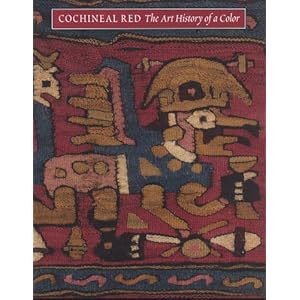
She is the author of Cochineal Red: The Art History of a Color (Metropolitan Museum of Art/Yale University Press, 2010). According to the Textile Arts Council, Phipps will trace:

“the origins of the famous insect-derived dye in the ancient Americas and its dissemination by global trade routes to the Old World. Thirty years of research and collaboration with scientists have enabled her to trace the world movements of this coveted dyestuff, illustrated by examples from the collections of the Metropolitan Museum of Art, New York. Interesting cultural, technical, and historical questions arise from these studies. A dye that was once relegated to history and replaced by modern chemical colorants has attained new status with today’s awareness of ecology.”

This lecture is free to Textile Arts Council members, $5 for FAMSF members and students, $10 for non-members. Tickets available only at the door. More details here.


Continue Reading

Wednesday Word: Fred Davis on the definition of Fashion

Setting a New Fashion in Pets. Los Angeles, California: Marian Nixon set a new fashion at the Universal lot by matching her new fur coat with her pet. She created something of a sensation when she was seen leading a pet leopard on a leash down a Hollywood boulevard. (c1925, via Corbis)

Clearly, any definition of fashion seeking to grasp what distinguishes it from style, custom, conventional or acceptable dress, or prevalent modes must place its emphasis on the element of change we often associate with the term. . . . Fashion, if it is to be distinguished from style and numerous other of its neighbor terms, must be made to refer to some alteration in the code of visual conventions by which we read meanings of whatever sort and variety into the clothes we and our contemporaries wear….”

— Fred Davis, “Do Clothes Speak? What Makes Them Fashion” in Barnard, Malcom (ed) Fashion Theory: A Reader. Routledge (2007)

Continue Reading

Tuesday Teaser: James Galanos gown at the Met in 1954

"These comparisons between the ultrasmart evening gowns of today and those worn by the well dressed lady of fashion a century or more ago were made in the fashion wing of the Metropolitan Museum of art, where the costume institute's collection of gowns, depicting the evolution of fashions for several hundred of years, is on display. The 1954 fashions were designed by James Galanos of California, winner of the 12th annual Coty American Fashion critics Award. In the photo at left the Galanos creation (left) is a gold and black metallic evening gown built over a pellon and black silk taffeta. Compare it with the ball gown of cloth of silver vertically striped with blue silk and gold tinsel, brocaded in polychrome and trimmed with silver lace, beside it, which dates from the 18th century, Louis XV period. french, of course. Photo at right shows the Galanos creation" (October 11, 1954, Corbis)
Continue Reading

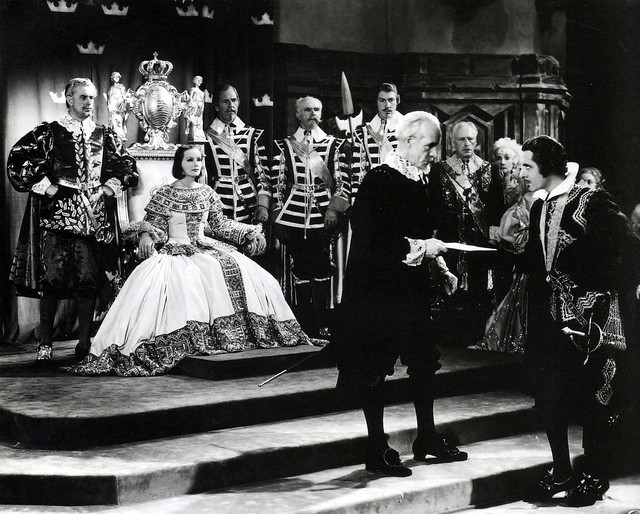
Adrian and Queen Christina (1933)

Greta Garbo as Queen Christina (1933) designed by Adrian

To prove the point that he always lets mind rule the clothes he designs, Adrian pointed out the case of ‘Queen Christina.’ Research disclosed the real woman had no interest in clothes and spent most of her life pursuing freedom in a man’s doublet and hose. Yet she was Queen, and as such, opulence was purposefully manifested at court functions. So, in creating clothes for this picture. Adrian expressed the cleverness of the real Queen, as well as the originality of Garbo before the cameras.”

–Harrison, Helen. “Adrian’s Fashion Secrets” Hollywood, September 1934.

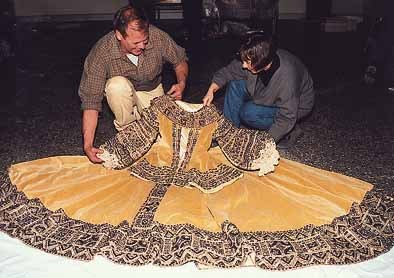
Queen Christina costume, in Sweden (via Garbo Forever)


Continue Reading

Two New Books on Coco Chanel

Chanel by Cassandre, 1942 (as seen in Amy De La Haye's new book)

The story of Coco Chanel has been told in many, many books over many many years — and all biographers have trouble figuring out what was true and what she made up. It has been said that she changed her past to suit her mood. Here, two authors from different backgrounds attempt to provide new perspectives:

Coco Chanel

by Linda Simon (October 1, Critical Lives – Reaktion Books)

This slim, lightly illustrated (black and white only) is a new contribution to Reaktion books “Critical Lives” series. According to the publisher, in this version of Chanel’s life “Linda Simon here teases apart the myth that Chanel and her adoring public collaborated to create, and explores its contradictions.” Kirkus, a publishing industry magazine, interviewed her about the book, and in an amazingly short review The Independent said:

“Too much of this book is devoted to Chanel’s love life, and not enough attention is given to her astonishing talent, although Simon’s assessment of the designer’s legacy – her fashion helped redefine ‘femininity as a sort of adolescent insouciance’ – is nicely put.”

Simon, who is an English professor, has previously written biographies of Alas B. Tolklas and William James – but has little fashion history/studies background. I’ll be very interested to see what other fashion scholars have to say about this retelling.

Chanel: Couture and Industry

By Amy de la Haye (October, Thames & Hudson/Victoria & Albert Museum

Alternatively, Amy de la Haye – who has written a number of fashion history text and reference books – has also just come out with a new book: Chanel: Couture and Industry. For those unfamiliar, de la Haye is a curator and dress historian. She has a Senior Research Fellowship at the London College of Fashion (University of the Arts) and from 1991-1998 she was Curator of 20th Century Dress at the V&A.

Of the two books, this is the one to get. Heavily illustrated, with sidebars and call-outs, it is still slim and concise – explaining key stages of Chanel’s career (and continuing briefly into the Lagerfeld years) and the issues she dealt with (in a textbook style-layout ideal for students). Of particular note are the introductory chapter “Chanel: Subject and Media” and the call-out section “1939-53: War and the Aftermath.”

Chanel: Couture and Industry includes a helpful chronology, as well as highlights of Chanel ensembles included in the Victorian & Albert Museum.  Copious full-color photographs, illustrations, art depicting the clothing she designed provide excellent evidence of her design prowess. It is far from dry reading, and includes fascinating tid-bits, discussions of her fashion designs, in addition to her style and her life.

Here’s a mix of vintage and more contemporary Chanel fashions (and Chanel herself) to wet your appetite:

Continue Reading

Myrna Loy on the Big Screen (SF and LA!)

This coming Friday (i.e. tomorrow), the Mechanics Institute will begin its Cinema Lit series of Myrna Loy film screenings (in celebration of a new book on the actress by Emily Leider, Myrna Loy: The Only Good Girl in Hollywood. Leider, who is best known (to me anyway) for her biography of Rudolph Valentino, Dark Lover: The Life and Death of Rudolph Valentino, will introduce the first two films in the series.

For those who are unfamiliar, Myrna Loy was discovered by Natacha Rambova and gave her a first film role in the late 1920s (changing her name, and giving her an ‘exotic’ look). However, she became famous for her roles opposite William Powell in The Thin Man series beginning in 1934 (see my post on the costume designer Dolly Tree for more on the costumes in this film).

Friday, October 7, 6pm. The Animal Kingdom (1932): Loy plays a beautiful and manipulative woman married to a reformed bohemian in this thoughtfully subversive pre-code comedy. Details here.

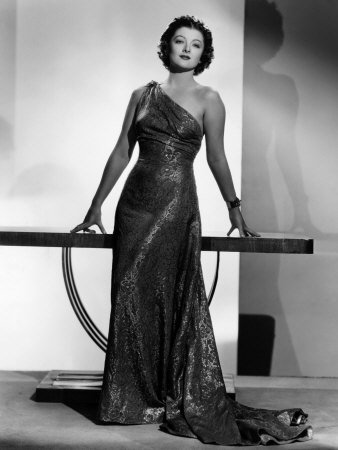
Myrna Loy, 'queen of the movies' (via Love Those Classic Movies)

Friday, October 14, 6pm. Penthouse (1933): A woman helps a lawyer vindicate an innocent man accused of murder in this blend of comedy and drama. Details here.

Friday, October 21, 6pm. Manhattan Melodrama (1934): with William Powell and Clark Gable, Two orphaned friends take wildly divergent paths, one into the district attorney’s office, the other into a life of crime — but they both love the same woman. Details here.

Friday, October 28, 6pm. Love Crazy (1941): William Powell teams with Myrna Loy in this comedy about a man who will do anything – even fake insanity – to prevent his wife from divorcing him. Details Here.

Can’t make any of those dates for screenings? There will be a few more in the Los Angeles and San Francisco area through the end of 2011 (Details forthcoming):

November 20, 2011, 1:00 PM – American Cinematheque (Los Angeles)

December 14, 2011 – Hollywood Heritage Museum in the Lasky-DeMille Barn, Hollywood, CAFebruary 21, 2012 – San Francisco Historical Society

Added bonus! Here’s a trailer of Manhattan Melodrama to wet your appetite:

Continue Reading

The Wednesday Word: Roland Barthes on the written garment

Author Roland Barthes

“I open a fashion magazine; I see that two different garments are being dealt with here. The first is the one presented to me as photographed or drawn–it is image-clothing. The second is the same garment, but described, transformed into language; this dress, photographed on the right, becomes on the left: A leather belt, with a rose stuck in it, worn above the waist, non a soft shettland dress; this is a written garment. In principle these two garments refer to the same reality (this dress worn on this day by this woman), and yet they do not have the same structure, because they are not made of the same substances and because, consequently, these substances do not have the same relations with each other: in one of the substances are forms, lines, surfaces, colors, and the relation is spatial; in the other, the substance is words, and the relation is, if not logical, at least syntactic; the first structure is plastic, the second verbal. Is this to say that each of these structures is indistinguishable from the general system from which it derives–image-clothing from photography, written clothing from language? Not at all.”

–Roland Barthes, The Fashion System

Continue Reading

Robin Hood (1938) and Costume Designer Milo Anderson

They worked only seven weeks, preparing for the picture. The studio worked nearly a year. The research work alone took months. The making of costumes, more months. And if you don’t think a costume designer like Milo Anderson has his headaches, consider his problem with armor alone: After chain mesh armor was made for various knights and soldiers, the sound department discovered that the noise of the chain mesh in action was like that of a navy raising anchor. Anderson finally devised a realistic-looking substitute out of woven string, sprayed with metal paint.”

“Craig, Carol. “A New Robin Hood,” Motion Picture. Jan. 1938., pg 60.


Continue Reading