Beauty: Its study and use

Over the summer, the exhibition, Beauty CULTure came out at the Annenburg Space for Photography looks at how the Los Angeles culture of beauty, media saturation influences the desire of women and young girls to look a certain way. Now, there are two new books that address several issues that came up in the exhibition. From UC Press’s, Pricing Beauty: The Making of a Fashion Model (September 2011) you have the inside story from model turned sociologist Ashley Mears, while Princeton Press gives us Beauty Pays: Why Attractive People Are More Successful by Daniel S. Hamermesh (August 2011). With New York’s Fashion Week and the accompanying perennial discussions of models and beauty now in full swing, these books seem particularly well-timed.

Ashley Mears is now a sociologist at Boston University, but she began her working life as a fashion model -working in both New York and London and she’s put her reflections and research on the industry into Pricing Beauty: The Making of a Fashion Model.

Author Ashley Mears

Earlier this week, a Boston Globe article reviewed the book, noting in part: “Mears has produced a fascinating study. . . . She knits together her revealing interviews and draws on the work of sociologist C. Wright Mills, feminist theorist Catharine MacKinnon, and other social critics. Yet the greatest strength of “Pricing Beauty’’ is Mears’s own story, one that she artfully threads throughout the book.”

Last week, on Slate.com, writer Libby Copeland took a longer look at the book and the trend of academics writing on the beauty ‘industry’. Copeland notes, Pricing Beauty “offers a mostly grim picture of what’s endured by those trying to make a living off their looks. Models are utterly dispensable, in Mears’ telling: They labor at the mercy of inscrutable bosses, lousy pay, and punishing physical requirements. And for most of them, that’s how the job will remain until they retire at the ripe old age of, say, 26.”

A third article, in the Boston University Arts & Sciences website titled “Defining Beauty” looks specifically at Mears discussion of race in the fashion industry – and interestingly, how it can determine editorial vs. catalog modeling opportunities.

Beauty Pays: Why Attractive People Are More Successful by Daniel S. Hamermesh does not look at modeling specifically, but rather examines how physical appearance affects earning power across a broad spectrum of occupations. And it seems to be getting equal attention from the media at large – though not always positively. Hamermesh is the Sue Killam Professor in the Foundations of Economics at the University of Texas at Austin, and professor of labor economics at Maastricht University in the Netherlands. More importantly, he’s a labor economist who is well-known for his research on “pulchronomics” – which Entertainment Weekly is now calling a ‘buzzword”. Pulchronomics means, essential, the economics of beauty.

Author Daniel S. Hamermesh

Hamermesh’s work, comes from a very different place than that of Mears (he studies the numbers, she studies people) and a recent Forbes Magazine article by Susan Adams called “Does Beauty Really Pay?” seems to find fault with his methods – saying in part “Hamermesh’s reasoning puzzled me, and I scratched my head at how he could pull precise percentages out of old data and what seemed like rough calculations.” She calls his work rambling, quirky and confounding. But also acquiesces that she found the book thought-provoking and illuminating. I’m rather curious to know how his fellow economists are receiving his work – and if anyone is checking up on his numbers. For those who might want to read an excerpt, the Chronicle of Higher Education published a short one in August.

Some of Hamermesh’s other papers on beauty and economics include:

  • “Changing Looks and Changing Discrimination: The Beauty of Economists,” Economics Letters, December 2006
  • “Beauty in the Classroom: Instructors’ Pulchritude and Putative Pedagogical Productivity,” Economics of Education Review, August 2005 (with A. Parker).
  • “Dress for Success: Does Primping Pay?” Labour Economics, October 2002 (with M. Xin and J. Zhang).
  • “Business Success and Businesses’ Beauty Capital,” Economics Letters, April 2000, (with G. Pfann, J. Biddle and C. Bosman).
  • “Beauty, Productivity and Discrimination: Lawyers’ Looks and Lucre,” Journal of Labor Economics, January 1998 (with J. Biddle).

I’ll be very curious to see how scholarly fashion studies publications – such as Fashion Theory – respond to this new work.


Continue Reading

Tuesday Teaser: Fashion at Manzanar?

Mrs. Ryie Yoshizawa, teacher, fashion designing class, Manzanar Relocation Center, California / photograph by Ansel Adams. 1943. Library of Congress.

“Mrs. Ryie Yoshizawa and class of women students at table with fabric and dressmaking equipment. Students are: Satoko Oka, Chizuko Karnii, Takako Nakanishi, Kikiyo Yamasuchi, Masako Kimochita, Mitsugo Fugi, Mie Mio, Chiye Kawase, and Miyeko Hoshozike.”

Continue Reading

Friday Freebie! Enter to Win a Copy of Berliner Chic

"Hey wait," you say, "I want that book!"

Berliner Chic offers a wealth of theoretical references, a historical framework, and a rich bibliography, as well as plenty of charming anecdotes, engaging stories, and ample photographs. One can imagine the reader packing this book before a trip to Berlin and using it as an alternative travel guide.”

Mila Ganeva, University of Chicago and author of Women in Weimar Fashion.

By happy accident I have just received a spare copy of this enticing new book and I’d like to share that wealth with you! To enter to win a copy of Berliner Chic: A Locational History of Berlin Fashion by Susan Ingram and Katrina Sark, simply:

“Like” the FashionHistoria page on Facebook, then add a comment on your favorite German fashion or style icon.

A winner will be announced next Friday – Thanks for reading!

Continue Reading

Anatolian flat-woven kilims,15th – 19th century turkey

Kilim, 18th century, Turkey, Anatolia. Wool, cotton; slit tapestry weave. 56 x 138 inches. The Caroline and H. McCoy Jones Collection. Gift of Caroline McCoy-Jones (FAMSF, de Young Museum)

Opening September 10 and running through June 10 at the Fine Arts Museums of San Francisco, de Young Museum, The Art of the Anatolian Kilim: Highlights from the McCoy Jones Collection includes two dozen of the finest examples of design types and regional styles. More importantly, these kilims are a part of the de Youn’gs permanent collection and are considered to be the most important group of Anatolian kilims outside Turkey.

Kilim, 18th–19th century Turkey, Anatolia Wool; slit tapestry weave 335.3 x 180.3 cm (132 x 71 in.) The Caroline and H. McCoy Jones Collection Gift of Caroline McCoy-Jones (FAMSF, De Young)

from the Press Release:

Curator Jill D’Alessandro explains, “The first presentation of works from this collection in 1990 signified a breakthrough in the appreciation of this weaving tradition. Not only was it the first time a Western museum had mounted a major exhibition dedicated to Anatolian kilims, but it was also the first time that kilims of this age, rarity and fragility were seen by the public; subsequently, the Anatolian kilim entered into the pantheon of the textile arts. With more than 20 years passing since this important collection made its public debut, many visitors, scholars and textile enthusiasts will be able to enjoy and study them for the first time.”

Curator Emerita of Textiles Cathryn Cootner will give a related lecture on October 15, titled Discontinuing Wefts: The Brilliance and Beauty of Anatolian Kilims—The Caroline & H. McCoy Jones Collection.

Ms. Cootner will illustrate how these kilims, once used to furnish houses, tents, and mosques, embody the architecture of color. Basic to this function is slit-tapestry’s huge capacity for color expression and the special character of each individual shade. The wonderful patterning only emphasizes the compelling interactions between and within colors.”

Continue Reading

Knitted Lace of Estonia (Lacis Museum in Berkeley)

September, 17, 2011 to February 4, 2012 at Lacis Museum of of Lace & Textiles

The Fall textile exhibit will focus on THE KNITTED LACE OF ESTONIA and its manifestations in relation to the alternate Estonian knitting disciplines, as well as the knitted lace in the cultures of Russia, Shetland, Germany and other geographic enclaves where lace knitting became the spirit of the soul.
Nancy Bush, sharing her love of Estonia, will be taking a curatorial role and will develop educational programs coordinated with the exhibit.  September 17, 2011 to February 4, 2012, with a Friday evening opening party on September 16.

An invitation is extended to lace knitters, who have ventured into the cultural knitted laces of the exhibit and who would like to share their accomplishments, to submit photos of their work for consideration as to inclusion in this exhibit.

Continue Reading

Tuesday Teaser: The ‘New Look’ arrives in San Francisco (1947)

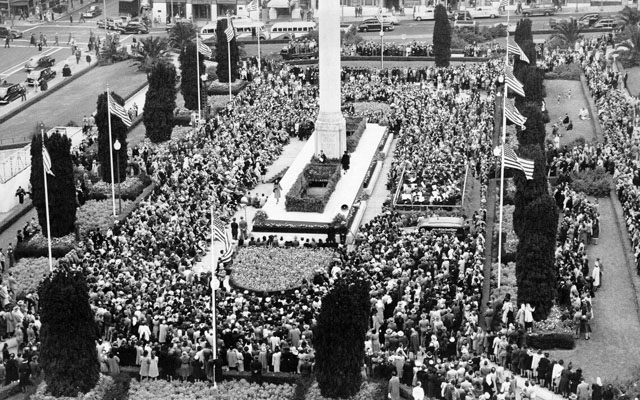
Sept 24, 1947: "That 'new look' came to Union Square today when O'Connor, Moffat staged an outdoor fashion show for a noon throng of fashion-conscious women. There were some men there, too. They came to see the comely models displaying the controversial 1947 fashions in dresses, and the controversial 1647 fashions worn by Linda Darnell in 'Forever Amber.' There was a band, a floral display, and pigeons - of course." (via the San Francisco History Center, San Francisco Public Library)


Continue Reading

Lilli Ann & West Coast Sophistication

Lilli Ann Ad, 1954

Lilli Ann established her ready-to-wear business in San Francisco in 1942. Despite her West Coast location, her exquisitely detailed coat and suit designs were versatile and sophisticated. Many of her suit styles were elegant enough to wear to the theater or cocktail parties. Lilli Ann ads of the period reflected this elegance through the dramatic fashion images created by the great Hollywood photographer George Hurrell. Writing in her book, Ready-Made Miracle, former Vogue editor Jessica Daves noted that in 1967, Lilli Ann was the largest American manufacturer of coats and suits in the price bracket of $69.50 to $250.”

As Seen in Vogue: A Century of American Fashion in Advertising By Daniel Delis Hill (Texas Tech University Press, 2004)

I have a couple of problems with this description of Lilli Ann’s West Coast-based business and its seeming East Coast bias. When I first read this brief description, I thought it was suggesting that Lilli Ann was able to overcome the apparent narrow-minded and unsophisticated location of her operations (San Francisco), and that she somehow managed to create designs that were “versatile and sophisticated” anyway. It seemed to be downright insulting to the city that W Magazine heralded as the last bastion of sophisticated society (in 2007).

Upon further reflection, however, I realized that the author was perhaps meaning to convey the perception at the time (1942) that New York, Paris and London were stronger fashion cities – rather than the contemporary opinion at the time this book was published (2004).

So I put it to you, fellow fashion scholars – what is your take and how could the author have made his point more clear?

Additional Resources on Lilli Ann:

Fairchild’s textile & apparel financial directory, 1983

Adolph Schuman for Lilli Ann: celebrating fifty years, 1933-1983 (1983)

Continue Reading

Tuesday Teaser: Striking workers stage fashion show (1941)

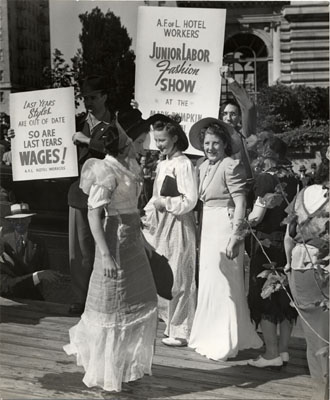
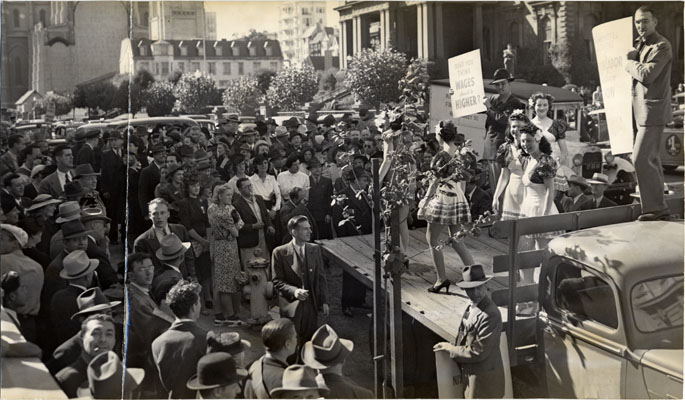
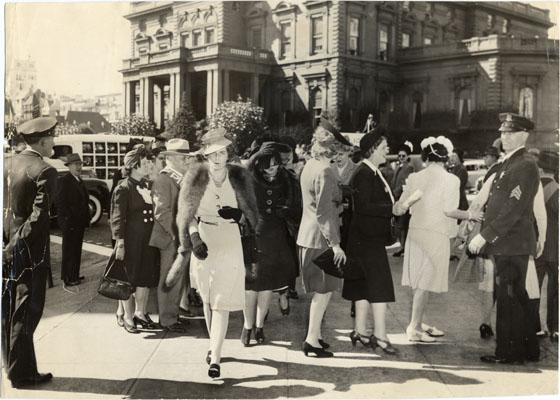
September 23, 1941: "Striking hotel workers put on a fashion show outside the Mark Hopkins Hotel yesterday afternoon to parody the Junior League's annual ditto within the picketed hostelry. Here is one of the several acts." (Via SFPL)
September 22, 1941: "Hotel strike pickets fashion show at Mark Hopkins" (via SFPL)
September 24, 1941: San Francisco -- Hotels. Strike -- Labor's Jr. Labor Fashion Show, Mark Hopkins". Via SFPL
Continue Reading

The Burning Man Series: Nevada’s Desert Dress History, 1993-2010

Christine Kristen aka LadyBee

I first have to thank readers for their enthusiasm over the first installment of The Burning Man Series: Nevada’s Desert Dress, by Jan Loverin. I received so many wonderful, supportive comments from people (as well as questions and corrections). Thank you!

The second installment in The Burning Man Series: Nevada’s Desert Dress comes to us from Christine Kristen (aka Lady Bee), who provides here an overview of the various costumes that have appeared at Burning Man between 1993 and the present – giving us a much needed history of how festival dress has changed and grown over the years.

LadyBee was the art curator for Burning Man from 1999 -2008, lecturing and writing about the art of Burning Man, as well as managing the theme art and the Archives, among other duties. After earning an MFA in sculpture from the Art Institute of Chicago, Christine spent four years in Africa and Jamaica as a Peace Corps volunteer, teaching art and working with woodcarvers.

I first attended Burning Man in 1995, when the population was relatively small, at 4000 attendees. Costumes were shown off in the Sunday fashion show, which is a tradition that continues to this day. In the early years of the event, virtually all the costumes were handmade and quite original – these were the days before fairy wings and fake fur.

Hence the costumes were quirky and sometimes included performance, like Kimric Smythe’s Java Cow. (image 1) On Sunday morning at dawn, a chariot driven by a cow-skull headed human drove up to the man and black coffee was offered to those up and about that early. In 1996, the year of Helco, devil outfits and all their variations were popular. The annual theme often inspires fantastic costumes; the Fertility theme of 1997 produced Gaia and her court of fruits and vegetables. (image 2)

As the event has grown, handmade costumes have been outnumbered by store-bought fashions, which have now coalesced into several distinct looks including fake fur bikinis, leggings and cat-eared hats; floor length fake fur evening coats, and Steampunk-inspired leather outfits with vests, leggings, corsets, gauntlets, goggles and top hats. (image 3) On the extremely mundane side, we see the shirtcockers – men wearing only a t-shirt, and the guys in Dr. Seuss hats, jeans and t-shirts. Nevertheless, you’d be hard pressed to find an event with more fabulous, original and diverse costumes. The “burner” look has spawned a cottage industry of costumers who create these looks and sell them at trunk and special pre-event sales. There is some criticism of this trend as its seems to go against Burning Man’s D.I.Y. aesthetic – why not create one’s own costume? But, in all fairness, not everyone has the time, skills or inclination to do so, and wearing these off-the-rack costumes might be a radical step for some. In addition, the makers of playa costumes and clothing are able to make or supplement their living via community support.

Still, you’ll see hundreds of amazing handmade outfits at the event; as the technology has evolved, so has its incorporation into fantastic programmed EL-wire costumes, which contain moving images like birds flying, figures dancing, and repetitive patterns. (image 4) Group costumes are popular, like the herd of giraffes from South Africa, and the Salvador Dali painting that formed when a group of men stood together, sections of the painting displayed on the backs of their tuxedos. (image 5-see above) Stilt-walking is popular at the event, and has inspired wonderfully whimsical elongated costumes. (image 6)

The fire performers have a particular look, dark and apocalyptic. Standard materials that are prolific at the event, including zip-ties, caution tape, plastic spoons and forks, and duct tape get incorporated into costumes in extremely clever ways. Political views are expressed, individuals made fun of, and social trends played with in costumes. I can’t think of a better place to debut a costume than at Burning Man, where you’re guaranteed an appreciative audience of thousands – currently upwards of 50,000 – who will likely want to know more about you – and your outfit.

Currently, Christine is the Global Arts Curator for www.newZonia.com. For the past two years she has been building a global creative community that will participate in the philanthropic economy being set up in newZonia, where artists can sell work while generating income for nonprofits, promote their causes, and collaborate with others to promote art and philanthropy.

*1999, The Dali Boys, Photo by LadyBee

Continue Reading