August 19, 1922. Mrs. Mallory Successfully Defends Title. Photo shows Mrs. Molla Mallory who successfully defended her title as National Women's Tennis Champion by defeating Miss Helen Wills, the sixteen-year old California girl in straight sets at Forest Hills on Saturday. Miss Wills made a gallant fight but was obviously nervous and was forced to bow to the veteran player. ( Bettmann/CORBIS)
Augu 4, 1925: Miss Helen Wills, National Women's Tennis Champion, is entered in the Women's Annual New York State Championship, which opened at the Westchester-Biltmore Country Club, Rye, New York. With practically the same field that competed in the tournament at Seabright, N.J., it is very possible that Miss Wills will again meet Miss Elizabeth Ryan of England and California in the finals. The court conditions at Rye will be more favorable to Miss Wills than those at Seabright last week, but she will find Miss Ryan a dangerous opponent. Miss Helen Wills, made at the Westchester-Biltomore Country club. (Underwood & Underwood/CORBIS)July 15, 1927: Portrait of Helen Wills Moody Miss Helen Wills, of California, returns home after her successful tour during which she won the women's tennis title at Wimbledon. (Underwood & Underwood/CORBIS)c1934: Professional tennis player Helen Willis Moody sitting in profile in a black armchair, with short wavy hair over her ears, and a pronounced nose. (Conde Naste/Corbis)
For more images of California’s own Helen Wills Moody, follow this link.
Myrna Loy in a Dolly Tree design (the Thin Man, 1934)
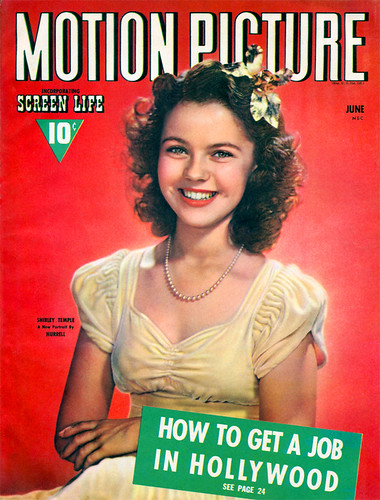
In Motion Picture magazine, June 1942, this funny little article was posted about costume designer Dolly Tree. She was probably best known for her work in the 1920s and 1930s – most notably The Thin Man series starring William Powell and Myrna Loy (For more on her early work in illustration, do travel over to this fascinating post at the Jazz Age Club). The brief piece below offered 1942 readers the unique opportunity to learn about the field of ‘costume design’ as a career directly. Including qualifications, income, and hazards of the position. I’d love to hear comments from those currently in the field to find out how much still rings true.
Motion Picture Magazine. (June 1942. 63(5): 27):
Top designer Dolly Tree can tell you hers is nice work, but the competition in this field is plenty tough”
Motion Picture Magazine, June 1942
Title
Designer
Working
Conditions
Assistants start at $50 a week. Top designers get $1,500 to $2,000. They keep regular office hours, but can never limit their work to those hours. They’re constantly getting rush calls for designs, both day and night. They have no guild.
Qualifications
First and foremost: tact. You have to please everybody. Also, you have to be a rapid sketch artist, with original and dramatic ideas. You must have an infinite knowledge of materials and dyes. And you must know dress construction, to be able to guide seamstresses.
Preparation
Start by designing, and making, your own clothes. You’ll discover how much you need to learn about costuming, materials and actual manufacture. Then go to some good school of design and, after you graduate, get a job—and experience—with some successful designer.
Getting Started
Know some influential person, and impress that person with your ideas. That’s how Natalie Visart became De Mille’s designer at 22. She learned he was going to film Cleopatra, did research on things Egyptian, whipped up hundreds of sketches—and got the job.
What Lies Ahead
With Hollywood fast becoming THE fashion capital, any successful Hollywood designer can stepout and open a profitable salon. (In fact, Adrian just has.) But, remember—the competition is keen and only the best designers succeed.
Beware!
The competition is the cut-throat kind. Just when you think you’re doing all right, some smooth-talking newcomer from Paris or New York will talk you right out of a job, unless you can succeed in out-talking him first.
I’m pleased to present the first in a new series for the month of August, that will focus on the Burning Man festival (which begins August 29). Each Friday, a different guest writer will present their point of view on this annual festival in the desert.
Jan Loverin, Curator of Clothing & Textiles, Nevada State Museum's, Marjorie Russell Clothing and Textile Research Center
First, I’m happy to present Jan Loverin, Curator of Clothing and Textiles Nevada State Museum’s Marjorie Russell Clothing and Textile Research Center who happily provides some context for the festival, for those who are unfamiliar. Loverin has a B.A. in Biology from Whittier College and a M.S. in Home Economics from the University of Nevada-Reno. She has worked (part time) at the Museum since 1985. She has written numerous articles and presented papers nationally and internationally. She is also a long-time member of the Costume Society of America.
Nevada once again becomes a mecca for art and community with the 25th year of the Burning Man Festival. For the past 21 years this event has been held on the Black Rock desert, north of Reno and has become one of the largest social gatherings in the northern hemisphere.
Nevada has historically been recognized as the home to massive gold and silver mining, legalized gaming, prostitution and world class entertainment. Now we are known for the spectacular, awe inspiring, Burning Man Festival and the community of Black Rock City. This temporary community of over 40,000 people inhabits the playa for seven days, creating a unique society based on a gifting economy, radical self expression and self reliance. This phenomenon has dramatically changed the look of our state.
Northern Nevada, particularly Reno, becomes a haven for the thousands of visitors who pass through on their way to the Black Rock Desert, seven miles past the small town of Gerlach. When the event begins we watch as the highways become crowded with fully packed and loaded vehicles heading toward this desert community and when it is over, we again watch the exodus of very dirty and dusty vehicles as people leave and go back to their daily lives.
Photo by Geoffrey Nelson (Via Dusty Couture)
While there have been many articles written about the concept of Burning Man, I am here to tell you that it is wonderful, freeing, transformative, dirty, fun, entertaining, richly rewarding and a place to shed your current persona and adorn yourself HOWEVER YOU WANT…… as long as it’s not current normative dress.
That’s right, costumes are an essential part of being a “Burner.” While theoretically, it is a place for total freedom of expression, it is not without some elements of conformity. Feathers are in(See note 1 below), boots are in; wings, stilts, crinolines, and ballet tutus are in; nudity and body paint are in; utili kilts are popular, as is wearing underwear as outerwear. Headgear and various forms of artistically created hairstyles (usually created to reduce the effects of wind and dirt) are essential and costuming for night is illuminated with elaborately constructed ensembles of el wire, glow sticks, fiber optic fabric, and accessories of fire.
Burning Man has once again put Nevada on the worldwide map. Burners are a part of our culture…with pre and post decompression events throughout the year, and exhibitions of art at local museums, and it has created a sizeable impact on our economy. Burners are as much a part of Nevada as showgirls, strippers, and Las Vegas night life. Burning Man has also has created a profound effect on us Nevadans. For a state that has been known for its conservatism, it has opened our eyes. Yes, you can create a society and tear it down 7 days later, leaving no trace. Yes, you can create a community of bartering(see note 2 below) and exchange and have it work. Yes, you can create magnificent art and have the sky as a backdrop. Yes, you can dress up and put on a new and different outfit to become new and different person. Yes, Burning Man works for Nevada.
As the curator of clothing and textiles at the Nevada State Museum, I am fascinated by the creative genius of Burning Man and in my opinion, this festival has embraced the natural beauty of Nevada’s desert landscape as a place of freedom, survival and community.
Thanks so much to Jan for giving us this brief introduction to the festival (and the Burning Ban Series). Tune in next Friday for another installment with a different point of view.
Bibliography
Clarke, Rachel. “Radical Conformity: Fashion Trends at Burning Man.” Popular Culture Association National Conference, San Francisco, CA, 2008.
Nelson, Geoffrey. A Tribe of Artists: Costumes and Culture at Burning Man. Exhibit Catalog Nevada Museum of Art, 2007.
*Image via LibreInk Blog Photo by Frederic Larson of the San Francisco Chronicle.
1. $teven Ra$pa. Arts Advocate & Special Events Producer for Burning Man wrote me this afternoon to make sure people understand that “Feathers–especially feather boas– are not “in” on the playa. They are on our list of things NOT to bring to Burning Man because they create MOOP (matter out of place) as they shed. In fact, feather boas can be confiscated by our Gate crew to avoid littering the playa with possible loose feathers, so it isn’t good to encourage people to show up with feathers.”
2. $teven Ra$pa. Arts Advocate & Special Events Producer for Burning Man also wants to make sure everyone understands clearly the culture of giving at Burning man: “Jan mentions “bartering” and the emphasis of Burner culture is gifting–giving something without the expectation of return. It is that spirit of giving that permeates everything at Burning Man: from self expression to the generosity of theme camps to the massive works of art.”
Thanks so much to $teven for pointing these subtleties out!
“California Fashion” is often defined by those glory days of the 1960s and the hippie…this video below includes some great interviews (Donna Karan and Frank Zappa to name a few) talking about the fashions of the 1960s.
If I had only one word to describe this past weekend’s CSA event at the Getty, it would have to be “opulent” – if only for the quantity of gold and silver on display. CSA Members and guests were treated to tours of not one, but two fashion exhibitions by two extremely knowledgeable curators at the Getty. Elizabeth Morrison, Curator of Manuscripts gave a masterful overview of Fashion in the Middle Ages (on view through August 14), and Charissa Bremer-David, Curator of Sculpture and Decorative Arts provided many insights into Paris: Life & Luxury (it closed last weekend at the Getty, but opens at the Museum of Fine Arts, Houston on September 18). I am extremely grateful to Kimberly Chrisman-Campbell for helping to arrange such an amazing and successful event for our members.
Left to right: Kimberly Chrisman-Campbell, Charissa Bremer-David (Curator of Sculpture & Decorative Arts) and Elizabeth Morrison (Curator of Manuscripts) at the Getty
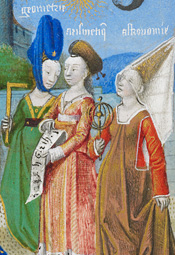
Though Fashion in the Middle Ages was curated by Margaret Scott (and also wrote the companion book), Morrison proved to be extremely familiar with all its intimate details. Most impressive of course, is the amazingly small and incredibly detailed image: Philosophy Presenting the Seven Liberal Arts to Boethius dating to about 1460 – which Morrison helped CSA attendees understand on several levels. It is the centerpiece of the exhibition, and the photograph below just doesn’t do it justice (the introductory image shows a close-up detail).
CSA member hand (for scale) & "Philosophy Presenting the Seven Liberal Arts to Boethius", attributed to the Coëtivy Master, in the Consolation of Philosophy, c1460–70 (Getty)
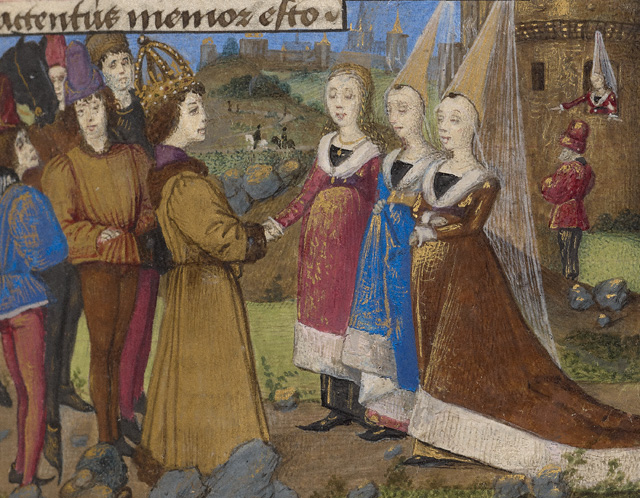
Morrison’s talk covered everything from the history of dyes, and textiles (I was especially fond of the ‘cloth of gold’ discussion) to sartorial shifts (including both clothing and accessories – especially interesting was her discussion of the iconic conical ‘princess hat’), as well as sumptuary laws and class distinctions. (Favorite tidbit: “According to a law of 1463, short gowns that revealed men’s buttocks were restricted to the upper classes.” (see the man in the red tights on the extreme left of the image below).
The Emperor Sigismund Arriving in Siena (detail), in The Story of Two Lovers, French, c.1460–70 (Getty)
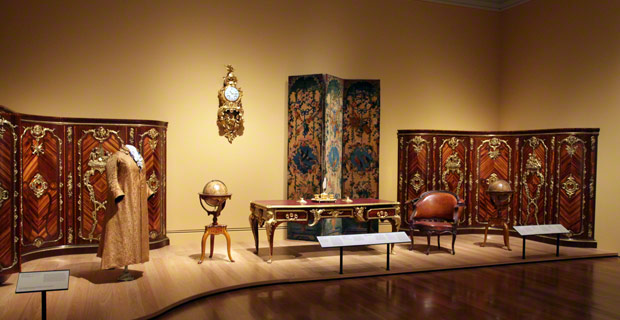
Note the men's Banyon at the left (Installation view of Paris: Life & Luxury at the Getty Center showing the accoutrements of a gentleman's study, including globes, a clock, and fine furniture via Getty)
Paris: Life & Luxury, was an especially unique experience and curator Bremer-David had arranged for the exhibition to include different kinds of objects together based on the hours of the day that they might have been used – providing marvelous context and understanding of everyday luxury of 18th century life. This, of course included clothing – primarily from the LACMA collection, but also some incredibly beautiful paintings. Men’s banyons, and dressing caps, as well as women’s attire were on display within their proper settings (including furniture, clocks and other decorative objects).
My two favorite rooms were “Morning: Rising & Dressing” and “Morning: Fashionable Pursuits of the day.” These two rooms included the many of the textile and fashion arts and I was especially fascinated with the tools used for sewing, embroidery and knitting (yes knitting!) The Skein-winder (or devidoir) of gilt bronze (1740-50) and a lacquered wood shuttle (a navette) dating (1750) on loan from Les Arts Decoratifs, Musee des Arts in Paris were both exquisite.
Skein-winder (devidoir) 1740-50 Gilt Bronze, wood, ivory & wool (Les Arts Decoratifs)
In terms of textiles, my two favorite pieces were the silk-satin bed hangings dating to 1690-1714 and the Robe a la Francaise with gold metallic lace trip dating to 1760-65. The bed hanging had been acquired some time ago (1979, I think) with little provenance information, and is somewhat mysterious – though incredibly beautiful. It had never been exhibited before, and is not likely to be seen again. For those interested in learning more on the Robe a la Francaise, be sure to check out the online slideshow complete with audio from Chrisman-Campbell on this dress. We were lucky enough to be standing in the center of the Fashionable Pursuits room at noon – and the brilliant sounds of a re-animated 18th century clock chimed out its bells. The curator had us stop and listen, and we were all transported back in time to the 18th century. It was magical. You can hear several 18th century clocks, and even download them as ringtones from the Getty’s blog.
Woman’s Robe à la Française and Petticoat, circa 1760-1765 via LACMA
Though this CSA event sold out, much of the information provided on these tours is available in book form, or from the Getty’s website. If you’re in Los Angeles, I encourage a visit to Fashion in the Middle ages before it closes next weekend. A slideshow of the highlights from “Paris: Life & Luxury” including some wonderful zoom-able images, are available via the Getty site.
CSA members attending the Getty program last weekend.
References:
Bremer-David, Charissa, Peter Bjorn Kerber, Kimberly Chrisman-Campbell and Joan DeJean Paris: Life & Luxury in the Eighteenth Century, Los Angeles: J. Paul Getty Museum, 2011.
Scott, Margaret. Fashion in the Middle Ages, Los Angeles: J. Paul Getty Museum, 2011.
van Buren, Anne H. (Author) and Roger S. Wieck (Editor) Illuminating Fashion: Dress in the Art of Medieval France and the Netherlands, 1325-1515, D Giles Ltd (London) & The Morgan Library (New York); 2011.
August, 1969: Diane and Egon von Furstenberg embrace in a Roman garden wearing a gown of her own design. (Conde Naste/Corbis)From the same photoshoot, via Conde Naste/Corbis
Recently retired to Stratford, Ontario from a career in teaching in the school of Animation, Art and Design at the Sheridan Institute of Design and Technology, to say that Joseph Hisey has a background in art and design history is putting it mildly. He is a Past Chair of the Costume Society of Ontario, a contributing correspondent for the Canadian Antique Collectors Association and a freelance costumer for local regional theatre and vintage clothing collector.
In April 2012, he plans to lead a costume and textile study tour to U.K. for members of the CSO and CSA. He also has a blog of his own jhisey.blogspot.com. For Fashion Historia, I asked Hisey if he would give us his point of view on the “Little Black Dress”
It seems that our interest in “The Little Black Dress” is as acute as ever. In response to the 50th anniversary of the film “Breakfast At Tiffany’s,” the Fashion Institute of Design & Merchandising are focusing on our infatuation with this cultural icon (on view through August 13, 2011). Although this fashion mainstay has been the stuff of editorials since the publishing industry began, contrary to popular beliefs, the use of black in fashion did not begin with the 18th century practice of mourning; black as a distinctive garment color can be documented back to the 15th century.
L to R: Hubert de Givenchy re-creation of the LBD from the opening scene of Breakfast at Tiffany’s, Courtesy of Hubert de Givenchy Couture. Valentina, c. 1947-1950, FIDM Museum Collection. Karl Lagerfeld for Chanel, 1985; FIDM Museum Collection.
Since the Renaissance, it was the dye of choice for many who wanted to express their power and authority, hence its domination of the male business wardrobe. At the very least, this neutral hue obscured dirt before commercial cleaning services were available. The mordant used was expensive and unstable. Consequently, a “true” black became a status symbol. Artists such as the 16th century Italian, Bronzino, painted black garments worn by the scholarly and 17th century Dutch masters introduced us to the religious and political powers of a new, prosperous middle class. By the early 19th century, black in fashion re-emerged from a hundred-year absence in paintings by Goya, Ingres, Tissot, and Sargent, all experts in depicting contrasts of lace, satin, and velvets against the starkness of black.
Our assumption that black was reserved for mourning is perhaps due to the influence of Queen Victoria and the influence she had on Western society. Regarded as exotic, with connotations associated with the Spanish court, the appetite for black became more pervasive by the second quarter of the 19th century. Fashion journals, such as Le Folet in France, described its use by the late 1840s for evening wear, as recorded by Ingres in several of his portraits. Whether this was the choice of the artist or the client, we will probably never know. In her book, Ingres in Fashion, Aileen Ribeiro dedicates an entire chapter to the black dress and the artist’s penchant for it.
In Whistler, Women and Fashion, authors Susan Grace Galassi and Helen M. Burnham go to great lengths to discuss the impact of the black dress from a portrait of Lady Meux, painted in 1881. Ambiguous at best, Whistler’s representation of her black velvet dress is defined more by the contrast of the white fur garment draped around her figure, than by the details revealed through his brushwork. Her jewels highlight her status and affluence, and provide a source of contrast that is otherwise not apparent in the image.
By the 20th century, the simple black dress became a standard in the fashion world. Exposure through the press and popular films elevated it to “must have” status. Edith Head was credited with the title, “costume supervisor” on Breakfast At Tiffany’s, and the dress created by Givenchy for Audrey Hepburn as Holly Golightly caused a sensation and demand for this fashion staple. So ingrained in our psyche is this dress that at auction, in 2006, one of three working copies by Head brought an astounding $923,187.00!
Perhaps then, this is the success of “The Little Black Dress.” It remains mysterious, ineffable, and possesses a fashion allure that extends beyond gender or class. Dress it up or dress it down, “The Little Black Dress” is truly a chameleon in the closet.”
Bathing suit by Elsa Schiaparelli, c. 1928 (c) Condé Nast Archive / CORBIS
Lannoo Publishers recently released a new book on the history of knitwear titled, Unravel: Knitwear in Fashion by Emmanuelle Dirix. Dirix teaches costume history at the fashion department of the Antwerp Academy and the book was published to coincide with an exhibition at the Fashion Museum in Antwerp (on view through August 14). Articles on the exhibition have already come out from A Shaded View and Dazed Digital. For more on the exhibit, check out this interview with MoMu’s curator Karen Van Godtsenhoven.
The catalog, however, is a hidden gem that could easily slip under the radar of many a fashion historian. It is printed in both English and Dutch, and includes a dozen essays covering various aspects of knitwear history as well as interviews with current knitwear designers and artists (including Sandra Backlund) . I am particular fond of the essays “Drop One, Pick Up Two, Drop One” by Emmanuelle Dirix , “Knitting for Victory” by Jane Tynan and “Twinset and Match” by Alistair O’Neill.
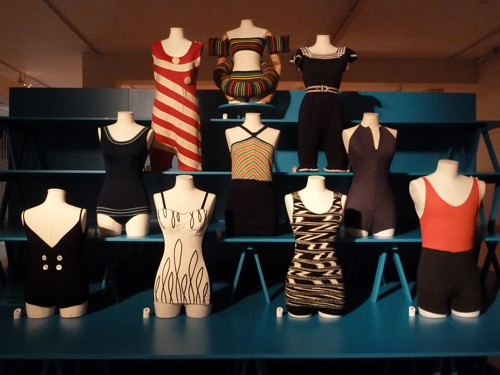
Swimsuits on exhibit from 1910-1955 (including McCardell, Gernreich) See below for close ups of these suits.
Dirix’s essay traces the history of knitwear from home knitting and ‘hobby culture’ in the arts and crafts movement through Chanel and Schiaparelli and Patou’s use of knitwear for sportswear and into the use of surrealism and trompe le’oeil sweaters of the 1930s. Her research continues through WWII, post-war era of refinement and into the youth rebellion designers of Mary Quant, Rudi Gernreich and Biba (among others). Her essay leaves off suggesting that the 1980s and 1990s held the “most shocking and subversive knitwear chapter in history” due to the ad campaigns by Italian knitwear label Benetton and its use of racial politics, the Aids epidemic and child labor to shock viewers.
Jane Tynan‘s essay “Kniting for Victory: Military Chic in Fashion Knitwear” tackles one of my favorite topics – knitting ‘comforts’ during wartime. Of particular interest is a booklet discussed in her essay titled “Women & War: How to Knit and Crochet Articles necessary to the Health and Comfort of our Soldiers and Sailors” (1914-1918). “In Twinset and Match: The Culture of the Twinset” by Alistair O’Neill, addresses the development of the iconic image of the woman in a twinset – including the work of Pringle of Scotland, hollywood starlets and the pre-war and post-war context of the sweatergirl. I should also mention the essays by Lydia Kamitsis (“Knitwear in French Fashion: From Gabrielle Chanel to Sonia Rykiel” and Joanne Turney: (“Dressing Like Grandad: Geek Chic and the Significance of the Cardigan in Contemporary Menswear.”)
This book is a gem, and features excellent writing by a number of authorities from an amazing array of viewpoints. If like me, you can’t make it to exhibition at the Fashion Museum in Antwerp before August 14, the catalog makes up for it in spades:
Jersey Swimsuit, Claire McCardell 1951 (Unravel, pg 27)
Rudi Gernreich Swimsuit, 1955 (Unravel, pg. 27)
Cotton Jersey Swimsuit, 1910s (Unravel, pg. 27)
Abstract swimsuit, late 1920s (Unravel, pg. 27)
Applique knitted swimsuit, ca. 1930s (Unravel, pg 27)
1910 Swimsuit (pg. 27, Unravel)
2008-09 Sweater by Dirk Van Saene (Unravel, pg 25)
“Smoking Pull” by Bernhard Willhelm, 2002-03 (Unravel, pg. 24)
1939: "Janet Gaynor and Adrian Married. Hollywood, California: Pictured as they recently danced here are film star Janet Gaynor and Gilbert Adrian, Hollywood fashion expert. The couple are Mr. and Mrs. now for they motored to Yuma, Arizona and were married there August 14th. The couple are en route to Mexico for a honeymoon." (Corbis)
Twins Beth and Sally Brewbaker of Virginia Intermont College (Class of 1964) in knit houndstooth check pullovers and matching skirts by Premier. Circa August 1964 (Conde-Naste/Corbis).


 *
*





 Jane Tynan‘s essay “Kniting for Victory: Military Chic in Fashion Knitwear” tackles one of my favorite topics – knitting ‘comforts’ during wartime. Of particular interest is a booklet discussed in her essay titled “Women & War: How to Knit and Crochet Articles necessary to the Health and Comfort of our Soldiers and Sailors” (1914-1918). “In Twinset and Match: The Culture of the Twinset” by Alistair O’Neill, addresses the development of the iconic image of the woman in a twinset – including the work of Pringle of Scotland, hollywood starlets and the pre-war and post-war context of the sweatergirl. I should also mention the essays by Lydia Kamitsis (“Knitwear in French Fashion: From Gabrielle Chanel to Sonia Rykiel” and Joanne Turney: (“Dressing Like Grandad: Geek Chic and the Significance of the Cardigan in Contemporary Menswear.”)