Aesthetic Fashion and “The Cult of Beauty”

Sometimes, when walking through an exhibit an object will stop you dead in your tracks – it’s visual impact interrupting any previous thought you might have had. Such is the case with the 1885 Liberty & Co dress currently on display in the Legion of Honor as a part of their current exhibition, The Cult of Beauty: The Victorian Avant-Garde, 1860-1900 (on view through June 17, 2012).

Liberty & Co. Ltd., dress Striped washing silk lined with cotton, c. 1885, V & A

This dress – in a gallery which houses all seven of the items of dress for the exhibit – is sculptural, simple and elegant. It’s a part of the Victoria & Albert’s permanent collection and the fabric is manipulated to resemble high art, to my mind references both painting and sculpture. The fabric seems to move like liquid and it’s no surprise to learn that the gown was designed by a sculptor (Sir Hamo Thornycroft) for his wife. Being a Liberty & Co. dress, the fabric is really the focal point and the artist has done a wonderful job of displaying this delicate, cotton-lined silk to it’s best advantage.

For more on their story, including letters between the two about this dress, see the V & A website here.

The rest of the show is equally impressive, and the exhibition catalog describes the styles utilized by the Aesthetic Movement (Japonism, Neo-Classisism, and Pre-Raphaelite), it provides insights on the artists, designers, makers and writers of the era – from William Morris to Liberty & Co, to Oscar Wilde, Whistler, Gowin and Bearsley. It includes painting, furniture, decorative arts (a fair number of tea pots, ceramics, a beautiful punched fireplace, even wall-paper and textile designs), illustrations, books and other works on paper as well as examples of fashion and adornment. It is, in fact, comprehensive.
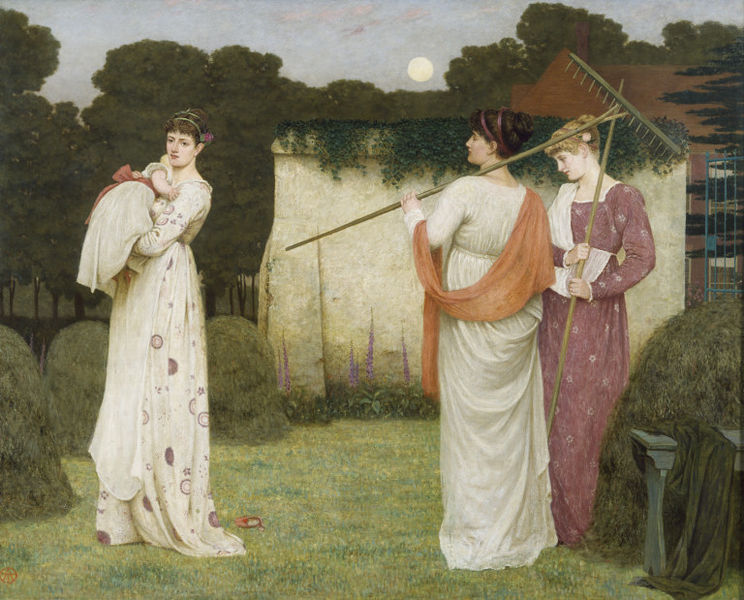
I fell in love with the dress on the left: Thomas Armstrong, "The Hay Field" Oil on Canvas, 1869, V & A.

Though fashionable dress and textile designs are scattered through-out the catalog (and exhibition) – two small sections focus on dress and jewelry-placing them within the greater context of the artists and art-forms of the movement.

Click here to purchase the exhibition catalog.

The first is an essay by Edwina Ehrman, Curator of Textiles and Fashion at the V & A, “Women’s Dress” and though short – it notes that the leaders of the Aesthetic movement (Edwin Godwin, William Morris, Walter Crane and Oscar Wilde) all argued in favor of “the beauty of the natural body and that a woman’s clothes should reflect her form and respect its physiology.”

She notes that “in the 1870s women wishing to dress artistically were recommended to look for inspiration in paintings, particularly those by the Pre-Raphaelite artists, and in books about period costume wher they would find attractive sleeve details and decorative combinations of colours and fabrics.”

If you can’t make it to see the exhibition in person in San Francisco, the catalog is highly illustrated and well-written – utilizing the V & A’s knowledgeable curators. I ended up both seeing the exhibit and getting the catalog – the lure of that one dress was too irresistible to pass up.


Continue Reading

Gaultier at the de Young: Technology, Craft and Art of Fashion

The Fashion World of Jean Paul Gaultier: From the Sidewalk to the Catwalk exhibit at the de Young has been getting a fair amount of media attention since it opened to the public on March 24. Much of the coverage focuses on the technology used for the mannequins, and indeed when I first saw them I was mesmerized – to the point that I forgot to look at the garments on display in the first gallery. I began to get concerned that the distraction of the display techniques would overpower the rest of the show. But, by the end of the first gallery, I had thankfully re-engaged with the content.

The Museum has been organizing large scale events, as well as academic explorations of the exhibition through events including a conversational lecture between Suzy Menkes and the designer; as well as historical perspective by Kimberly Chrisman-Campbell. In Menkes introduction of Gaultier, she takes a moment to clarify that the ‘tricks’ and cleverness often used by designers (both exhibition designers and fashion designers) are not the real value of the exhibition. She points out that the value is really in Gaultier’s focus on “technique, skill and handwork.” She also made sure to draw attention to Gaultier’s ability to capture a moment in time.

Her comments are by no means insignificant, and when speaking on “technique, skill and handwork,”she points out that “if you search, you can find them” –perhaps implying that they weren’t as much of a focus as they should be. While I was certainly drawn in and amazed by the technology -ultimately it was his focus on craft and design (and yes, details) that ultimately kept me engaged.

The exhibit features over 200 utterly captivating objects that I’d put in the category of contemporary art – several of the speakers at the press preview felt that way too. Gaultier’s work is both ‘of the moment’ and contains historical reference and I frequently found myself identifying a particular moment in history: the Madonna cone bra being the obvious iconic element.


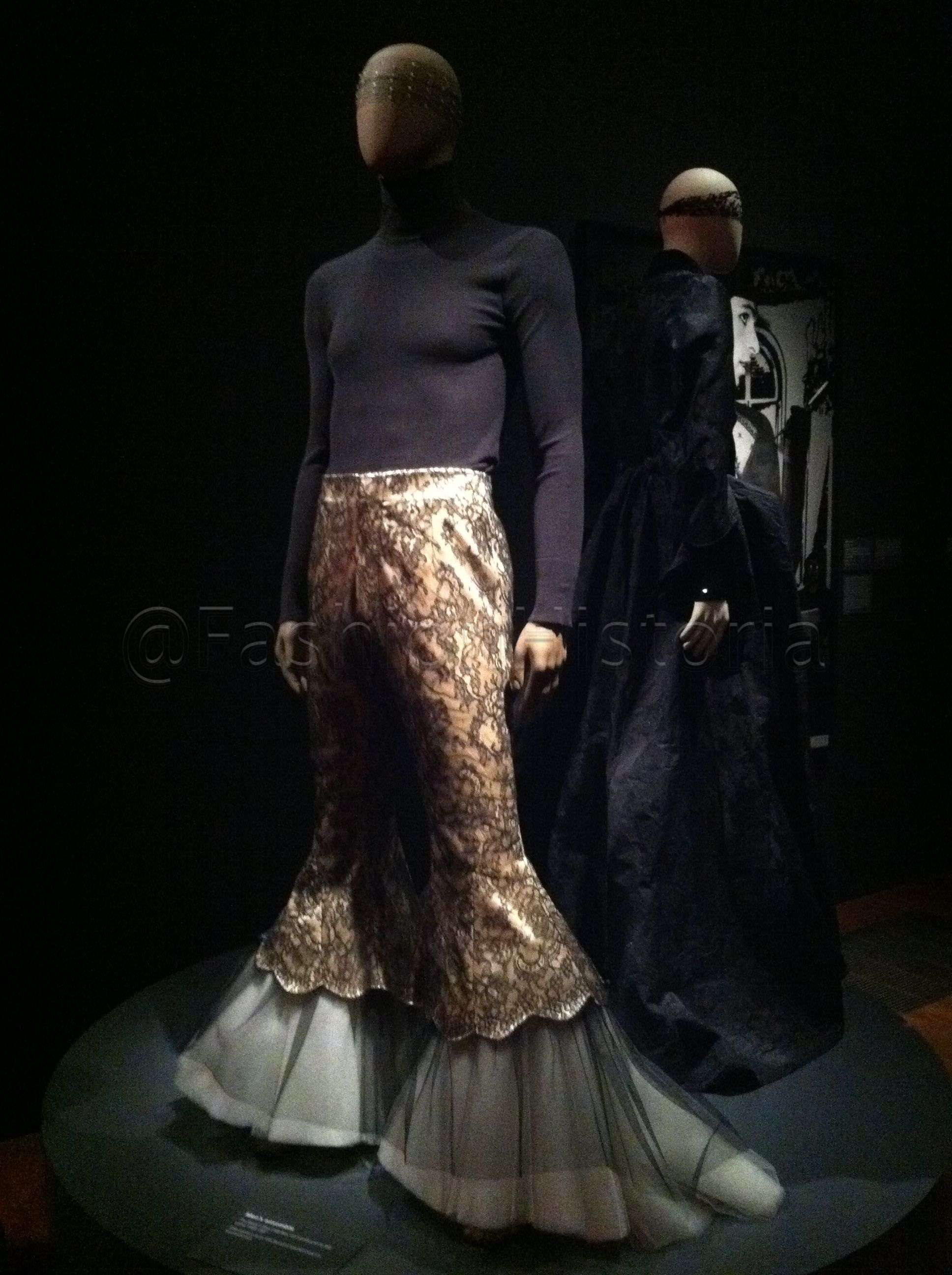
I also found historical references in a pair of men’s pants that reminded me of a Charles James ball gown; or the Red-beaded headdress in the shape of a schooner harkening Marie Antoinette; or a pair of women’s trousers with knife-pleates at the bottom which reminded me of some of Dior’s work from the 1950s. For those not able to see the show in person – there is a huge exhibition catalog (and Amazon is selling it at a discount: it’ll save you $50). For those of you who are able to see it (or who saw it in Montreal) – what’s your take on the mannequins?

Please enjoy the brief photo-tour


Continue Reading

Rosalind Russell, Travis Banton and Mourning Becomes Electra

Rosalind Russell and Kirk Douglass in Mourning Becomes Elecetra (1947)

Actress Rosalind Russell said to Mourning Becomes Electra (1947) Costume Designer, Travis Banton “We have got to change these petticoats because they are going to make too much noise on the microphones; the taffeta will rustle.’” (Russell, Rosalind and Chris Chase. Life is a Banquet. New York: Random House, 1977, pg 144)

Can you hear them?

Continue Reading

Travel opportunity: Folk Costume of Romania

From the Exhibition, Between East and West: Folk Art Treasures of Romania (Mengei International Museum in San Diego)

Joyce Corbett, curator at the Mengei International Museum in San Diego, sent me this notice of a tour she is leading to explore the folk art of Romania. For a quick preview of what you’ll see on the tour, check out my photos from last year’s exhibition Between East & West: Folk Art Treasures of Romania.

Below is the description and registration information for the tour that Joyce is planning:

THE FOLK TREASURES AND HERITAGE OF ROMANIA

May 29-June 10th, 2012

Join us for a journey back in time as we experience the history, folk culture and legendary sites of the Transylvanian Carpathians, Maramures and Bucovina. We’ll travel through the Romanian countryside to enjoy a close-up look at the several cultures of Romania: Hungarian, Romanian, Saxon, Jewish and Roma. We’ll visit UNESCO World Heritage sites, see the beautiful wooden architecture and gates of Transylvania and Maramures, experience the ancient painted monasteries of Bucovina, and stroll through Saxon German medieval towns, fairy-tale castles and quaint villages. We’ll see craftspeople practicing traditional folk arts. We’ll look at collections of regional embroidered textiles and costumes, enjoy performances by folk dancers and Roma musicians and sample wines from local vineyards. We’ll also stop at the largest regional fair in Transylvania, where village people sell local wares, and folk art. .Our tour includes: comfortable lodgings in pensions and hotels, hearty breakfasts and dinners featuring regional specialties, wine tastings in local cellars, all transportation in our private bus, plus all site entrance fees. We will have our own experienced English-speaking Transylvanian guide, a local expert on the history and culture of the region.

Land Only Price: $2999.

For detailed itinerary and information, contact Joyce Corbett joyce-dot-corbett-at-yahoo-dot-com or  call 619-825-9590.


Continue Reading

Blue Jeans: The Art of the Ordinary (excerpt)

Daniel Miller, an Anthropolgoist at the University College London and Sophie Woodward, a Sociologist at the University of Manchester have teamed up to present a new book in the denim history catalog: Blue Jeans: The Art of the Ordinary.

Here is a brief excerpt from the introductory chapter, explaining how this book fits within the others on this subject:

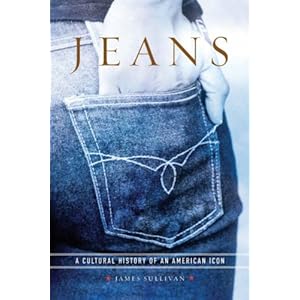
“Other publications have covered ground different from that explored in this volume, such as the history of denim, its production, and sale [See Global Denim, also by Miller and Woodstock]. By contrast, the present volume focuses on our ethnography of possessing and wearing jeans. Still, the central question behind all these research projects remains: why jeans? For many this would appear to lead naturally to the route of historically tracing the origins of jeans. Indeed, much of the literature on denim and jeans falls within the disciplinary rubric of history (and often popular history). This includes the histories of both indigo and the textile denim. The former traces the origins of the blue color of denim to the mere happenstance that the plant-based dye indigo fixes its color to cloth without needing a mordant, the substance that is used to fix other dyes to cloth. This is what made indigo one of the key world crops from ancient times to colonial times [See Indigo by Balfour-Paul 1998; and “Redeeming Indigo” by Taussig in Theory Culture & Society, 2008). There is an equally well established history of cotton, which alongside indigo would give us an understanding of many aspects of human history, from the global evolution of political economy down to periodic fashions and styles in almost any part of the world [See The Spinning World by Riello and Parthasarthi 2009; South Carolina Cotton Museum 2007]. There is also now a well-established historical perspective on blue jeans more generally, from the patenting of the rivets by Levi Strauss to the icons James Dean, Marilyn Monroe, and John Wayne [See Jeans: A Cultural History of An American Icon by Sullivan 2006). (page 5)


Continue Reading

In Memory Of

Ethaan Boyer (via Facebook)

I try to keep my personal life out off of FashionHistoria as much as possible. Today, that is simply not possible and I need to use this space to honor a lost friend and fellow dreamer, Ethaan R.A. Boyer.

He was a friend who has become an inspiration, a dream, and a legend. Though not directly related to fashion history, his work often appeared on his screen-printed t-shirts and fabric. I shared his love for design, art, and craft. He will be greatly missed by his family, friends and the Santa Fe art community at large.

Update: A Memorial Fund has just been established in Ethaan’s memory to help support both his wife, and to create a lasting memory of his character, spirit and talents. More information here.

Continue Reading

News Flash: Exhibit includes Rambova sketches

Via Leonard Maltin's blog

Leonard Maltin’s blog highlights this exhibit honoring Cecil B. DeMille (one that has been on display at the USC School of Cinematic Arts since September). The building is open to the public, and the exhibit continues through March 16.

Maltin notes, of the above Rambova sketch:

“Natacha Rambova (née Winifred Shaughnessy) is best remembered as Rudolph Valentino’s wife, but she was also a talented artist who designed memorable sets and costumes for a handful of films including DeMille’s Forbidden Fruit (1921). Several of her original ink-and-watercolor originals are on display at USC.”

As many of you know, the focus of much of my research has been on Natacha Rambova’s design career (including her costumes for Broadway, Opera, film, as well as fashion ) I knew these sketches existed, but still I wish I had a trip planned to Los Angeles to see them in person.

For more, see his article here: DeMille on Disply

Continue Reading

Russian Elegance: Country and City Fashion (min-review andexcerpt)

Russian Elegance: Country & City Fashion from the 15th to the Early 20th Century

By Luisa V. Yefimova and Tatyana S. Aleshina (Vivays Publishing)

Publication Date: January 9, 2012

For anyone with an interest in the beautiful folk costume and decadent fashions of Russia – this is a sumptuously illustrated, and informative new book from Yefimova and Aleshina.

My interest in Russian fashion stems from both a love of folk costume and detailing (which is copious in this book), from Natacha Rambova’s fascination with Russian culture and arts (especially the Ballet Russes), but also because of the strong Russian ex-patriot influence on Parisian fashion in early 20th century. Given these interests, and the recently opened exhibition on Russia here in California (at the Sonoma County Museum of Art) and the anniversary of Fort Ross (settled by Russians), it seems appropriate to delve deeper.

Written by two staff-members of the State Historical Museum in Russia, both are experts in the field of Russian costume and fashion history. Here’s what the pair have to say on the differences between Country and Town clothing in Russia:

“The history of costume in Russia has one essential feature. At the turn of the 18th century Peter the Great, the young reforming tsar, remotely and uncompromisingly decided the destiny of Russian costume. He forced the upper strata of Russian society by decree to wear European dress. Only the peasants and the Orthodox clergy were excluded from the decree. And so, while the gentry adopted the latest Paris fashions as far as their finances allowed them to, the Russian peasants continued to wear their distinctive traditional garb. Thus costume in Russia was divided into two types: traditional Russian dress and fashionable town clothes of the Western European style.”

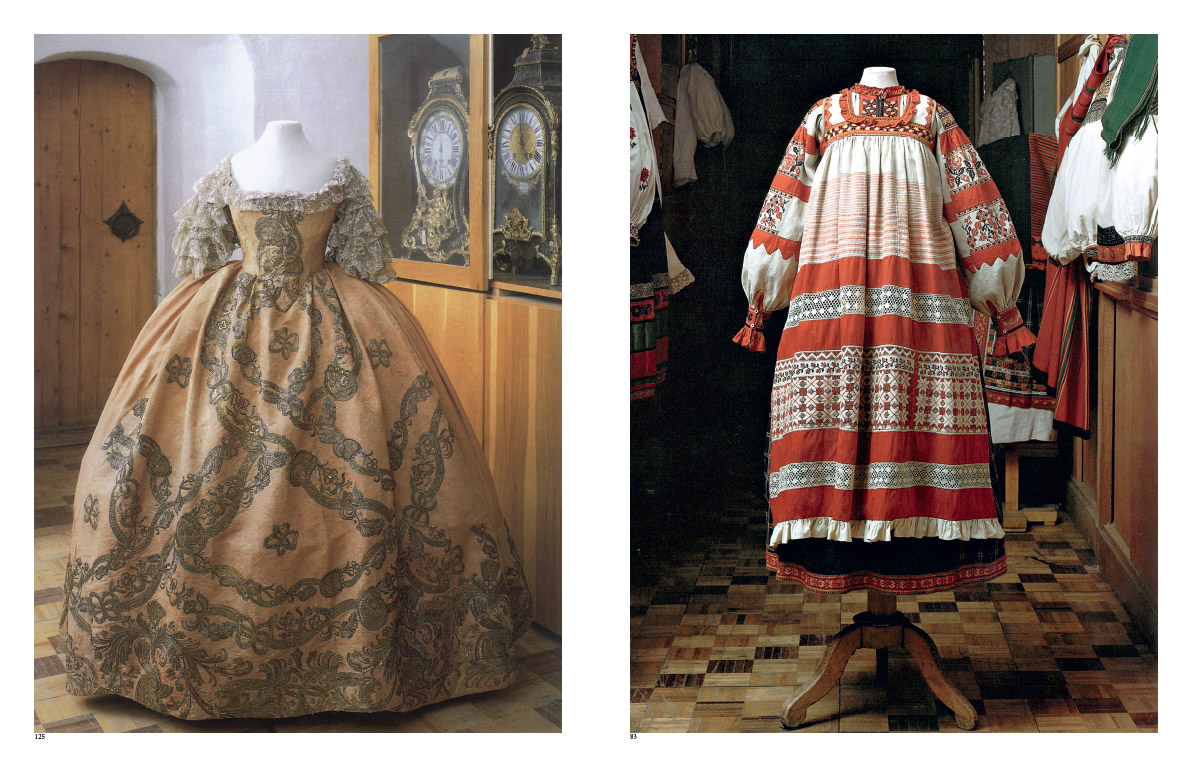
Dress belonging to Empress Elizaveta Petrovna, 1750s, France (left – see note 1) and Peasant Woman’s festive dress, Late 19th-early 20th Century, Yeleski district, Orlov province (right – see note 2).

“All Russian peasants, as well as town commoners and merchants favouring the manners and customs of former times wore traditional Russian dress, which was essentially Russian national costume. Fashionable town clothes were made in the Parisian style, yet not without partiality for bright colours, fancy patterns and a generous amount of trimmings. There was a general fondness for shawls, kerchiefs and wraps, which were skillfully combined with fashionable dress. . .”

Peasant woman's outer dress - corsetka; Late 19th-early 20th century Voronezh province of homespun undyed cloth. (see note 3)

“While national dress and urban costume differed in their basic features, they developed under the same social conditions and evolved in parallel. During the lively celebrations of public holidays on the country estates of the gentry, and at fairs int he towns, aristocrats came into contact with peasants and merchants. By associating with their neighbours and being part of a group containing all kinds of people, those who were interested in costume formed a kind of association. This provided fruitful soil for mutual influence by the folk and town style of Russian costume on each other. Thus, details of fashionable costume such as a low neckline and fully rounded, elbow-length sleeves of the woman’s shirt, and also outer clothes of a fashionable cut became prominent among traditional clothes. At the same time, articles of folk handicrafts such as embroidery and lace began to be used in decorating town clothes.” (8-9)

Much of what is included here corresponds with the notion of country and town influencing each other – and what is evident from the photographs is the appreciation held by all classes for intense detailing and decorative elements – Lace, embroidery, brocade, applique, pearls, fur, beading and quilting appears on every kind of clothing, for all ages and all genders. It is a beautifully produced book – and I’m thrilled to be able to share it.

Image Notes:

1. “Dress belonging to Empress Elizaveta Petrovna, 1750s, Franc. Restored with remnants of a crimson silk suplice. Silk, embroidered with coloured fabric, ornamentation, tinsel, lace. This silk dress from Empress Elizaveta Petrovna’s wardrobe was recreated by the Museun’s restorers from a church vestment. Only its front part, the skirt and part of the bodice survived. It was made of heavy reddish-orange silk of French manufacture with a self-coloured floral pattern. The Museum’s masters restored the dress from the empress’ portraits and fashion plates of the period. It is a ball dress with a narrow bodice compressing the waist and a low-cut neckline both in front and at the back. The elbow-length sleeves are of the French needle lace ‘point d’Argentan,’ and the same lace is used for trimming the neckline.” (112)

2. “Peasant woman’s festive dress, blouse, homespun skirt, apron, late 19th – early 20th century, Yeletski district, Orlov province. The blouse has straight inserts, a short body, with sewn-on collar, long sleeves with frilled cuffs. It was made from homespun linen, decorated with embroidery and cotton threads in a cross. Calico strips were sewn into sleeves. The homespun check wollen skirt, has a woven pattern band at the hem. A sleeveless, straight-cut ‘curtain’ apron with back, was made from homespun red-patterned sackcloth, with sstrips of structural embroidery sewn on, cross-shaped embroidery, lace and calico. Strips of red and white cotton fabric decorate the border of the hem.” (89)

3. “Peasant woman’s outer dress — corsetka. Late 19th-early 20th century, Voronezh province, made from homespun undyed cloth. The foreground shows a Voronezh corsetka seen from the rear – a long garment with knife pleats and decorations on the belt in the form of patterned ‘little discs’ sewn to the cloth. The ends of the sleeves are decorated with embroidery made from factory-made materials.” (95)

Continue Reading
1 8 9 10 11 12 20