1/16/1932-Palm Springs, CA- Pola Negri, film actress, recuperating from her recent illness at Palm Springs, CA, had quite a chat with Na Glee Nonassa (the Peacemaker) Princess of the Navajo tribe of Native Americans living in that section. (via Corbis)
After years of plugging away at the academic study of dress and textiles, I am about to start a new position in my preferred field! My new job as the Marketing Director for the San Jose Museum of Quilts and Textiles begins tomorrow, and I’m so thrilled to be working in a museum, with textiles, and in the bay area!
For those who aren’t familiar, the San Jose Museum of Quilts and Textiles is a small museum with a big mission: to “promote the art, craft and history of quilts and textiles.” and they will celebrate their 35th Anniversary this year.
Haena Point (Hawaiian Sunset No. 1), By Mark Adams, Quilt, 1979 From the Collection of the Stanford Library of Art and Architecture
It all began in 1977, when the Santa Clara Valley Quilt Association opened in a Los Altos storefront. Now in its permanent home in downtown San Jose, the collection houses “850 quilts, garments and ethnic textiles, and a research library of more than 500 books on the history and making of quilts and textiles.”
If you’ve never seen an art quilt on a museum wall, you are missing out – quilts are a flexible form, that can work as painting, sculpture or artifact. I’ve seen quilts as portraits, landscapes, using the same painterly techniques as pointillism or impressionism and the fashion techniques of bead and ribbon work to create evocative masterworks of art. The museum also frequently exhibits non-quilt textiles, including fashion, crochet and knitwear, and tech-textiles.
Sea jellies crocheted with metal by Arline fisch at SJMQT
I can’t tell you just how excited I am about this opportunity. As I grow familiar with my new role, I’ll be sure to share exciting exhibitions, events, objects and opportunities with you.
Check out the Facebook page, and the list of upcoming exhibitions for a preview of what I’ll be working on – and if you happen to be down in the South Bay, be sure to pop by!
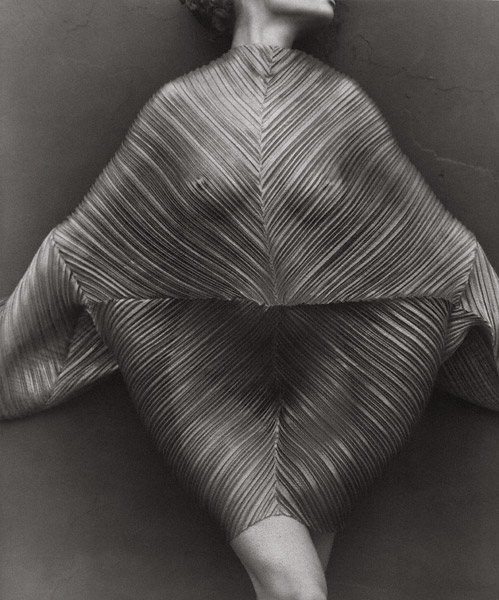
Following in the footsteps of other important fashion photographers such as George Hurrell, Horst P. Horst, Louise Dahl Wolfe, Irving Penn, and Richard Avedon, 1980s photographer Herb Ritts (1952–2002) is now the center of an exhibition titled Herb Ritts: LA Style, through August 26, 2012, at the Getty Center, West Pavillion in Los Angeles. Best known for his fashion photography, nudes and celebrity portraits in dazzling black and white his photographs seem to search for and elevate pure beauty.
The online component of the exhibition includes a brief overview, and of the above photograph, explains:
“To show off this dress by Issey Miyake, Ritts selected a dark backdrop and had model Karen Alexander adopt a ballet-like pose. Lighted from above, the semitranslucent fabric both reveals and obscures the contours of the model’s body. The photographer’s choice of the platinum printing process over the less expensive and more common gelatin silver process gives the photograph a significantly wider range of tones and a luxurious matte surface.”
Tomorrow evening, visual studies scholar Jonathan Katz will give a lecture titled “Aide/AIDS-mémoire: Herb Ritts and the Picture of Health.” His lecture will, in part, resituate “Ritts’s work in the social and cultural context of the worst years of the plague” and argue “that his commercial and critical import stem in large part from the fact that he was an openly gay photographer who nonetheless proffered a utopian dream…”
On Thursday, May 10 at 12pm, The Commonwealth Club of California in San Francisco will play host to the Chavez Santiago family of the “famed weaving village of Teotitlan de Valle presents its story of this ancient art form, a family, a culture and preserving a way of life across generations.” The New York Times travel writer Freda Moon included them in her article “36 Hours: Oaxaca, Mexico” in January (they also have a wonderful slideshow that includes some great images of weaving).
Panelists for the Commonwealth Club talk include:
Caracol pattern rug dyed with pecan shells by Federico Chavez Sosa, Master Weaver, Teotitlan del Valle, Oaxaca, Mexico (Via Facebook)
Federico Chavez Sosa, Master Weaver in the Zapotec tradition
The Chavez Santiago family uses a “combination of traditional patterns and weaving techniques with modern colors and sensibilities.” The family also works to support their local community and the traditional Zapotec culture. I’m particularly interested in their commitment to using only 100% natural dyes in their work, which seems both forward-thinking and historically accurate.
Doors open at 11:30am, with the program beginning at noon. Tickets are free for Commonwealth Club members and cost $20 for non-members and $7 for students (with valid ID). Tickets can be purchased online here. Hope to see you there!
For a quick taste of the talk, here is a short film featuring Federico Chavez Sosa:
It's A Cinch: Carmen, New York, Harper's Bazaar 1951 gelatin silver print by Lillian Bassman (Peter Fetterman Gallery)The Well-Spent Dollar, girdle by Gossard, 1956
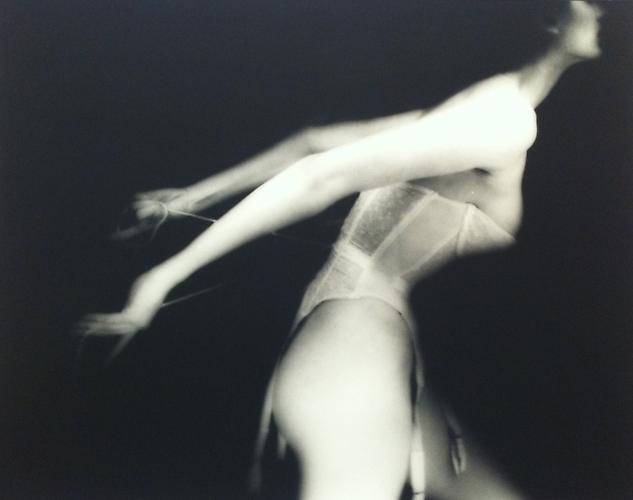
Lillian Bassman: Lingerie is a visually rich book of fashion photography, spanning sixty years of Bassman’s career (Bassman passed away just a few months ago in February 2012). If you want to understand anything about the way the fashionable silhouette has changed over those sixty years – a good start would be to look at the lingerie underneath.
The book includes eighty of Bassman’s black and white images, as well as an introductory essay by Eric Himmel, Vice President, Editor-in-Chief at Harry N. Abrams, Inc. He deftly places her in within the context of the fashion magazine world and greater historical events. He describes her working relationship with Alexy Brodovitch and Carmel Snow, art director and editor for Harper’s Bazaar – whom she began working with in 1948. Himmel’s introduction notes, “She was an inveterate observer of women and their ways.” and describes the role of lingerie photography in her career:
“Over time, the photography of women in lingerie became a part of Bassman’s regimen, akin to a painter’s weekly sessions with figure model and sketchbook. As the structured undergarments of the fifties gave way tot he more natural styles of the sixties, she captured a new freedom of movement in her models that replaced the languid sensuality of the earlier photographs. The jobs, both editorial and commercial, as well as sessions with friends to experiment, were occasions to represent the female figure, one of the oldest tasks in art, intimately familiar to Bassman from her days as an artist’s model. . . Each image has passed through many states on the way to its reproduction in this book, but none would be unpleasing to the thirty-one-year-old in her homemade bodice and skirt.”
Happily, the Peter Fetterman Gallery in Santa Monica is currently exhibiting Lillian Bassman: A Life through June 9 at and it includes her lingerie work as well as her other fashion photography. There’s also this marvelous video that Harper’s Bazaar put together – its insightful and reveals much about her career and process.
June 1, 1935: "Women Play Bowls A bowls match with participants wearing the latest fashion in beach pyjamas, England, 1935." Via Corbis
Initially introduced as fashionable women’s wear in 1922 by Paul Poiret as pajamas, they eventually evolved into casual wear worn for specific occasions– for sleeping, lounging and the beach (Watson, 2004). Lounging pajamas, according to Vogue, were for “when informal entertainments and masquerades are the order of the day.” Chanel helped with the general acceptance of women’s trousers, and was often seen wearing sailor-style pants. Pants of this era were loose with an elastic or drawstring waists with a side closure (Mendes & De La Haye, 1999).
The opening reception will be on April 21st from 1-3pm and the exhibition will also be open during the University’s Commencement, on Saturday May 19.
In scrolling through some of the artists profiles I was struck often by Dan Herrera‘s work and his interest in the body. Of his series “Estan de una Herencia Extraña” he notes “This work centers around the idea of skin, and thinking about skin as a continuous surface in relationship to time and movement. . . . Working in this way, the elasticity of both time and skin can be stretched – revealing curious illustrations of movement.” But it was his series “The Alchemists” which I found both aesthetically pleasing as well as engaging intellectually. An artist statement related to these images was absent from his portfolio, but they almost don’t need one. Enjoy, and for more visit his website.
"Corset" 2004 by Dan HerreraCreation, 2004 by Dan Herrera
After attending a CSA Western region event back in 2008 (see my review of “Fashion Conscious” at UC Davis), I became interested in the ethics of producing the fashions that eventually become fashion history. The conversation about the impact the fashion industry is having on our environment continues to grow and change, and this is being reflected in the cannon of literature covering the topic. Fashion & Sustainability by Kate Fletcher and Lynda Grose, smartly uses the second half of their book to discuss “ideas that are transforming the fashion system at root into something more sustainable.”
I don’t know about you, but whenever I hear the words “fashion system,” I immediately think of Roland Bathes. However, here are what Fletcher and Grose have to say on the subject when considering sustainability:
Betabrand's commuter cycling pants with reflective pockets and hems (a San Francisco Company)
“However much we innovate and act to improve the sustainability credentials of a piece of clothing, the benefits brought by these changes are always restricted by the behaviour of the person who buys it. Producing a garment with lower-impact fibre or better labour conditions, while important, changes the overall system very little, for these ‘better’ fibres and pieces are made into the same sorts of garments, sold by the same retailers and then worn and washed in the same way as before. Part Two of this book explores new ways of engaging with the process of sustainability in fashion, starting at a point that acknowledges the profound and multiple challenges inherent in bringing together sustainability, the fashion industry and our economic system based on growth.”
Fletcher and Grose go on to explore nine different concepts: Adaptability, optimized lifetimes, low-impact use, service and sharing, local, biomimicry, speed, needs and engaged – all of which present creative ways that various designers and innovators are thinking about the design and use of clothing. Not exactly Roland Barthes – but perhaps a bit more practical?
Join CSA Members and guests this summer for a special private curator-led tour of Colors of the Oasis: Central Asian Ikats at the historic Seattle Asian Art Museum (SAAM) in Seattle, WA on June 14, 2012. The show originated from the Textile Museum in Washington D.C. – a premiere institution – and it’s a unique opportunity for West-coasters to see it without having to travel very far.
Registration forms are due by June 28 – and at the low $30 registration price, tickets are bound to go fast. Hope to see you there!





“Over time, the photography of women in lingerie became a part of Bassman’s regimen, akin to a painter’s weekly sessions with figure model and sketchbook. As the structured undergarments of the fifties gave way tot he more natural styles of the sixties, she captured a new freedom of movement in her models that replaced the languid sensuality of the earlier photographs. The jobs, both editorial and commercial, as well as sessions with friends to experiment, were occasions to represent the female figure, one of the oldest tasks in art, intimately familiar to Bassman from her days as an artist’s model. . . Each image has passed through many states on the way to its reproduction in this book, but none would be unpleasing to the thirty-one-year-old in her homemade bodice and skirt.”

 2012 Master of Fine Arts Thesis Exhibition at San Fransisco State University:


