I told you to watch this space for more give-aways! Today’s contest is to win a copy of Balenciaga and Spain by Hamish Bowles. This is an exhibition catalog from the Fine Arts Museums of San Francisco’s exhibition last year. Worn Through writer, Lauren Michel reviewed the show back in May 2011 and included a number of wonderful photographs, plus an interview with Hamish Bowles.
To enter to win a copy of the lavishly illustrated book, I want to know which of his many inspirations speaks to you most. In the comments section below, tell me which Balenciaga design you love – and what inspired it (and be sure to include links to photos!)
Yesterday, the Smithsonian Magazine’s blog, Past Imperfect posted a rather long article on Rudolph Valentino and his impact on sex and seduction in the early silent film era – and of course there is a brief mention of Natacha Rambova (the main subject of my own research). The article spends much of its time focused on the very public battle over the speculation of his sexuality, and his impact on masculinity in film. However, the article fails to discuss the role that Rambova played in the creation of his on-screen persona – especially in the role that many suggest established him as an entirely masculine star, The Son of The Sheik.
Although Rambova and Valentino had already separated by this point, their time together had inevitable effect on the development of his on-screen personas. This, coupled with the fact that Rambova’s costumes from Hooded Falcon were used for The Son of The Sheik, suggests that she had a significant (perhaps unintentional) hand in his career trajectory.
“A stunning Moorish costume adorned the stalwart form of our hero, including a pair of cerise satin Zouave trousers plentifully braided and embroidered in gold. These had been secured in Algiers originally for ‘The Hooded Falcon,’ which Rudy never made and which was the high spot in the Valentino contention with the Ritz-Carlton Company, which sent him into the United Artists fold. Natacha Rambova was the one who designed the costumes, to the tune of $100,000. They now lie on the wardrobe shelves. This is the first use that has been made of any of them.”[1]
Regardless of whether this bit of publicity is true (often the film studios publicity machine’s put out information that was in fact dead-wrong) – many actors regularly explain that putting on their costumes has helped them to ‘realize’ or ‘achieve’ the personality of an on-screen character (see the work of Dr. Deborah Nadoolman Landis). This is no less true in the early days of film. Rambova’s impact on Valentino is regularly discussed – often with negative connotations: she was too avant-garde for some, and European tastes often read as ‘effeminate’ to middle America. It’s unfortunate that this positive association is overlooked.
Despite this foible – I think the article is a good introduction to those unfamiliar with the scandals and speculations associated with Rudolph Valentino and his now infamous cult of celebrity.
[1]Chicago Tribune, April 11, 1926. William McGuire Papers, Library of Congress, Box 83, Folder 1.
On the occasion of the Dance/USA Conference held this year in San Francisco, Museum of Performance and Design will display, for one day only, a selection of unique documents and costumes from the dance archives. The Museum will also give a tour of the regional hub of Dance Heritage Coalition’s Secure Media Network, which is hosted locally at MPD. The Secure Media Network is an online searchable database of streaming archival-quality dance footage.
“What cannot be pushed past the censors with words is often tried with costume. Marilyn Monroe was an expert at this—often to the despair of designers. Miss Monroe refused to wear underclothes. She felt they inhibited the rotary motion of her hips, dulled the color of her skin and, in general, reduced her sex appeal. Even in a high-necked gown with long sleeves she managed to be so revealing that on one occasion beads had to be added as a sop to the censors.
“Miss Monroe’s favorite comment about the concern of censors with her cleavage was: ‘The trouble with censors is that they worry whether a girl has cleavage. They ought to worry if she hasn’t any.’ To make sure her cleavage was shown to best advantage, she would slyly pull down the décolletage before camera time. This infuriated some of her designers.”
Poppies, 1976 56" x 42" From the E. Mark Adams and Beth Van Hoesen Adams Trust
Melissa Leventon, former curator of Costume & Textiles at the De Young Museum of San Francisco, as well as a past president of the Costume Society of America, Western Region will be part of a Tapestry symposium on artist Mark Adams being held on Sunday, June 24, from 1-4:30pm. Hope to see you there!
In conjunction with the Mark Adams exhibition, a symposium, Mark Adams: His Tapestry and Collaborators brings together some of Adams’ key collaborators in the tapestry process, contemporary tapestry artists, as well as the leading essayist from the soon to be published catalogue raisonné on his work, Mark Adams.
The symposium will delve into Mark Adams’ deep connection with the tapestry medium and give unique insight into his design process and extensive body of work, directly from the people who knew and collaborated with him.
Presenters include:
Melissa Leventon – former curator of Costume & Textiles at the De Young Museum of San Francisco, Principal of Curatrix, (a museum consulting firm), and essayist for the Mark Adams catalog.
Haena Point (Hawaiian Sunset No. 1), 1979 63" x 67" From the Collection of the Stanford Library of Art and Architecture
Jean Pierre Larochette – tapestry weaver, instructor, director and co-founder of the San Francisco Tapestry Workshop
Phoebe McAfee – co-founder of the San Francisco Tapestry Workshop and principal weaver of Mark Adams tapestries.
Rudi Richardson – principal weaver of Mark Adams tapestries and currently a primary weaver for the tapestry project creating a new set of “The Hunt of the Unicorn” tapestries (seen at the Cloisters, MET, NYC) at Stirling Castle, Stirling, Scotland.
Constance Hunt – artist weaver, who studied at the SFTW, and will speak about her close mentor relationship with Mark Adams.
Sunday, May 20 at the UICC, 4pm Irish People, Irish Linen with Author Kathleen Curtis Wilson. Presented by the Irish Literary & Historical Society of the San Francisco Bay Area.
The Irish Literary & Historical Society welcomes Kathleen Curtis Wilson who will speak about her highly acclaimed book Irish People, Irish Linen – the story of the craft, industry, and traditions of the Irish linen trade. The story of Irish linen is a story of the Irish people. Many thousands of men and women made Irish linen a global product and an international brand. Into this cultural history Ms. Wilson weaves personal narratives and the words and songs of individual spinners, factory workers, and out-workers like Sarah McCabe, who created fabulous linen lace. The book has garnered high praise, with one scholar proclaiming “Kathleen Curtis Wilson eloquently describes the saga in her beautifully illustrated book on linen, the queen of fabrics.”
Ms. Wilson arrived at her passion for textile crafts early in life, captivated by a chest full of Japanese fabrics she found in her grandparents’ attic, she pursued weaving from the age of 12 under expert tutelage. She became a renowned authority on Appalachian crafts, and became increasingly drawn to the Scots-Irish roots of Southern textiles, and linen in particular. This took her on a path of discovery to Northern Ireland and the treasures of linen craft that have been handed down for generations. Please join us for this very special event, a reception will follow the presentation
When: Sunday May 20, 4pm
Where: The United Irish Cultural Center, 2700 45th Avenue, San Francisco, CA 94116. (Saint Francis Room)
Admission: $5 for visitors, free for ILHS members
More information: www.ILHSsf.org or call Kathy Hall, Membership Secretary ILHS at 650-235-6862
Original caption: "The early fall bathing at Venice, California, where beauties cavort in beach costumes of abbreviated nature not sensed by the censor were treated to a rather unusual sight with Miss Marilyn McKinney appeared on the sands wearing a bething costume of oriental design and heavily beaded." October 10, 1922 via Bettmann/Corbis
“David Cox, who had been [Gilbert] Clark’s assistant, stayed on until 1931 and became a fully-fledged designer. He did Joan Crawford’s famous beaded Charleston dress for Our Dancing Daughters and the rest of her films until the arrival of Adrian.
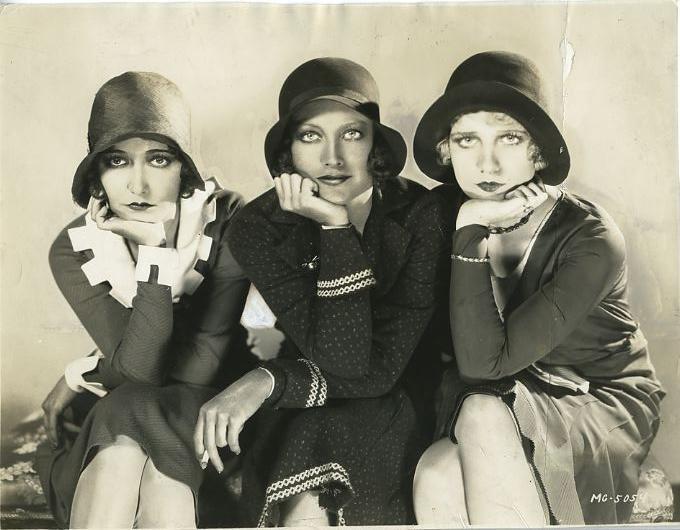
Anita Page, Joan Crawford, and Dorothy Sebastian in costumes by David Cox.
Six days before the film had its world premiere in New York on 6 October, an article appeared in the New York Evening Journal that was ostensibly written by Joan Crawford herself. More likely, it was the creation of an anonymous writer in the publicity department. In either case, this article, widely reprinted across the country, goes a long way toward establishing an image for the actress that would reverberate throughout her career at MGM:
‘Something new has entered the world of clothes and personal adornment. It is not just a change in fashion, a new style. It is a concrete, tangible thing. A spirit. The spirit of modernity. The spirit finds an expression of itself in the clothes we wear. They are modern. They are startling. They do not blend; they contrast. They do not conceal; they expose. They do not rustle; they swing. They do not curve; they angle. Perhaps this new feeling in the dress finds its first and most definite expression in the motion picture world. We are the first to exploit a style. The modern clothes spirit I am talking about is abundantly typified in the picture Our Dancing Daughters. My own wardrobe, and the wardrobe worn by Dorothy Sebastian and Anita Page, breathe the very essence of restless activity…the costumes of that particular production as the costumes of my own personal wardrobe.’
Excerpted from
This article was one of the final pieces of publicity in an exploitation onslaught that made Our Dancing Daughters a watershed film for the marketing and publicity departments at Metro-Goldwyn-Mayer.”
Choose from thousands of opera, theatre, dance, musical theatre and film-related items. These items are duplicate material from our library collection. Pay one admission for each time you pass through the Sale in the Main Gallery and take away as much as you can carry in one arm load. Individually priced items will be available for sale in the adjacent Reception Gallery. Proceeds benefit the preservation of MPD’s collections.






_03.jpg)