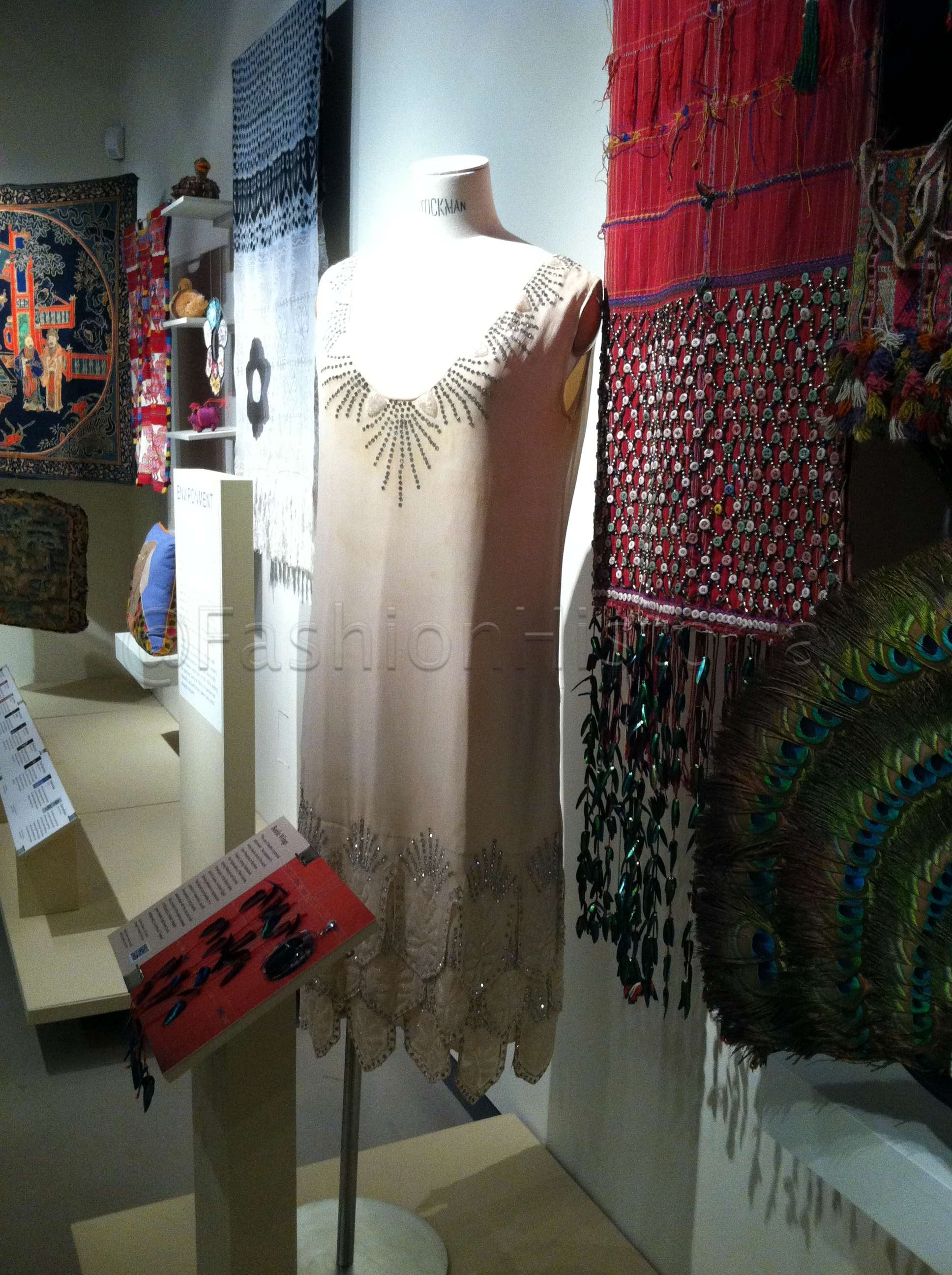
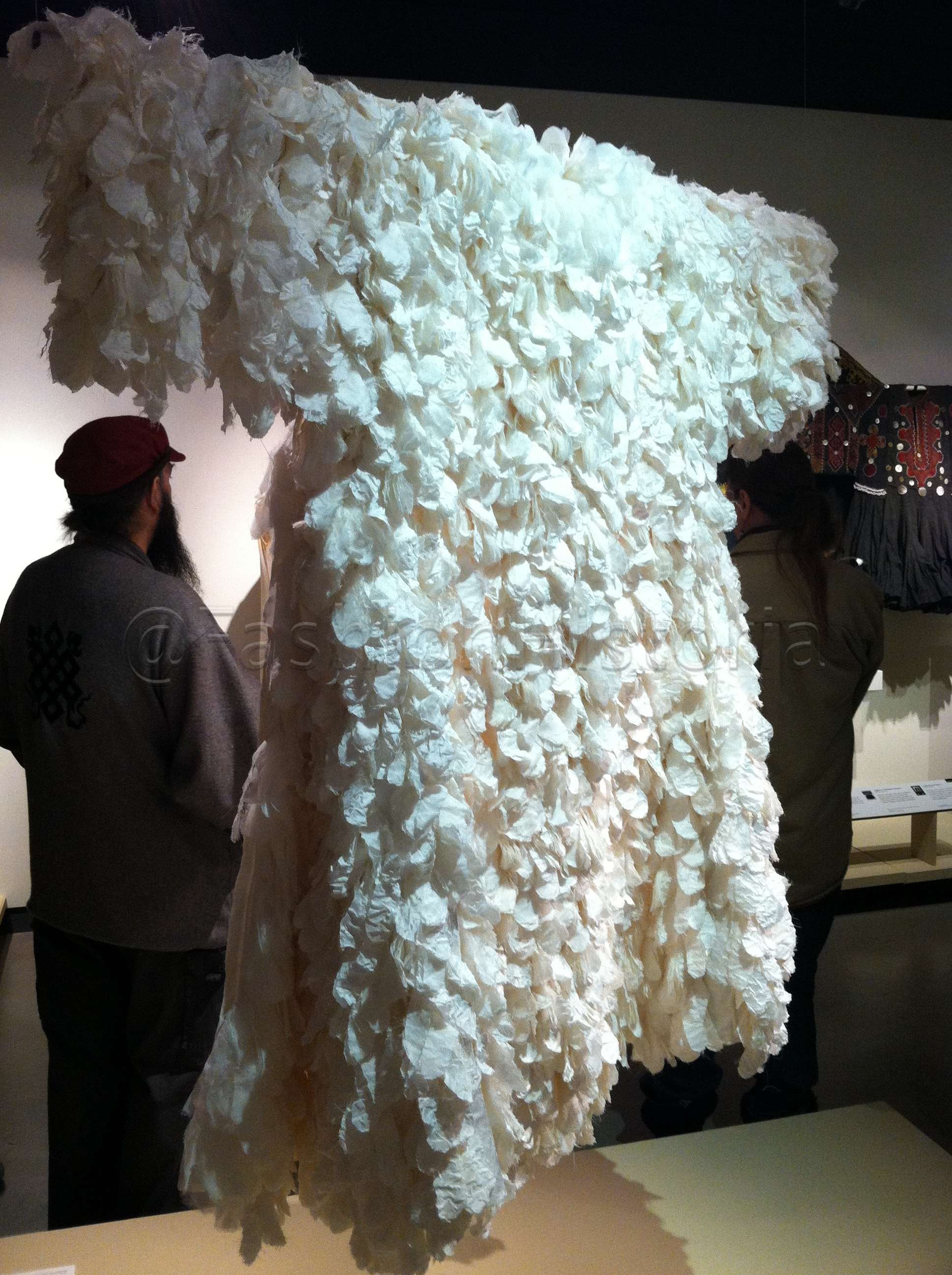
Yesterday I had the unique opportunity to go to a Costume Society of America Meet – Up (an informal and free event giving CSA members the opportunity to mix and mingle with their fellow enthusiasts) at the UC Davis Design Museum. Organized by past-president, Jo Ann C. Stabb, we had gathered together to see Structures, Signifiers and Society: People and Textiles which happened to include a curators walk-through with Mary Schoeser, a UC Davis alumna.
Schoeser, who also has a beautiful new book out Textiles: The Art of Mankind provided an amazing depth to the exhibition — highlighting unique objects and connections within the UC Davis collections. Objects ranged in age, country, technique and quality. It included both hand and machine-made textiles intended for both the art connoisseur and mass market consumers. The exhibition included groupings of historic and ethnographic textiles as they related to environment, identity, and other groupings. In her walk-through, Schoeser drew fascinating connections between the development of the loom and the development of the computer; the rise of the QR Code and it’s connections to textile weaving; in addition to the links between brain chemistry and textile production. It was truly a unique experience.
Making the meet-up all the better were the people in attendance. CSA past presidents, board members, conservators, professors, curators, as well as current students in attendance made for a valuable exchange of ideas. Following the tour, attendees mingled in the hallway over two pieces of historic clothing and examined their ins and outs. Melissa Leventon and Meg Geiss-Mooney pored over the two garments (one from c.1917, the other from c.1894) discussing their ideas about their history while attendees listened in, hovering nearby and asking questions. It was a marvelous day, and a wonderful opportunity.
Structures, Signifiers and Society: People and Textiles is on view through March 18, at the UC Davis Design Museum. Below are some photos to further tempt you:
Veteran’s Building, Fourth Floor, MPD main gallery – Come see what treasures you could snap up for a great deal.
Thousands of theatre, dance, music, opera, musical theatre, and film-related books and memorabilia as well as exhibition materials, office and audio/video equipment, and other odds and ends will be available for purchase.
Guests will pay one admission each time they pass through the sale and can take away all they can carry in one arm load (does not apply to specially priced items).
Admission Prices
Members $20
Non-Members $25
Be sure to arrive early to get first pick of these treasures!
Museum members will be allowed in at 11 am.
The sale will open to the public from Noon to 4 PM.
Proceeds from the sale go toward preservation of the Museum’s collections.
Special Note: MPD sells only duplicates of material already in the collection, material donated specifically to be sold, or material which falls outside the scope of our collecting policy.
Deborah Nadoolman Landis recently released the fantastic resource, Hollywood Sketchbook: A Century of Costume Illustration (Nov. 2012) as a follow-up to her Dressed: A Century of Hollywood Costume Design (2007). My dear friend Natasha Rubin has a marvelous essay in the book that provides depth as well as some unique insights into the research process of the book. After reading it, I wanted to know more. Natasha was kind enough to grant me an interview, which I’m pleased to share with you here:
Heather Vaughan: In your essay you note that you researched costume illustrations that had no signature or movie title: how often did that happen, and were any ‘mysteries’ solved in the book?
A Star is Born, 1954 (Costume Designers: Jean Louis, Mary Ann Nyberg, and Irene Sharaff; Illustrator: Mary Ann Nyberg; sketch courtesy of Catena Passalacqua
Natasha Rubin: “Many mysteries were solved while researching the book. The author, Deborah Nadoolman Landis, and I began to recognize designers’/illustrators’ styles and this helped us match illustrators with designers as well as identify some of the movie titles. Deborah and I had always wondered if Jean Louis drew the sketches he signed for A Star is Born (1954). Due to issues with the production, this film had three credited designers (Jean Louis, Mary Ann Nyberg and Irene Sharaff). One day, while searching the Cinémathèque Française’s digital archive, I came across costume illustrations for additional films that Mary Ann Nyberg designed and the drawings were a perfect stylistic match.
Another huge surprise was learning that John Truscott did not draw all his own sketches. Truscott only designed two films, Camelot (1967) and Paint Your Wagon (1969). The sketches from both of these films are immediately recognizable because of their distinct style, so I was quite surprised when I came across an interview on Galactica.TV’s website with costume illustrator Haleen Holt, which credits her as an illustrator for Truscott on Camelot.
Camelot, 1967 (Costume Designer: John Truscott, Illustrator: Haleen Holt, sketch courtesy of Tom Culver)
I immediately contacted her and she came over to our offices at UCLA and identified—to the best of her memory—which drawings were hers and which were Truscott’s. Ms. Holt has spent over 35 years working in the entertainment industry as a costume illustrator and assistant designer, yet no collector knew her name and no museum or archive identified her in their records. In addition, Ms. Holt noted that Judy Evans (who went on to become an Emmy-winning costume designer) painted many of the aged, speckled backgrounds of the Camelot sketches. Really, if there was one illustrator I thought could not be copied, it would have been John Truscott. In the interview, Haleen recounts the difficult task she had in mimicking his style. This experience was eye-opening in terms of research and what is still unknown. Whether the lack of information was intentional on the part of the designers or the studios or deemed unimportant at the time varied from production to production and sometimes sketch to sketch.”
HV: The bibliography and resources sections of this book are extensive, though mostly primary resources. You also make note that this field has “little academic research, we are establishing the foundation of a field of study.” Who else would you say is at the forefront of historic film costume illustration research?
Paint Your Wagon (1969) via icollector
NR: “First, I must acknowledge the extensive research of Susan Perez Prichard, who wrote Film Costume: An Annotated Bibliography (Scarecrow Press, 1981). Ms. Prichard’s book provided the cornerstone of cinema costume history, and I would be remiss if I didn’t mention her. Sketch collectors and Golden Age fans have also been helpful.
While there are extensive collections of costume illustrations at archives and museums such as the Academy of Motion Picture Arts and Sciences (AMPAS), the British Film Institute (BFI), the Cinémathèque Française, the Brooklyn Museum of Art, the Deutsche-Kinemathek and the Los Angeles County Museum of Art (LACMA), there has been very little scholarship on their holdings. At the Cinémathèque Française Deborah was told she was the only non-museum employee who had ever come to look at the collection.
Additionally, these sketches are rarely, if ever, exhibited. Scholarship takes time and requires financial support, which has become more and more scarce. As the internet continues to compile information, more and more is available online. It would have been virtually impossible to publish this book even ten years ago, just tracking down the sketch collections would have been prohibitive, much less the text research. Though too late for our research on Hollywood Sketchbook, the Theater Library Association published Documenting: Costume Design (2010), edited by Nancy Friedland, which will provide guidance to future scholars in the field.
Also, Lynn Pektal wrote an excellent book called Costume Design:Techniques of Modern Masters (Back Stage Books, 1999), but it focuses primarily on theater designers. Many of today’s working illustrators are much more savvy about getting their work seen, whether through their own websites or book publishing; it’s fantastic that there will be a record of their contribution.”
CONFERENCE: “Conserving Modernity: the Articulation of Innovation,” 9th North American Textile Conservation Conference
San Francisco, California November 12th – 15th, 2013
Synthetics. New ideas to old problems. Wearable art. Creative treatment solutions. Evolving installations. Collaborations with contemporary artists. These are some of the topics that will be addressed in two days of papers and posters presented in the deYoung Museum in Golden Gate Park for the 9th biennial North American Textile Conservation Conference.
Two days of workshops will precede the presentations and will cover aqueous cleaning solutions for textiles, natural and synthetic fiber identification, and progressive display techniques. There will also be workshops offered by San Francisco artists on innovative techniques for resist dyeing and working with ribbon to custom design trims and other embellishments.
The opening reception will take place in the Jackson Square District hosted by Peter Pap Oriental Rugs and the Lotus gallery. The closing gala will be held at the Asian Art Museum.
Following the conference, two additional tours will be offered: a cultural adventure throughout the East Bay and a tour of the Levi Strauss & Co Archives.
For more information contact: contactNATCC@natcconference.com
As you might have noticed, the last few weeks here at FashionHistoria have focused on book reviews. In October I began to receive a steady-stream of packages with glorious, lovely, over sized, and decadent fashion history books. I slowly, but methodically, began sharing their insides with you, starting back in October with Katherine Hepburn’s Costumes: A Book and An Exhibition. Each week in November, there was a new topic and a new book to explore:
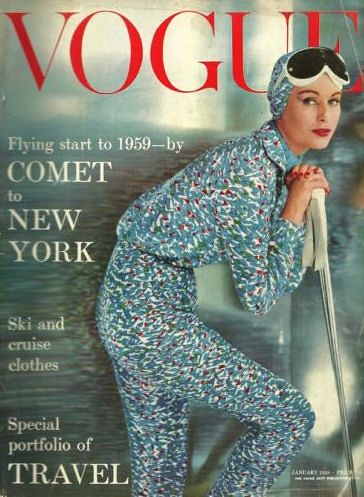
Available as of November 15, Vernier: Fashion, Femininity, and Form by Robert Muir and Becky Conekin (Hirmer Publishers) offers a highly illustrated documentation of Eugene ‘Gene’ Vernier, a photographer at British Vogue from 1954-1967. Beautiful, evocative photographs of 1950s British high fashion are included in this volume, with equally stunning essays by Robin Muir, Becky Conekin and Alistair Layzell.
British Vogue, January 1959 (Cover photo by Eugene 'Gene' Vernier)
Admittedly, I had not heard of Vernier (blame it on my American bias), but his covers and interior photography for Vogue in the 1950s and 1960s are absolutely stunning, and deserve the attention that this publication brings. For a quick over-view (and sneak-peek at the images included in the book), BBC News has a great video interview with Vernier from May of last year. More images can be found in this Flickr set.
Allstair Layzell’s essay, “Eugene Vernier: A life” uses the uniquely modern invention of the QR code to link still images to nine clips of film online, allowing readers to see some of Vernier’s early film work for Pathe (he was a camera man). (I’ve included one below) It’s a unique feature of Vernier: Fashion, Femininity, and Form, and one that I’ve not seen implemented in a book before.
Around Britain: 1947 (Click Image to go to watch the video)
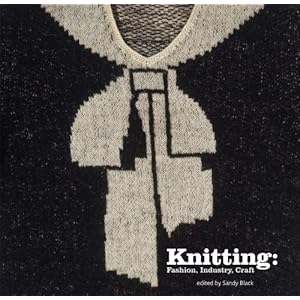
I was so excited when Knitting: Fashion, Industry, Craft by Sandy Black arrived on my doorstep. Black is a well-known clothing and textiles scholar from the London College of Fashion (who also founded the journal Fashion Practice). Sandy Black’s work in this book is not only fascinating, but satisfying to someone (me) who’s been looking for a comprehensive history of knitting. In four well-illustrated chapters Black covers the history of knitting:
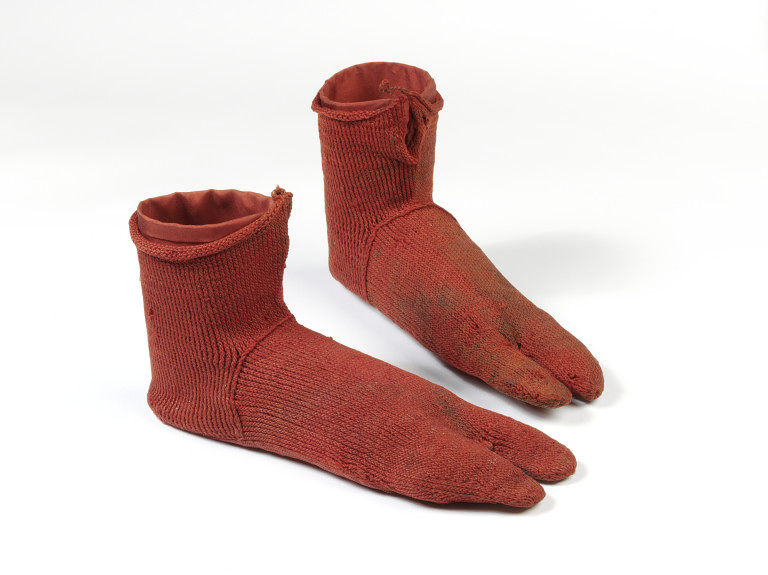
Red toe socks, 4th-5th century, found at Oxyrynchus (now El-Bahnasa), Egypt. "This pair of ankle length socks in red wool is in good condition with only one hole in the sole. The sock is worked seamlessly in single needle knitting..." (10)
1. History, Tradition and Mythology: from the Third Century to the Late Nineteenth Century
2. Livelihood and Industry: Hand- and Machine-knitting from the Seventeenth to the Twenty-First Centuries
3. Knitting in the Home: from the Eighteenth Century to the Present Day
4. Classics to Couture: Fashion Knitwear from 1900 to Now.
Knitting: Fashion, Industry, Craftis full of historical eye-candy for those looking for inspiration, but also includes plenty of the hard facts that historians crave. I was particularly drawn to the “Knitting in the Home” chapter (since that’s what I often do and write about). It includes a section on the evolution of the knitting pattern that begins:
With the development of printing and the rise of literacy, the popular market for needlework and knitting had grown considerably by the end of the nineteenth century. To reach this audience at more accessible prices than the drawing-room manuals, there emerged several series of low-priced monthly journals. Significant among these were the Family Friend (1849-66 and 1870-1921) and Weldon’s Practical needlework series (1886-1929), including Practical Crochet and Practical Knitter. . . . Knitting instructions also evolved. Gradually, more attention was paid to teaching the basic knitting skills in printed form, and reference began to be made to the notion of knitting tension and needle gauge. instead of continuous prose, instructions were separated into lines. Despite Mrs. Gaugain’s pioneering efforts, the standard knitting abbreviations now in common use were first established by Weledon’s in 1906.”
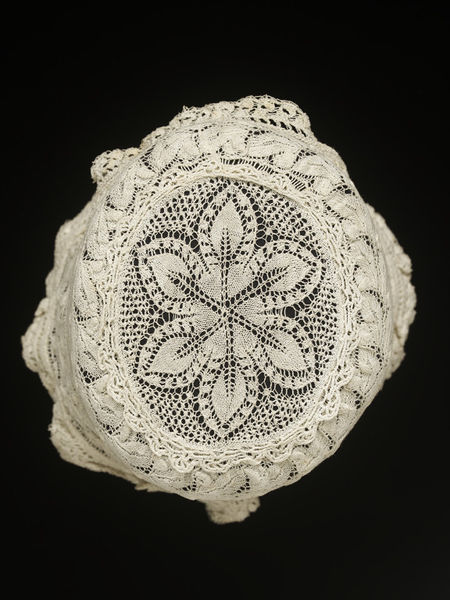
Bonnett. 19th Century, Britain. The back of this intricate textural bonnet forms an unusual six-pointed figure made up of obrdered leaves on an openwork mesh ground. (V &A)
Granted – the vast majority of in-text examples and photographs in Knitting: Fashion, Industry, Craft relate more specifically to knitting in the UK, and many of the objects shown are held in the collections of the V & A. Of course, that isn’t all that surprising, given that this is a V & A book.
That said, major American companies – like Oregon-based Jantzen – are mentioned. Smaller American companies, like Jack Frost, are not. American knitwear is occasionally mentioned in a number of places, like the sportswear section. World history of knitting is included (Europe, Americas, Asia), as are technological developments and knitwear trends in high fashion through history.
Knitting: Fashion, Industry, Craft includes a diverse number of viewpoints, and perspectives on knitwear throughout history: and also includes knitted dresses by designers like Jean paul Gaultier and Julien Macdonald; as well as World War II knitting; intricate lacewear; Victorian beaded bags; and socks from all eras.
It seems a thorough examination, and I can’t wait to dive into it more deeply.
This past weekend I had the distinct pleasure of visiting the de Sassiet Museum at Santa Clara University for a Costume Society of America Western Region program, led by Elise Rousseau, on the collection of liturgical vestments of the California Mission era.
The skill and craftsmanship displayed within these examples are a beautiful sight to behold – regardless of any personal religious affiliations. They included delicate metallic embroidery, stump-work, lace, and other high quality hand-work. The textiles themselves included rich brocades, chenille pile velvets, taffeta’s, and other delicate objects of finery (all VERY old, especially for California). The de Saisset Museum houses one of the most important collections of ecclesiastical garments and liturgical accessories dating from the founding of Mission Santa Clara de Asìs in 1777 through the 1920s. This collection had been hidden behind a false wall for years, unknown to the collections staff until a recent 2005 renovation revealed it.
Mission-Era Vestments from the Permanent Collection (on view to December 2) presents only a small portion of what may very well be the largest known collection of California Mission Vestments. Groups of 17th and 18th century copes, dalmatics, chasubles and accessories demonstrate a range of styles and purposes, as well as fabric and production origins.
The composition and use of these textiles offered a glimpse into the history and role of the global silk trade with far east Asia on the Spanish Galleons during the height of the Spanish Empire, Colonial Nueva España, and into the Franciscan Missions in California.
Costume design by Connie Strayer for Sunken Cathedral, choreographed by Mark Foeringer for Mark Foeringer Dance Project
From the heavy and concealing costumes for dance in the time of Louis XIV to the more revealing body hugging costumes of today, design for dance has evolved alongside fashion, but has been molded by individuals in the field with vision and/or purpose. They are artists, choreographers, directors, and the dancers themselves. Political upheavals, literature and art movements, as well as technical advancements have made their mark on the visuals of dance. These major events coupled with unique individuals have brought us to a bounty of visual riches in dance today. In this lecture we will take a whirlwind tour into the origins of dance design up to the current day, and beyond.
Connie Strayer is a Costume Designer and Senior Lecturer in Design in the Department of Theatre and Performance Studies at Stanford University.
This event will be held at the de Young, Koret Auditorium, de Young Museum, San Francisco:
A Chenille and Lurex dress Fassett knitted with actual pearls, in front of one of his needlepoint tapestries. (1970s)
The new book, Dreaming in Colour, an autobiography by Kaffee Fassett, presents the story of this well-known, eclectic textile designer. Born in Big Sur, California, Fassett designed knitwear for Bill Gibb, the Missonis, and private clients (including Lauren Bacall and Barbara Streisand).
Though he trained briefly as a painter, his creative outlets have also included a wide-range of other textile arts, including needlepoint, rug-making, tapestries, costume design, yarn and fabric design, as well as quilting. He was also the subject of a rare, one-man retrospective show of his textile work at the Victoria & Albert Museum in 1988. Though one can’t exactly call him a California designer (he’s lived in England most of his adult life), it’s clear his work was often inspired by California.
Kaffee Fassett in front of the Jars Tapestry, with a couple of his knits from the 1980s (Chapter opener for "The Glorious Eighties", pg 130)
Dreaming in Colour is a full of brightly colored photographs and illustrations of not only Fassett’s textile work, and illustrations, but also historical photographs. The chapters are laid out historically, and begin with a discussion of his “Childhood in California (1937-1956)”. They continue on to discuss “England in the Swinging Sixties” and “The Glorious Eighties,” among others: often focusing on the dress and textile history of those periods.
One interesting aspect of the book is how the photo-collages in each chapter show his development as a designer. Family photographs and artwork by other family members are juxtaposed by representations of his own work – showing a direct line of influence (such as a painting by his sister Holly of the Big Sur coastline shown alongside a handwoven fabric of the 1990s inspired by the colors of the ocean at Big Sur).
Those looking for previously unpublished information on Fassett’s design inspiration, history and art are sure to find their answers in Dreaming in Colour. It’s also a marvelous book for those in need of inspiration for their own art and craft endeavors.
Camp chairs Fassett covered with needlepoint florals, he called them "Gibson Girls" (1985-87)The Hollyhock Tapestry, commission for the Stamford Shakespeare Company (9 X 6 feet), a more recent project.Bordered Diamonds from "Simple Shapes Spectacular Quilts" (2010) by Kaffe Fassett


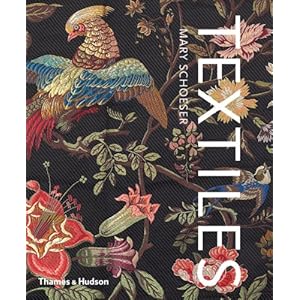 Schoeser, who also has a beautiful new book out Textiles: The Art of Mankind provided an amazing depth to the exhibition — highlighting unique objects and connections within the UC Davis collections. Objects ranged in age, country, technique and quality. It included both hand and machine-made textiles intended for both the art connoisseur and mass market consumers. The exhibition included groupings of historic and ethnographic textiles as they related to environment, identity, and other groupings. In her walk-through, Schoeser drew fascinating connections between the development of the loom and the development of the computer; the rise of the QR Code and it’s connections to textile weaving; in addition to the links between brain chemistry and textile production. It was truly a unique experience.